




















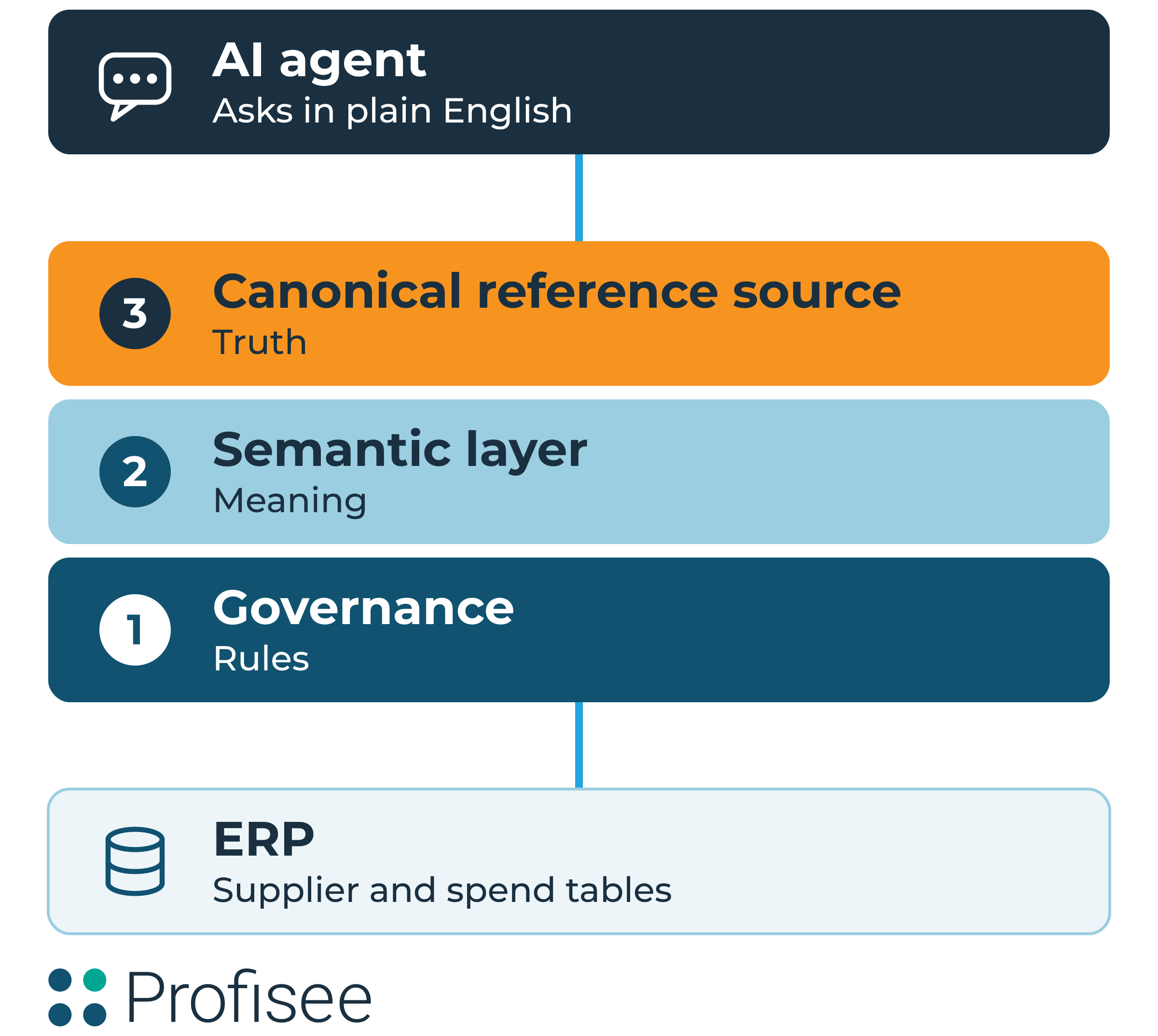
Grounding LLMs with structured data requires three things to be available every time an agent answers: rules that define what a correct record looks like, definitions that tell the model what your terms mean and a canonical reference source that tells it which records are real. Build them in that order, starting with a single use case, and the agent’s answers become something you can defend. Skip the third and the model reads your tables fluently while getting the answer wrong.
That third item is master data management (MDM) applied to a small slice of your data, and it is the step most teams skip.
Why Structured Data Trips Up an LLM
An LLM trips on structured data because it can read your tables, but it cannot know what your business means.
Picture an organization that wants to enable category managers to ask an agent questions in plain English. It connects a text-to-SQL agent to its ERP’s supplier and spend tables. A manager asks how much the organization spent with Acme Industrial last quarter and whether Acme counts as an active supplier.
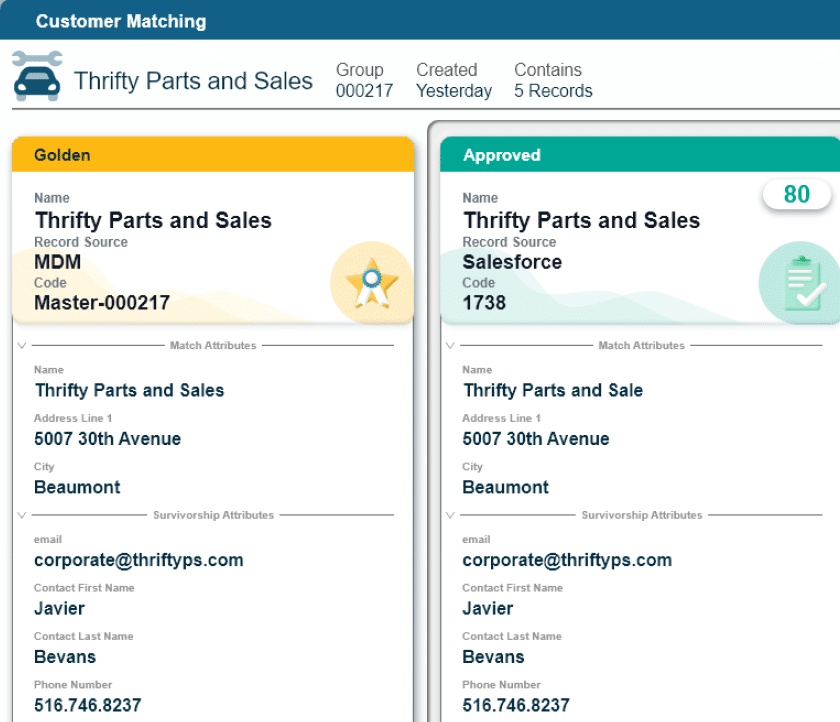
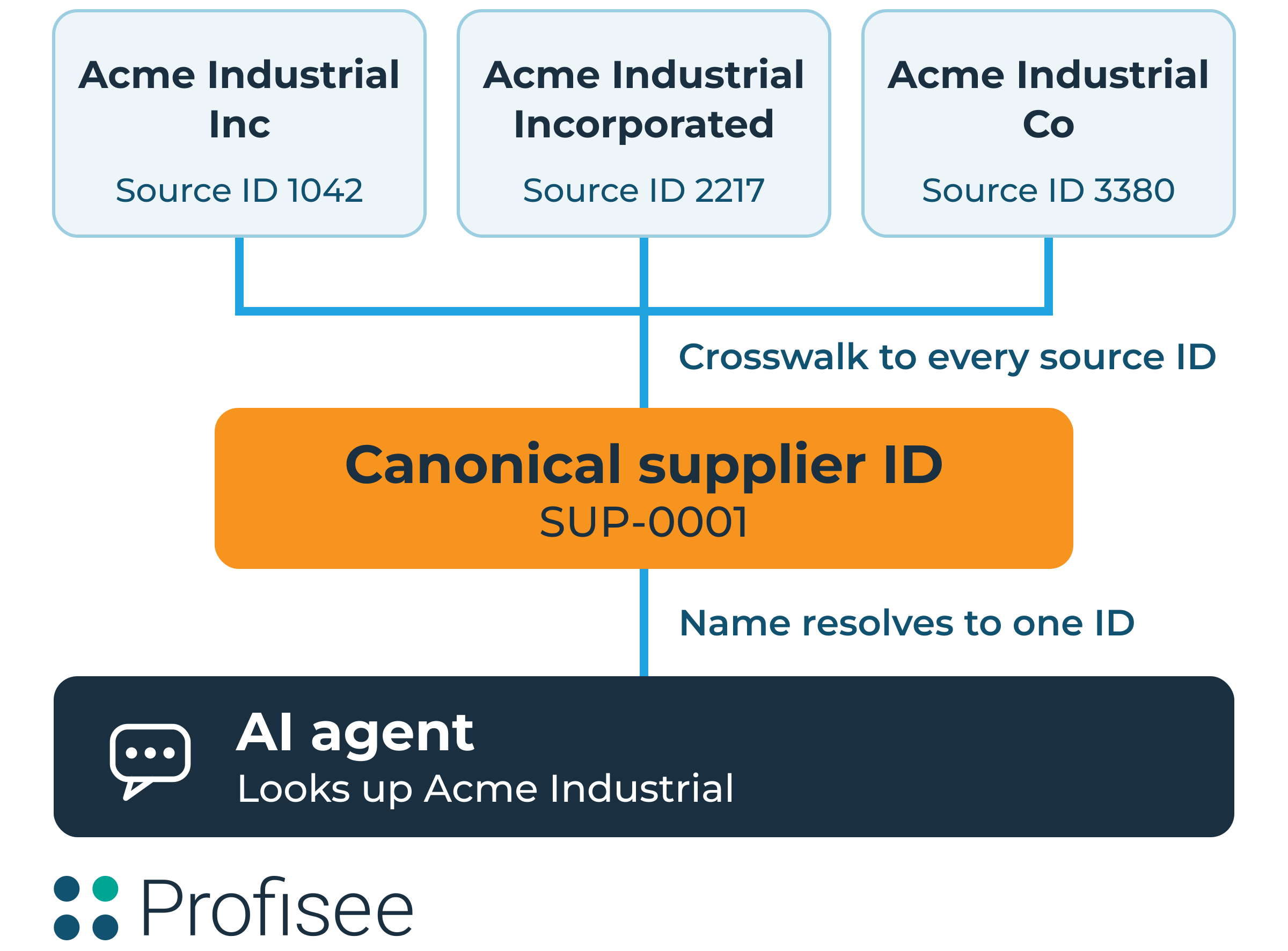
The agent writes correct SQL. But the tables hold three records for the supplier: Acme Industrial Inc, Acme Industrial Incorporated and Acme Industrial Co. Each has its own ID and a share of the spend. While procurement defines an active supplier as one on a current contract, accounts payable defines it as one paid in the last 12 months. The agent picks one record or all three, depending on how the names match, and returns an answer.
The LLM fails, but quietly. Nobody notices a gap because the answer reads well, and worse, an agent running in production will repeat the failure on every request. The manager finds themselves in a contract renegotiation with incorrect spend.
Duplicate supplier records are a familiar data quality problem, and most teams respond to the agent version of it by building a semantic layer that defines “active supplier.” But the agent cannot discern that three records are the same supplier. Handing the model more context doesn’t help, because extra context only helps it understand the question without giving it a way to check the answer.
The Three Steps for Grounding AIs With Structured Data
Sequence matters. Start with the rules because the other two steps depend on them. Scope stays at one use case throughout: one agent, one domain of master data and one source system where the context is already known. That keeps the work small enough to finish. Nobody has to master every domain before the first agent goes live.
Build a Data Governance Function Sized to One Use Case
Why it matters. Governance defines the rules for correct records, so an agent never inherits internal inconsistencies. Instead, you get an answer you can defend: when finance, procurement or a regulator asks where a number came from, every definition and every rule traces to an owner who signed off on it.
Where it goes wrong. When a team starts with a data governance framework instead of a use case, they can end up spending a quarter of their budget on committee charters before a single rule reaches an agent. Other teams may develop written policy documents that are out of the model’s reach. Still others may hard-code rules into pipelines and ETL jobs, where only an engineer can change them and no data steward can see them. Each version produces governance that looks complete but constrains nothing.
What works. Rules that an agent reads on every request do more work than a framework lost in SharePoint. This is the working core of data governance. Choose one accountable data steward for the domain. Write the rules as short, testable statements. For example, a supplier record needs a legal name, a tax ID and a country. Keep them in a format a human can edit and an agent can retrieve, such as versioned text. Agree on who settles disputes and how fast.
A master data governance practice for a single domain stays small enough to run. When a rule needs changing, one owner changes it once and every answer afterward reflects the edit.
Add a Semantic Layer That Carries Meaning
Why it matters. A semantic layer gives the model one definition for each term, so “active supplier” returns the same answer whether a category manager, a finance analyst or an agent asks. The outcome is that procurement and finance stop arguing over whose number is right, and the agent’s answer matches the report people already rely on.
Where it goes wrong. Definitions often live inside a BI tool, which makes them invisible to an agent working somewhere else. Some definitions have no owner, so they drift as the business changes. Teams that try to define the whole enterprise at once may take so long that they lose their sponsor. Some teams may be convinced that meaning settles everything and stop at this step.
What works. Define only the terms your use case touches. For the spend agent, that is perhaps a dozen: active supplier, spend, approved supplier, category and fiscal quarter among them. State each definition once, name its owner and map it to the source field it comes from. Plain language works best, since the model reads a definition the way a new analyst would.
Deliver the definitions through retrieval, so the agent receives them with every question. Store your definitions in a plain text file or in a data catalog. Because each term has one meaning, you have no conflicts to resolve.
Create a Canonical Reference Source for the Records That Matter
Why it matters. A canonical reference source answers the question a semantic layer cannot: which record is the real one? For the spend agent it means one record per supplier, so spend rolls up to the organization that received it. The outcome is a renegotiation, a risk review or an onboarding decision built on the actual number for the right supplier.
Where it goes wrong. A common mistake is expecting the semantic layer to settle identity. Another mistake is matching duplicates inside the query itself, which buries the rule in code that one person understands. Still another is inferring identity at query time. A model, or a knowledge graph fed enough transactions, can reach a confident guess that Acme Industrial Inc and Acme Industrial Co are one supplier. But that’s entity resolution done on the fly, and a guess is not a curated record. Nobody approved it, nobody can audit it and the next query makes the agent guess all over again.
What works. Match and merge the duplicates with explicit survivorship rules so a human can see which value won out and why. Matching is probabilistic even though the rules that drive it are deterministic, so route any borderline pairs to a data steward and let humans review the exceptions. Our data matching guide covers how that works in practice.
Publish a stable canonical ID with a crosswalk to every source system ID, so the agent resolves “Acme Industrial” to one ID and queries every source record under it. The result is a golden record for each supplier. Then make that record retrievable at request time. Profisee MCP Server, which connects governed master data to AI agents, is one way to do it.
What Breaks About the Common Shortcuts
Each shortcut gives the model something real, and each leaves a gap.