





Data Management in Healthcare: Preparing for CMS-0057-F

Select an AI tool to explore this article

Key Takeaways

  • Starting Jan. 1, 2027, CMS-0057-F moves prior authorization onto APIs, and every electronic request has to identify the patient, the provider and the service correctly.

  • Cloud data platforms and data quality tools move or flag provider data, but they don’t resolve conflicts between systems. Those conflicts flow into every request and cost health systems time and revenue.

  • Master data management (MDM) creates one trusted record for every provider. Mass General Brigham built that record to help patients find care, and electronic prior authorization depends on the same record.

Lisa Morella, now Senior Director of Revenue Cycle Performance & Transformation at Boston Children’s Hospital,  spent 15 years at Mass General Brigham, where she led a program to help patients find the right provider. Then she went looking for a pediatrician for her own son. She found a profile of a doctor she liked, called to book an appointment and learned the physician had left years earlier.

That gap between what a system says and what’s true is about to get more expensive for providers. The CMS Interoperability and Prior Authorization final rule (CMS-0057-F) requires many payers to run a Prior Authorization API as of Jan. 1, 2027, and every electronic request depends on getting the provider right. I recently sat down with Lisa, who formerly advised health systems through her firm, Lubo Consulting, to talk about what the rule means for data management in healthcare and where health systems should start.

Why the Deadline Hurts Without Trusted Data

Roughly 60% of prior authorization requests are still handled manually, according to the CAQH Index. When systems disagreed, it was easy to work around them with a phone call or quick fix. But CMS-0057-F moves requests onto APIs, which means that every request has to identify the patient, the provider and the requested service correctly. An API only transmits the data it’s given, so getting the right prior authorizations is dependent on accurate data.

“The operational readiness question is bigger than just can we connect to the payer. It’s really can we trust the information that we’re sending through that connection?”

– Lisa Morella, MBA, Senior Director of Revenue Cycle Performance & Transformation at Boston Children’s Hospital

Although Lisa sees health systems investing heavily in moving to Snowflake, Databricks and Microsoft Fabric, she sees less investment in the data going into them.

She also sees the same foundational data issues surfacing as a result. When the payer cannot reliably identify the provider, the patient, the scope of work and the required clinical information, she says, “you’ve simply digitized the same friction.”

This friction multiplies with every payer. A health system whose provider facts live in several places ends up having to reconcile them again for every connection. Health systems already run on thin margins and lean teams, and resourcing this additional work is burdensome.

Friction between systems also multiplies with scale. Lisa learned early in her career that small amounts of friction become very large amounts of money at healthcare system scale, and that every manual handoff, missing piece of information and reworked workflow carries a cost. Patients absorb part of it: CAQH CEO Sarah Ahmad says inaccurate provider data delays care and drives up costs for patients and health plans, according to MedCity News.

The Use Case: One Trusted Record for Every Provider

Lisa Morella shares Mass General Brigham’s MDM story at the 2023 Data Hero Summit.

Lisa’s provider data management program at Mass General Brigham began before the rule, with a patient experience goal: help patients find the right provider across a health system of 14 hospitals. The record built to help patients find a provider is the same record electronic prior authorization depends on, so starting with providers was a logical first step.

The question seemed simple. Who are the providers, where do they practice and what services do they offer? At Mass General Brigham, different systems held different pieces of the answer (and often different answers altogether), and the provider information on the 14 hospital websites had gone stale.

The health system had roughly 13,000 credentialed providers, and classification variables were myriad. It’s not uncommon for a single doctor to be employed, contracted or affiliated with several hospitals, practicing in multiple locations and even changing departments mid-year. Lisa found that the real question was never who Dr. Jane Smith might be. It was about her relationship with the health system, where she practices and whether she is accepting new patients. And without that answer, the health system could not see its own capacity.

Patients found the gaps first. In a national survey of privately insured patients, 53% found inaccuracies in their insurer’s mental health directories. Lisa’s search for a pediatrician was a small version of the same gap.

“We didn’t wake up one morning saying we need an MDM platform. We had a patient and business problem that we couldn’t solve reliably without first creating a trusted source of provider data.”

– Lisa Morella, MBA, Senior Director of Revenue Cycle Performance & Transformation at Boston Children’s Hospital

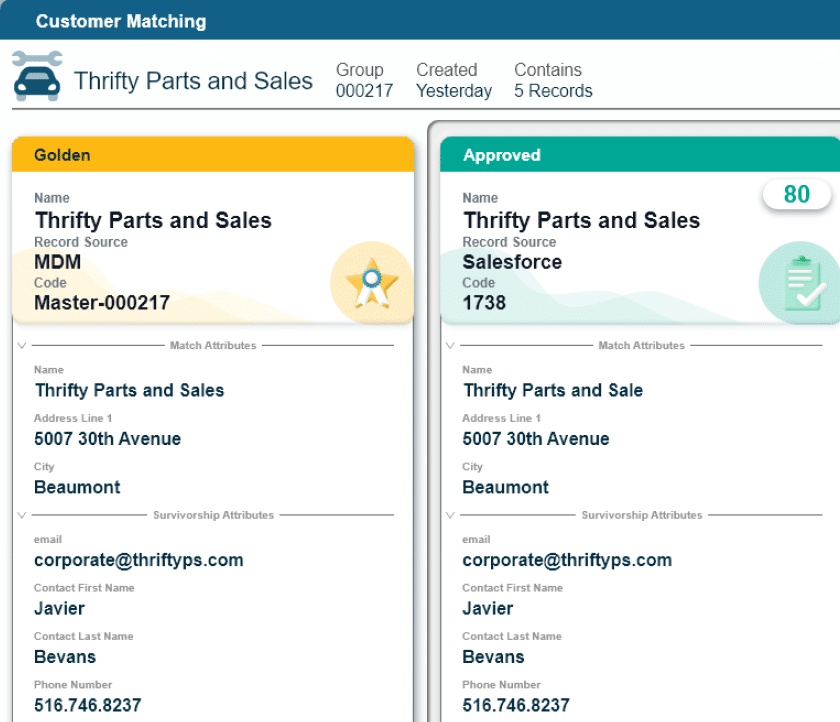
Mass General Brigham implemented Profisee MDM to match, merge and standardize provider data from its disparate source systems into golden records. Today, the find-a-doctor tool on its website lists active providers that patients can filter by accepted insurance, specialty and location, all built on the provider hub created, managed and governed in Profisee.

Lisa says other teams saw uses for the same record, from sourcing clinical trials to analytics and accountable care organization (ACO) reporting. A health system with that record in place has one trusted record to draw on when each payer’s requirements arrive.

She calls master data management (MDM) fundamental to achieving the trusted data that prior authorization APIs depend on. “It’s much more than a data management project,” she says.
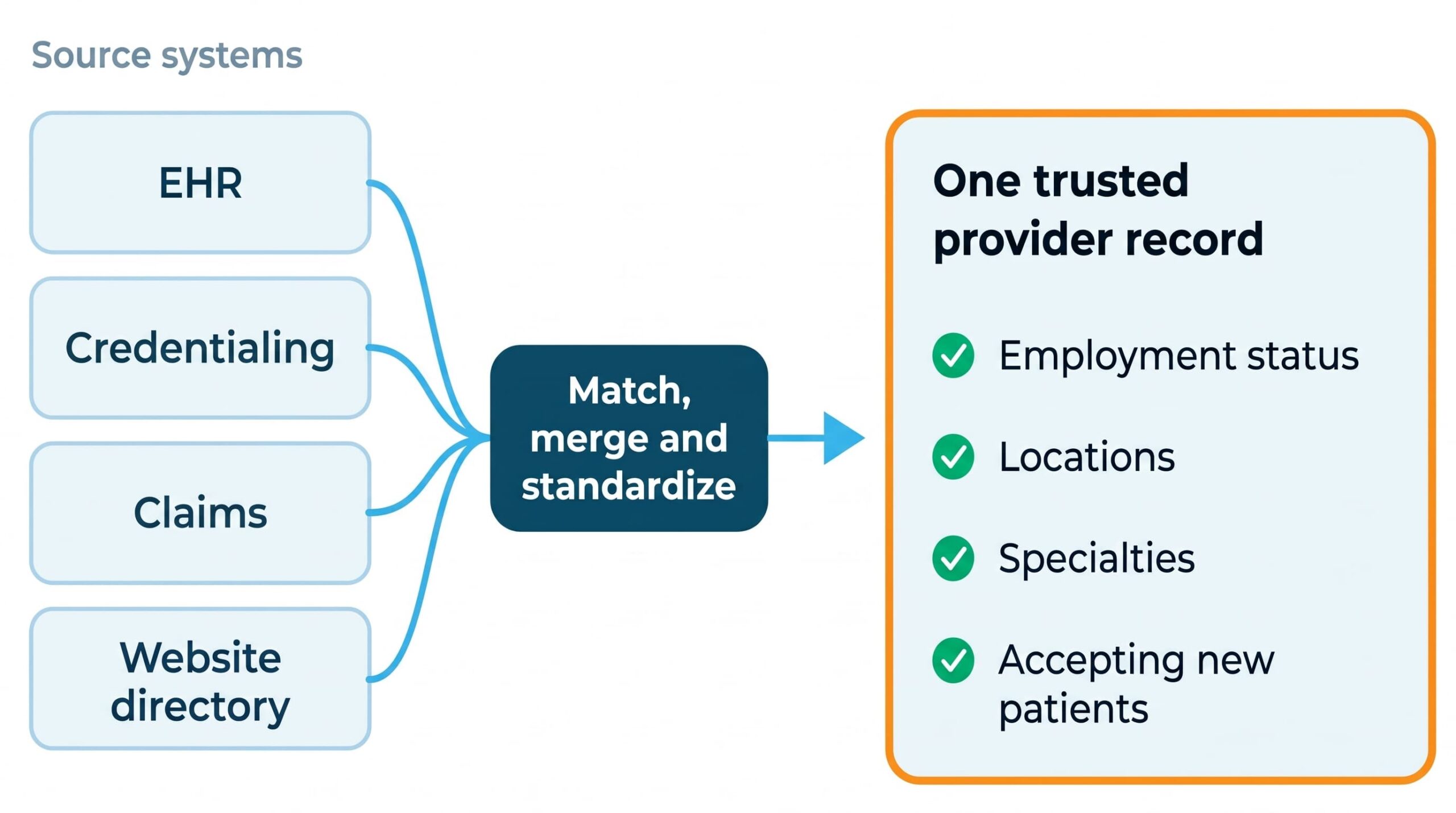
Provider data from several source systems resolving into one trusted provider record

Why Alternatives to MDM Eventually Break

Typical alternatives work for a while, but they each break at a predictable point. I saw the first one up close in a previous marketing role at a home health organization with about 300 locations, where staff called individual sites to ask, “Do you still take Humana?” A spreadsheet and a phone list can answer that once. The challenge is scale.

ApproachWhere it worksWhere it breaks
Spreadsheets, crosswalks and phone callsFast to start, no software cost.Breaks across systems, because the answer lives in a file or a person. Phoning each location does not scale.
Cloud data platform pipelines (Databricks, Snowflake, Fabric)Powerful, engineering-friendly and the right home for analytics.Business users cannot maintain the matching logic, and provider data carries system disagreements with it when it’s moved.
Data quality, governance and catalog toolsDefine rules, find problems and document lineage.Flag problems in records without creating a trusted golden record across source systems.
A separate integration for each payerMeets one payer’s requirements quickly.Because each payer varies, every build carries its own copy of the provider facts and its own reconciliation.

“Moving poor quality data into a modern cloud platform just doesn’t magically make good data. You just move the problem.”

– Lisa Morella, MBA, Senior Director of Revenue Cycle Performance & Transformation at Boston Children’s Hospital

What to Look for in a Healthcare MDM Platform

Look for a platform that models how providers relate to your organization, keeps pace with change, lets business teams own the record and fits your security and deployment requirements. Four criteria matter most:

Model How Providers Relate to Your Organization

Provider records should carry employment status, affiliations, locations, specialties and schedulable resources. They also have to reflect changes to these variables over time. Look for a flexible data model and matching rules you can tune to your organization. Data matching is probabilistic, so the platform also needs a stewardship queue for uncertain cases that call for human insight. The outcome should answer the question every prior authorization request asks: which provider is this, and are they in our ecosystem?

Keep the Record Current as Networks Change

Plans enter and leave networks, clinicians change departments and practices add services, so a program built on one-offs will go stale between projects. Look for integration that continuously refreshes the master record. Our platform’s integration hub Connect makes it easy to connect to source systems like EHRs, claims and credentialing systems. The outcome is a directory and a request feed that’s always up to date.

Let Business Teams Own the Record

The people who are aware that a provider has moved are in credentialing or patient access, not in data engineering. When a platform is built for the business, each role has its own interface. Instead of submitting a ticket when an inconsistency is discovered, the person closest to the change can update the record on the spot. FastApps, our role- and user-specific stewardship interfaces, are built for that. When ownership follows business domains, the outcome is faster corrections.

Meet Healthcare Security Requirements

Most organizations start with provider data, but they rarely stop there. Once patient or member data is in the equation, you need field-level visibility by role, flagging for protected health information and an audit trail for every change. Our MDM platform supports HIPAA/HITECH requirements and is SOC 2 Type II certified, with role-based access and auditability built for sensitive healthcare data. Deployment options include SaaS, PaaS and hybrid. The outcome is a program your compliance team can defend.
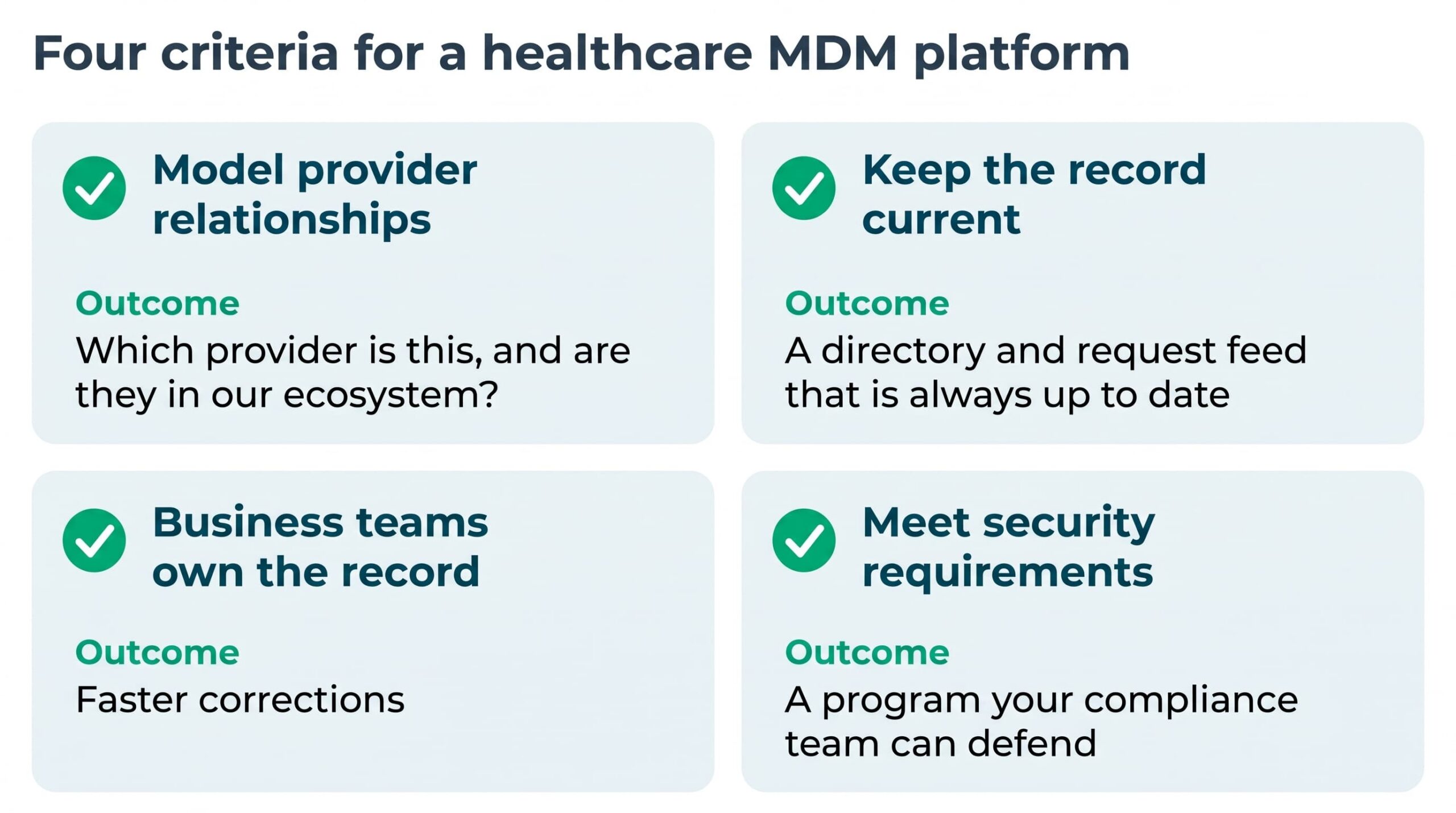

Four criteria for choosing a healthcare MDM platform and the outcome of each.

“The technology is important, but it isn’t the business case. The outcome is the business case.”

– Lisa Morella, MBA, Senior Director of Revenue Cycle Performance & Transformation at Boston Children’s Hospital

Lisa’s advice is to skip the request for money to implement MDM and start with the organizational problem: quantify it, then show that trusted master data solves it and several others behind it. The budget conversation changes when the first slide shows leaked referrals and reworked requests instead of an architecture diagram. To go deeper, read our guide to measuring the business value of MDM, explore how to secure funding, or learn how our MDM platform helps healthcare providers comply with CMS interoperability requirements like CMS 0057-F. 

Where should a health system start with MDM?

Before the payers’ APIs go live, start with the one question every system should answer the same way: who are our providers, and what is each one’s relationship with us today? You don’t need perfect provider data to begin. Start with the attributes patients and payers touch most, then expand to more domains as the program earns trust.

Trusted Provider Data Comes Before the API

Lisa’s search for a pediatrician and an electronic prior authorization request fail the same way: both depend on a provider record nobody confirmed was still true. A parent can recover with a phone call. An API can’t.

CMS-0057-F doesn’t create that problem. It takes away the workaround. For data management in healthcare, one trusted record for every provider is the place to start, and health systems that start now will have it ready when each payer’s requirements arrive.

Get Ready for Prior Authorization

If you’re preparing your health system for electronic prior authorization, watch my full conversation with Lisa on demand.

Frequently Asked Questions

Data management in healthcare is the set of processes a health system uses to collect, store, protect and share patient, provider, location and financial data. Master data management reconciles information from multiple source systems to create a single, centralized golden record of each provider or patient that every downstream system, including AI tools, can trust. Most health systems start MDM for healthcare programs with provider data. Our guide to MDM in healthcare covers the other domains in more depth.

The API requirements fall on payers first. Medicare Advantage plans, Medicaid managed care plans, and qualified health plan issuers on the federal exchange must comply as of 2027. Hospitals are also affected through the payers they work with; the Electronic Prior Authorization measure in Medicare’s Promoting Interoperability Program is an optional bonus measure in 2027 and required starting in 2028, according to CMS. For payers and hospitals, data matching and merging lays the groundwork for CMS interoperability requirements.

Fragmented provider data is a revenue problem at its root, because every wrong answer about a provider sends a patient, a referral or a claim somewhere it should not go. Skip the request for money to implement MDM and start with the organizational problem: quantify it, then show that trusted master data solves it and several others behind it. 

Your Moment is Right Here, Right Now.

Boards are asking. Budgets are opening. The data work you’ve been quietly doing for years just became the reason you have a mandate – and it won’t stay open forever.

We recently held the DATA HERO SUMMIT covering just this and more – catch it on-demand for real practitioner stories, and the playbook for what to build next.

Right Here, Right Now. Profisee’s recent DATA HERO SUMMIT covered real data practitioner stories, and the playbook for what to build next.

MDM vs. MDS graphic