




































Ready to Transform Your Data?
Key Takeaways
Context isn’t truth. Semantic layers and RAG tell an AI what a “customer” means. They can’t tell it which records are real. Anthropic fed their agent thousands of queries. Accuracy barely moved. The problem was duplicate, unresolved entities, not missing context.
Trustworthy AI needs MDM, even if nobody names it. Anthropic curated canonical datasets. They assigned ownership. They resolved duplicates and added lineage and quality checks. That is master data management. The engineers just never called it that.
Earlier this year, Anthropic published an unusually honest account of something every data professional will recognize. They set out to automate the bulk of their internal analytics with AI agents. They pointed an agent at their data warehouse, let it write queries, and felt the thrill of watching it work.
Then the thrill turned to dread.
The agent could write solid SQL all day long. What it could not do was know, with any certainty, which customer a given row belonged to, or which definition of “active user” it was supposed to count, because the underlying entities had never been resolved to a single trusted version. The hard problem was never the query. The hard problem was knowing which version of an entity to trust.
If you have spent any time in this field, you know exactly what happened. At Profisee, we used to call it hitting a brick wall. You start confident the data is in reasonable shape; you build something, and at the worst possible moment, usually in front of someone who matters, it hands you an answer that is confident, articulate, and completely wrong.
What Anthropic did next is why I I wrote a full guide on what CDOs need to do to avoid ending up in the same spot. This post is a short version. So, what did they do?They fixed it by rebuilding our entire discipline – from scratch.
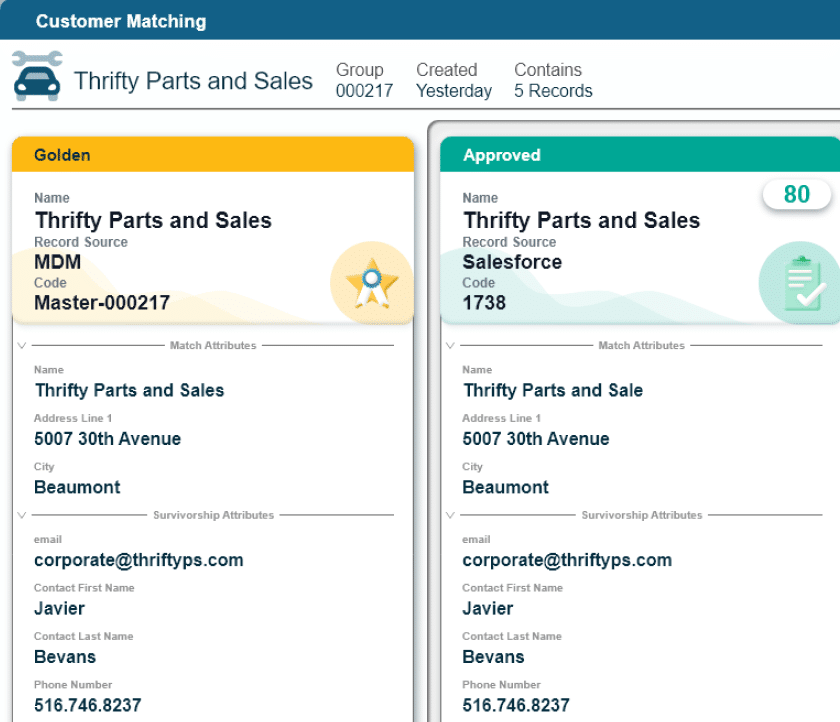
To make their agent trustworthy, Anthropic curated a small set of canonical, single-source-of-truth datasets. They assigned clear roles and responsibilities. They resolved the duplicate and near-duplicate tables that had been confusing the agent. They added lineage so an answer could be traced to its source. They built freshness and quality checks. And they committed to maintaining all of it after watching their own accuracy decay when they stopped.
That is master data management (MDM). It is also data governance and data quality. The three disciplines our field has been practicing for forty years, described in operational detail by a team that never once used the words. The phrase “master data” does not appear in their account. “Data governance” appears once, in passing.
This is the strongest validation of MDM I have seen in years, and it is also an important warning about where our discipline is headed. It’s a validation because the engineers automating their analytics did not set out to prove MDM was necessary. They set out to get trustworthy answers, and the pursuit of trustworthy answers dragged them to master data, whether they had a name for it or not. That’s far stronger evidence than any vendor testimonial, because it comes from people with no stake in the conclusion.
The guide walks through how you can build a trust layer in your own organization, stage by stage. This post is the thinking behind it. That is a distinction I think most CDOs are missing, and the test for knowing whether you even need to build this trust layer. If that clicks, the guide has the full story.
For this post, I want to zero in on one distinction: context versus truth. It’s one of the biggest oversights I see CDOs making right now.
A context layer cannot deliver trust by itself
The trustworthiness of a GenAI answer is a function of two different things. The first is meaning, which is what a semantic layer provides: a shared, governed understanding of what the words in your business refer to. The second is truth, which is whether the specific records behind the answer are actually correct. These are different jobs. A semantic layer can tell you precisely what a customer is and still have no idea whether the two hundred rows your system believes are two hundred customers are, in reality, eighty companies wearing slightly different names.
That’s the core difference between meaning and truth. Consistency is not accuracy. Conformity is not truth.
Right now, the entire industry is infatuated with meaning. Knowledge graphs, semantic layers, RAG, context engineering. These are all valuable things. But none of them is sufficient to deliver trustworthy responses from GenAI on their own. Anthropic proved this under controlled conditions: they gave their agent thousands of prior human-written queries, verified that it read them, and measured the effect on accuracy. Accuracy moved by less than a single percentage point. The context was right there, it was consumed, and the answers were still wrong, because the bottleneck was never access to context. It was the absence of a resolved, trusted entity for the context to attach to.
Meaning without truth is confusion.
A beautifully governed definition computed over unresolved, duplicated, or stale records produces an answer that is polished, plausible, and wrong, in the most dangerous way there is, because it looks right.
So, if truth is the missing half, what actually produces it? This is where master data management comes in, and it is worth saying plainly, because the whole industry keeps talking around it. MDM is the discipline for resolving your enterprise entities, your customers, products, and suppliers, into a single trusted version and keeping them that way. It is, quite literally, how truth gets into the machine.
Not every GenAI use case needs MDM.
Before anyone runs off to “do MDM,” the truth is that a great many GenAI use cases don’t need it. Draft a poem, brainstorm campaign names, and summarize a contract you just uploaded. These touch no shared enterprise entity, and master data has nothing to offer them.
There is a single test for knowing when you have crossed the line, and it is not a maturity score or an audit of your data function. The test is sharing. Master data is what you need whenever data about your entities must be shared and trusted across more than one system or process. If a piece of data lives and dies inside one application, leave it there. The instant that same customer must mean the same thing in two places, or an insight must stitch together a process that crosses business functions, you are in master data territory, whether you have named it or not.
A practical path, not a two-year program
For the use cases that do cross that line, you do not need a sprawling initiative. This is the part that surprises people and frustrates consultants. You build only what’s needed to support one specific use case, and no more. This concept also extends into the governance needed to support that use case, which should also follow an ‘MVP’ approach.
The full guide lays out a three-stage path for this MVP approach using a ‘crawl, walk, run’ metaphor, where each stage shows the grounding needed for a progression of increasingly complex GenAI use cases. Most solutions never need to reach the final ‘run’ stage, and reaching for it before a use case requires it is its own kind of mistake. I will leave the mechanics of each stage to the guide, which I would encourage you to download.
What matters here is the principle sitting above all three stages: you start with one high-value use case a real business sponsor actually wants, ground only the data that use case requires, prove the value, and let your trusted data accumulate as a consequence of solving one problem after another. The unit of progress is always the business outcome, never the domain.
And you go no further up the path than the stakes demand, because grounding is not free. Every trusted fact you retrieve is paid for, in tokens, on every query, forever. The more trustworthy you need a solution to be, the more it costs. So, you build to the stage the use case needs, and not one step further.
The north star
The mandate to deliver trusted master data has never been stronger, and Anthropic proved it without ever meaning to. The mandate to keep calling it master data management has never been weaker, because the people building the future are learning our practice under new names. Those two facts are not in tension. They are the instructions: build a truth layer, but be relaxed about the label. Start from the business outcome, apply the test on the necessity of MDM, and ground only what the solution needs.
Meaning, increasingly delivered by a semantic layer, tells you what a customer is. The ground truth provided by MDM tells you which customers are real. GenAI needs both, and the market has spent the last two years infatuated with the first while forgetting the second. Master data is how the truth gets into the machine.
This post summarizes my white paper, “Connecting the Dots: Using Master Data as the Truth Layer for Enterprise GenAI.” The full paper includes the complete build guide, the people, process, and technology for each stage, and the governance model. You can find it at profisee.com.

Malcolm Hawker
Malcolm Hawker is a former Gartner analyst and the Chief Data Officer at Profisee. Follow him on LinkedIn.