









































- What Is Agentic AI for Data Management?
- How Does Agentic AI Differ from Traditional Data Management?
- Why AI Agents for Data Management Are Necessary for Modern Enterprise
- Use Cases of Agentic Data Management
- Build a Foundation for Agentic Data Management with Profisee MDM
- Real AI. Real Results.
- Frequently Asked Questions
Ready to Transform Your Data?
Key Takeaways
Agentic AI for data management is a solution that operates autonomously to monitor, improve and manage business data with minimal human intervention.
Traditional MDM systems manage one area at a time and require manual intervention, whereas agentic systems can handle multiple areas simultaneously and operate in real time.
Profisee MDM provides agentic AI systems with the reliable, unified data they need to perform effectively and support smart, automated operations.
Agentic AI marks the next evolution of master data management (MDM).
Traditional MDM centralizes and governs data, but heavy manual oversight creates operational drag and slows enterprise responsiveness. With agentic data management, you transform MDM from a static system of record into an autonomous system of action. By using goal-driven agents to monitor, resolve and enforce policies without human intervention, this approach ensures your business can trust its data at the speed of AI.
What Is Agentic AI for Data Management?
Agentic AI for data management is an autonomous system that executes multi-step workflows with minimal human oversight. By pursuing specific goals, such as resolving entities or remediating quality issues across disparate systems, these agents handle the operational heavy lifting of data stewardship. McKinsey reports that centralizing these agents’ capabilities on a unified platform can eliminate 30% to 50% of non-essential work by reducing redundancy across isolated, one-off implementations.
Effective agentic data management consolidates shared services—including ingestion pipelines, matching logic and policy enforcement—within a single governed architecture. Instead of deploying fragmented bots for narrow tasks, organizations operationalize standardized agent functions across multiple domains. Built on a trusted MDM foundation, this approach moves teams toward a proactive, self-optimizing environment that scales without architectural waste.
How Does Agentic AI Differ from Traditional Data Management?
Agentic AI differs from traditional data management by using autonomous, goal-driven processes rather than fixed, manual workflows. Legacy systems need people to make changes when requirements shift, but agentic systems learn from experience and improve their strategies as they go.
| MDM feature | Traditional data management | Agentic AI for enterprise data management |
|---|---|---|
| Operation | Manual, human-driven processes with predefined, rigid workflows | Autonomous, goal-driven operations with minimal human supervision |
| Adaptability | Fixed constraints requiring significant human intervention to adapt to new requirements | Continuous learning from experience, adaptation to dynamic environments and strategy refinement |
| Scope | Specific, siloed tasks such as data entry or scheduled batch processing | Complex, multistep workflows and multiple agents orchestrated to achieve broad goals |
| Proactivity | Reactive approach addressing data issues after they arise | Proactive identification and remediation of data quality, optimization and governance |
Why AI Agents for Data Management Are Necessary for Modern Enterprise
AI agents for data management are necessary for modern enterprises because business operations now generate more data across different systems at a faster pace than manual processes can govern reliably. As data volume, variety and velocity increase, human-led workflows cannot monitor quality, enforce policy or resolve conflicts in real time. The result is delayed decisions, inconsistent records and governance gaps.
AI agents address this scale and speed gap directly. Instead of relying on periodic human review, they monitor data as it moves across systems, apply governance rules at the point of change and resolve conflicts before they cascade into operational errors. This continuous, automated execution shifts data management from reactive correction to scalable, always-on control.
Use Cases of Agentic Data Management
The impact of agentic AI is most visible in day-to-day operations. These four use cases show how agentic data management is shaping the future of MDM in customer, supplier, product and regulatory workflows:
Automate Multidomain Entity Resolution and Survivorship
Fragmented records across your enterprise prevent a unified view of enterprise relationships. A single customer may exist in banking, CRM and billing platforms with conflicting attributes, while suppliers often appear under different aliases across procurement and logistics.
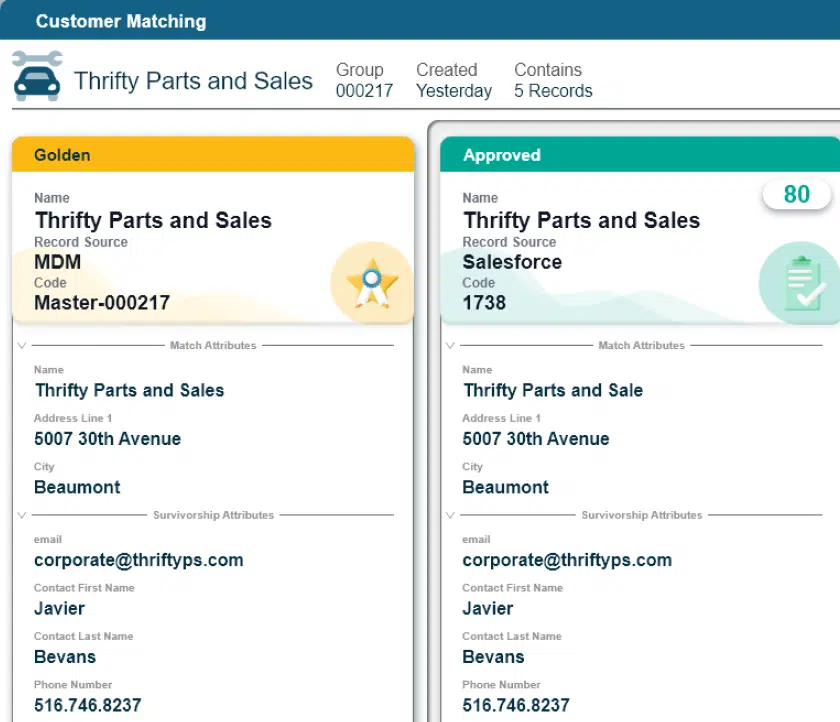
AI agents apply machine learning to identify matching records across domains and select the most accurate attributes for the final golden record. This automation eliminates duplicate payments, improves customer experiences through unified views and reduces compliance risk without manual intervention.
Profisee’s matching agent, one of the specialists Aisey orchestrates, applies these matching rules continuously against new records as they arrive and routes ambiguous cases to a steward for confirmation. Trusted entities stay trusted as the business changes.
See how Profisee MDM can automate matching with our entity resolution solution.
Operationalize Proactive Data Quality and Self-Healing Remediation
Traditional enterprise data quality processes detect issues only after they disrupt operations. Invalid addresses trigger failed shipments, incomplete supplier records delay procurement and inaccurate product data impacts revenue. Profisee mitigates these risks by embedding agent-driven monitoring and remediation directly into data workflows at the point of change.
Agentic AI for data quality embeds continuous monitoring into master data workflows. Agents establish quality baselines, detect anomalies as they occur and trigger remediation based on governed rules. For anomalies with clear resolutions, agents act. For anomalies that require judgment, a steward is notified and given the context to decide. This is what Profisee’s data quality agent does natively, with a full audit trail of what the agent did and why.
Enforce Global Data Governance and Privacy Policies Autonomously
Data governance typically relies on regular audits and manual checks, which are reactive and can leave organizations vulnerable to policy violations, fines and data misuse. Agentic systems turn governance into a continuous, automated process by understanding complex rules and enforcing them across all data.
Agents classify sensitive data based on content and context, apply access controls defined in policy and check compliance with GDPR, the CCPA and other regulations at the point of data change. Manual audit effort drops, policy drift is prevented and enforcement stays consistent across systems.
Accelerate Golden Record Enrichment with Intelligent External Data
Golden records lose value when attributes become incomplete, outdated or inconsistent. Missing or stale attributes distort segmentation, weaken predictive models and reduce the accuracy of reporting and forecasting.
AI agents for data management enrich master records by validating and augmenting attributes with authoritative third-party sources. For example, agents can verify addresses against postal databases, append product specifications and enhance supplier profiles with ESG certifications. With continuous validation and enrichment, you maintain high-confidence records without manual research or periodic batch updates.
Profisee’s integration agent connects to authoritative third-party sources (postal databases, business registries, ESG data services) and enriches master records continuously, so the golden record stays complete and current without a batch enrichment project.
Build a Foundation for Agentic Data Management with Profisee MDM
Agentic AI delivers value only when it operates on trusted master data. Inconsistent, incomplete or siloed data doesn’t just slow agents down. It amplifies their errors at machine speed. Profisee turns scattered records into a single, governed foundation of trusted entities that AI agents can act on with confidence.
Profisee’s MDM platform provides three core capabilities to prepare your data for an agentic future:
- Cleanse and standardize master data across customer, supplier, product and location domains.
- Consolidate duplicate and conflicting records into trusted golden records.
- Govern data across domains within a single, multidomain architecture.
Once your data foundation is established, Aisey — Profisee’s built-in agentic AI assistant — manages ongoing data operations. Our assistant monitors data quality, identifies issues as they arise, enforces rules and resolves them before they escalate. You get measurable impact with Aisey:
Real AI. Real Results.
 0
%
0
%
faster onboarding and training
 0
%
0
%
fewer data quality rule violations
0
%
accelerated system integration
0
%
faster data quality rule creation
Schedule a demo with Profisee to start shaping the future of MDM with agentic AI for data management.
Frequently Asked Questions
To determine if your data is ready for agentic AI, assess whether your master data is accurate, consistent, complete and accessible across your organization. A strong data foundation is the best indicator of AI readiness. If you have issues with poor data quality, data silos or inconsistent rules, you need to address them before using agentic AI.
An agentic data management platform is a system that uses autonomous AI agents to manage data across your enterprise, combining the goal-driven intelligence of agentic AI with data management capabilities to automate tasks such as entity resolution, data quality remediation, governance enforcement and golden record enrichment. The goal is to create a self-managing, self-correcting data system in which agents continuously improve data trustworthiness without manual intervention.
Before selecting an agentic data management platform, you should determine if it improves data quality, governance and scalability without introducing risk. Ask these questions to guide your evaluation:
| Agentic MDM evaluation area | Questions to ask | Why |
|---|---|---|
| Data foundation | Does the platform ensure data quality before applying AI? | Agentic AI scales underlying data conditions. Without trusted master data, it automates errors instead of value. |
| Domain scope | Can it manage multiple domains (customer, supplier, product, location)? | Enterprise workflows span domains. Single-domain tools create fragmentation and limit cross-functional automation. |
| Governance and seamless security | Are policies enforced automatically and auditable? | Autonomous systems must apply controls consistently and maintain audit trails to support regulatory compliance. |
| Transparency | Are agent decisions explainable and reviewable? | Data leaders need visibility into how records match, which attributes are selected and which actions are triggered, especially in regulated environments. |
| Integrations | Does it integrate with your existing cloud, data lake and analytics ecosystem? | Native integrations across your cloud, data lake and analytics ecosystem prevent the creation of new silos and let agents operate across the full data landscape. |
| Human oversight | Can data teams review, override and govern agent actions? | Effective agentic AI supports human-in-the-loop control, preserving accountability. |
| Cost and scalability | What is the total cost of ownership and scalability model? | Reusable agent capabilities and platform consolidation reduce redundant development and long-term operational costs. |
The difference between the two is direction. Using AI to do data management applies AI agents to accelerate the work of MDM itself:
- Configuration
- Matching
- Quality monitoring
- Stewardship
Using data management to enable AI keeps the master data those agents depend on trusted, resolved, governed and current, so they can act with confidence.
Profisee delivers both specialist agents through Aisey that accelerate MDM work and mastered entities that fuel AI initiatives downstream via the Profisee MCP Server and native integrations across the AI ecosystem.

Benjamin Bourgeois
Ben Bourgeois is the Head of Product and Customer Marketing at Profisee, where he leads the strategy for market positioning, messaging and go-to-market execution. He oversees a team of senior product marketing leaders responsible for competitive intelligence, analyst relations, sales enablement and product launches. He has experience managing teams across the B2B SaaS, healthcare, global energy and manufacturing industries.