






































What Are the 4 Pillars of the Data Governance Framework?
The 4 pillars of data governance are people, processes, policies and technology. Together, they establish accountability, standardize data management practices and help you maintain trusted, secure and compliant records.
- People: Assign clear roles and responsibilities to data owners, stewards and governance councils to establish accountability and guide decision-making
- Processes: Standardize how teams create, maintain, access, monitor and retire data to ensure consistency throughout its lifecycle.
- Policies: Establish rules and standards for data quality, security, privacy, compliance and acceptable records use to support consistent governance across the organization.
- Technology: Use master data management (MDM), metadata control and quality solutions to automate workflows, enforce policies and improve visibility.
How Do Data Governance Frameworks Work?
A data governance framework works by defining how you manage, protect and use records throughout its lifecycle. It establishes the rules, roles and processes that support consistent decision-making, improve quality and align practices with business objectives.
Your team defines data standards, an MDM platform enforces them across cloud or hybrid environments and data teams audit results and refine the process. Every effective framework relies on three principles:
Total Data Governance
For the data governance project to succeed, you need to cover every source and use case across the organization. Framework rules and processes dictate:
- How new data sources will enter the system
- What shape the data will take upon cleansing
- How to identify reliable and usable data
- How to discover and integrate previously unknown sources
- What technology the company uses and for what purposes
- When processes must change
Ideal governance blankets the entire organization. The framework reduces the risk of malformed or unusable data that throws off the reliability consensus of the information currently in use.
Individual Accountability
In the ideal data situation, every person at the company takes responsibility for the accuracy and usability of the company’s data. Accountability requires:
- Frank communication between individual contributors (ICs), managers and leadership on how data does and will inform daily work
- Education and training to shift to a data-informed environment
- Stakeholders from every business unit will guide communication and decision-making
- Scheduled audits followed by training, where needed
Data stewards or governance offices need to audit the existing structures, update the documentation and guide training. Without individual accountability, professionals will spend their days enforcing and reinforcing rather than improving processes.
Full Company Buy-In
The company shows its support for the data governance program by embedding its principles into everyday operations. This requires proper training and documentation of processes within the departments and roles in addition to adherence to company-wide rules and processes.
Components of Data Governance Frameworks
The Data Governance Institute (DGI) organizes data governance framework components around five fundamental questions: why, what, how, who and when. Together, these components define the purpose, objectives, responsibilities and processes that align governance activities with business priorities.
These sections explain the role of each component:
- Why: The mission of data governance. An ideal mission statement will serve all parts of the company.
- What: The goals that define the data governance program, informed by success metrics, funding and capacity. The goals should be prioritized from most to least impact on lines of business.
- How: The rules that regulate how you collect, access, use and destroy data. These rules and processes ensure that business actions align and receive stakeholder support. The “how” of the framework should cover:
- Focus areas
- Data rules and definitions
- Decision rights and responsibilities
- Who: The people who support consistent adherence to data governance rules, continuously measure success and investigate shortfalls and communicate results and next actions to stakeholders and the company at large. The framework should outline:
- Accountability assignments for reporting and analysis
- Data stakeholders, including governance officers and stewards
- When: The training, technology and communication plans that support a successful data governance roll-out, upkeep and further projects.
Benefits of an Enterprise Data Governance Framework
A strong framework for data governance provides a consistent approach to managing information across the enterprise. As you mature your practices, you create a scalable foundation for growth, regulatory compliance and risk management, AI initiatives and future records projects. Key benefits include:
More Reliable Data
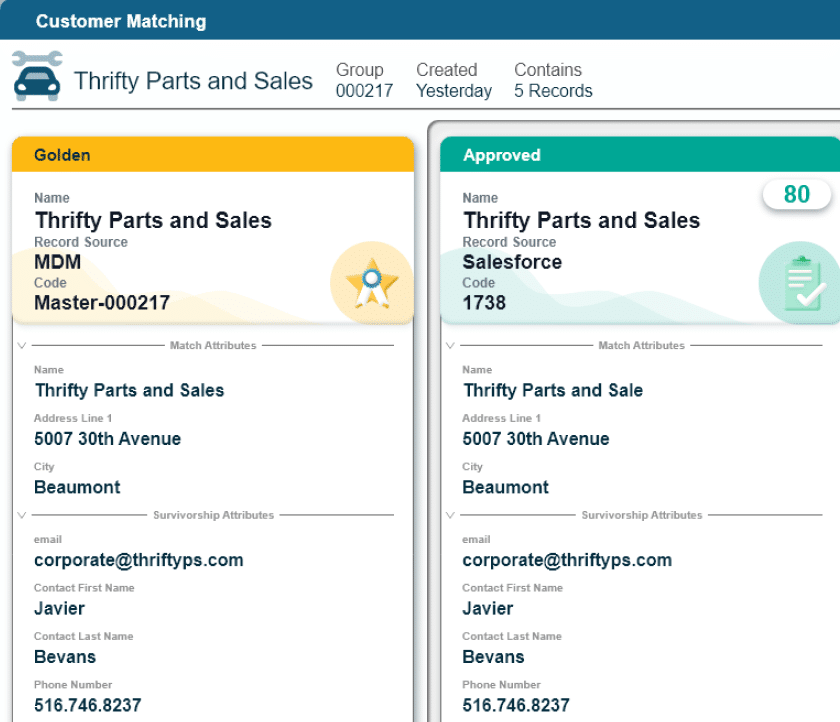
More reliable data is more useful data. When the full team agrees upon and adheres to rules and processes for the data, everyone can feel more secure knowing the information they’re using to make decisions and drive the business is accurate for all departments. MDM tools with capabilities such as fuzzy matching and reference data management help address data discrepancies.
Better Data Communication
When all parts of the enterprise can agree on the reliability of the records they use to make decisions, they can communicate and collaborate on how to achieve the company’s goals. From master data like customer, location and product information to sales and revenue figures, a framework assures all team members that their data is accurate and consistent.
Faster Decision Making
Data governance helps organizations build trusted information assets, enabling faster decision-making by reducing the time spent searching for and validating information. Instead of spending hours or days locating the right metrics across disconnected sources, teams can access reliable information that is ready for analysis.
Reliable records are even more important when companies introduce AI through augmented data management, machine learning and AI assistants.
Data Democratization
A data-aware organization equips employees at all experience and access levels to understand and use trusted information effectively. Well-informed teams can generate reports and perform analyses independently, reducing ticket volumes and the burden of routine report requests on technical teams.
By fostering data literacy and confidence in shared information, organizations respond more quickly to changing business needs.
Learn why data literacy is harder than it looks and how to help your teams use trusted information with confidence. Watch our video.
Regulatory Compliance
Data governance frameworks incorporate regulatory requirements into policies and processes from the start, making compliance part of everyday operations. While you still need to audit and monitor information for security and regulatory risks, built-in controls reduce the need for manual oversight and allow your team to focus on exceptions.
AI Readiness
AI models are only as reliable as the information they use. A strong framework for data governance establishes the standards, ownership and controls needed to deliver trusted, consistent information for AI, analytics and automation.
As AI adoption grows, governance requires executive oversight. According to McKinsey’s State of AI report, 28% of respondents whose organizations use AI say their CEO oversees AI governance, while 17% say their board of directors is responsible, highlighting the need for clear ownership and cross-functional accountability.
Profisee MDM bridges this gap with a governed data foundation that is fueled by AI, critical for AI. Our machine learning-based matching engine and generative AI tools extract unstructured data and structure it for enterprise AI consumption. By feeding your large language models and copilots with a single source of truth, we reduce AI risk, improve model performance and help your team spend less time correcting outputs and more time acting on them.
Explore the Profisee AI readiness solution.
How to Create a Data Governance Framework
Building a framework without a clear roadmap results in rigid, disconnected processes that erode real business value. Gartner projects that by 2027, 60% of organizations will fail to realize the anticipated value of their AI use cases due to incoherent data governance frameworks. These four steps give you a structured path to avoid that outcome:
1. Define business objectives and audit the data landscape
Start by defining the business outcomes, such as regulatory compliance, AI readiness, mergers and acquisitions (M&A) integration or operational efficiency and secure executive sponsorship to fund and enforce the governance framework.
Without objectives tied to business priorities, governance drifts into documentation exercises with no measurable impact.
Then audit your current data landscape:
- Catalog your master data domains
- Map how information flows across cloud and on-premises systems
- Identify owners
- Flag data quality issues and integration gaps
This baseline reveals where governance is most urgent, uncovers data silos that need MDM enforcement and prevents you from building policies around data that doesn’t drive business value.
2. Establish organizational roles and data governance structures
Establish data governance structures that define ownership, accountability and decision-making across the organization. Appoint a governance council to set strategy and priorities, assign owners for key business domains and designate stewards to oversee quality, documentation and issue resolution.
Document responsibilities, decision rights and escalation paths to eliminate ambiguity and ensure consistent execution. Clear roles improve accountability, reduce cross-functional friction and allow teams to focus on improving processes instead of enforcing them.
3. Develop data policies and quality standards
Define enterprise data quality standards for each domain by setting thresholds for accuracy, completeness, consistency and timeliness. Build a centralized business glossary that documents agreed-upon definitions and establish policies that govern how your teams collect, access, use, retain and protect information across your systems.
Tie each policy to a specific business rule so enforcement is automatic. Clear standards reduce regulatory risk, prevent front-line teams from entering malformed records, eliminate interpretation gaps between teams and give data stewards a measurable baseline for audits and continuous improvement.
Learn how data governance and quality work together to improve trust and consistency.
4. Deploy supporting technology and measure performance metrics
Select and deploy MDM tools like Profisee, data catalog, quality monitoring and workflow automation to enforce policies and give your team real-time visibility into data health. Integrate these solutions within your cloud, hybrid or on-premises environment, including platforms like Microsoft Fabric or AWS, so governance applies across every data source.
Track KPIs such as quality scores, data matching rates, policy compliance and issue resolution times on a regular cadence. Use the results to identify gaps, refine your policies and demonstrate business value to your executive council.
Learn to measure MDM’s business value.
Data Governance Framework Examples
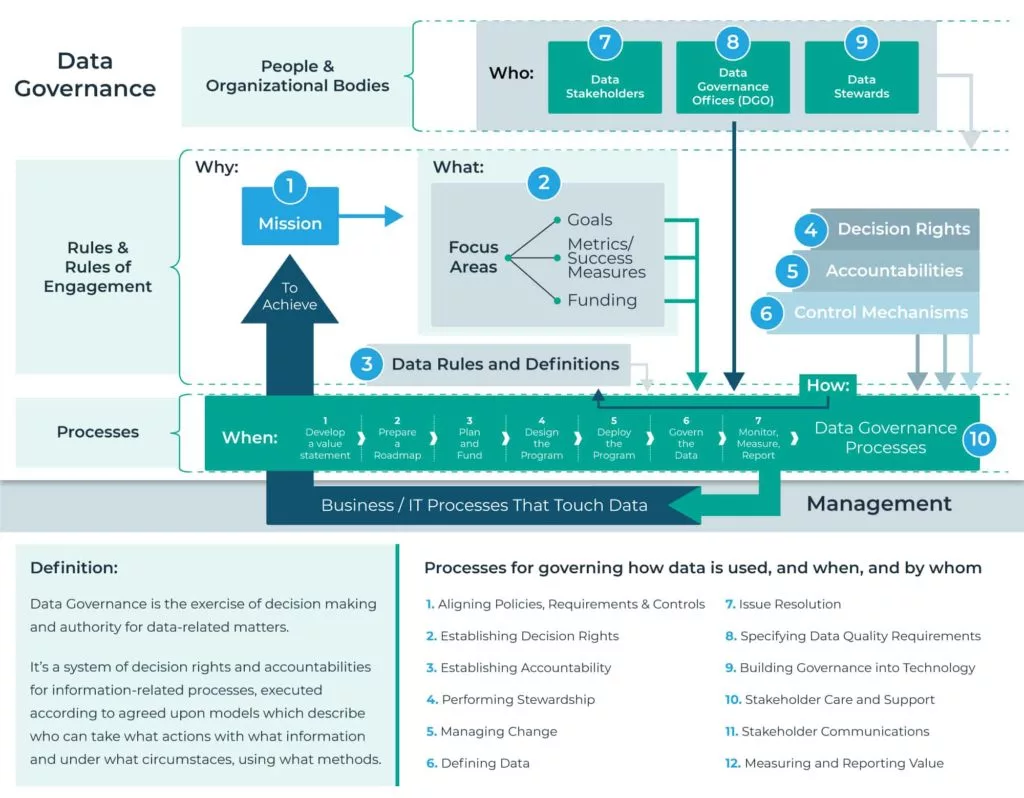
Choosing the right approach depends on your organization’s size, regulatory environment and governance maturity. The data governance framework from McKinsey prioritizes structural flexibility over process specificity, whereas frameworks such as the DGI and DAMA-DMBoK offer comprehensive, step-by-step guidance.