






































- What Is Single Source of Truth (SSoT)?
- How Does a Single Source of Truth Architecture Work?
- 5 Single Source of Truth Benefits
- What Are the Challenges in Creating a Single Source of Truth?
- How to Build and Implement a Single Source of Truth
- Key Features to Look for in Single Source of Truth Software
- Single Source of Truth Examples and Use Cases
- Frequently Asked Questions
Ready to Transform Your Data?
Key Takeaways
A single source of truth is a reliable and complete data record that encompasses domain inputs from across the enterprise.
An SSoT can improve resource management, enable better decision making, and result in more accurate analysis and forecasting.
A flexible, multi-domain MDM platform like Profisee enables SSoT initiatives without the complicated set-up of multi-tool solutions.
Despite the growth of digital transformation initiatives and the resulting data planning for enterprise companies, most organizations still struggle with data silos and inconsistent data. These issues are only exacerbated by AI initiatives that require reliable data and contextual metadata to work properly. Single source of truth initiatives that seek to build a consistent and reliable view of data for the whole enterprise bring better decision making and compliance.
In fact, Profisee Chief Data Officer Malcolm Hawker stresses in the State of MDM 2026 report that AI initiatives and incoming agentic AI tools require companies to go beyond the single source of truth by using it as a reliable and stable foundation for departmental context that extends from the SSoT. But most organizations have to build that single source foundation before they can build the departmental context that will serve agentic AI in the future.
What Is Single Source of Truth (SSoT)?
A single source of truth (SSoT) is a data repository where the most reliable, up-to-date and complete version of business data lives. In an ideal system, the SSoT will pull in data from every business source to aggregate and standardize within the source of truth database before sending the data back to the source in a reliable form.
Many software types, like ERP or project management software, claim to be a single point of truth for organizational data. However, if such tools don’t consolidate data from across the enterprise, the team runs the risk of siloed data within a single department. To achieve a true single version of the truth, customer, product, location and other critical data domains must be deduplicated, cleansed and standardized.
While a project management tool may hold the single truth data about the project portfolio, it will not be automatically updated alongside the CRM without a dedicated process. For many manufacturing organizations, a master data management solution provides the central database along with the software architecture required to ingest, cleanse, store and send SSoT data back out to source software alongside the governance and stewardship automations and tools that can sustain reliable data long-term.
How Does a Single Source of Truth Architecture Work?
A single source of truth architecture requires cooperation and collaboration across the enterprise to work efficiently and effectively. The main goal of an architecture of this type is to ensure that no data gets left in a silo and that all systems can receive the source of truth data to work with. These steps outline how a SSoT workflow could be implemented in an organization. We use a master data management solution as the SSoT software that would facilitate these steps.
- Ingest and integrate data: The SSoT software connects via API or ETL software to systems across the enterprise, including ERP, CRM, HR, finance, project management and legacy systems where data is held. These connections allow the SSoT to pull data into a single environment for further processing and storage.
- Normalize and standardize data: The SSoT tool cleanses, formats and aligns inconsistent data it brought in across the systems. For example, date formats may exist as mm/dd/yyyy in some systems but dd/mm/yyyy in others. To normalize date formats, the data team chooses a single format for all date records then performs the required transformations on date records. The same process must be done for all record types, like units (pounds vs. kilograms), naming conventions or product unique IDs.
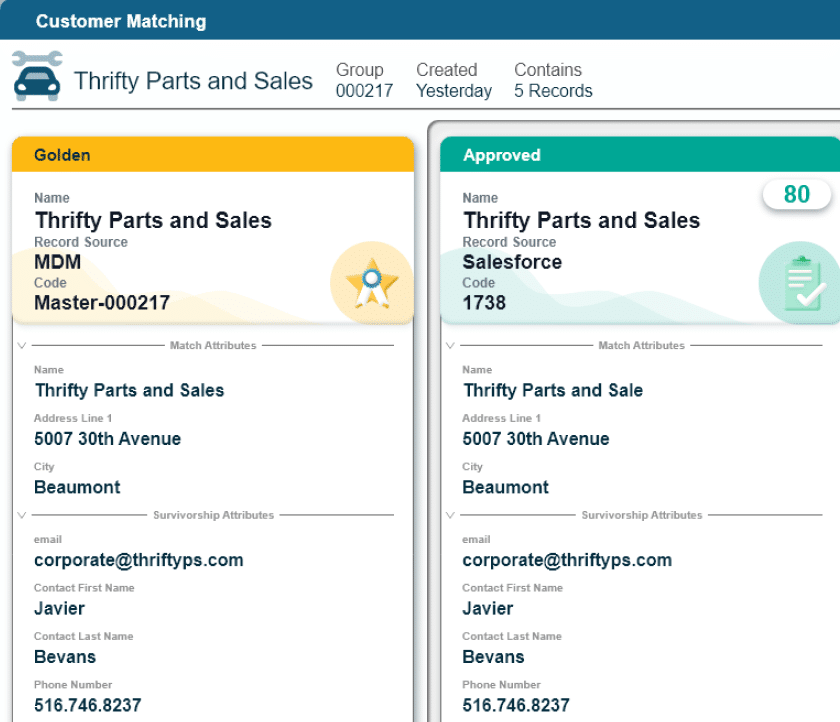
- Resolve and deduplicate identities: A SSoT solution will use automations and formulas to match and merge duplicates into a single, trusted entity. For example, a record for Acme Corporation may exist in the CRM as Acme Co. but in the ERP as Acme LLC. Data professionals at the organization will set an acceptable level of overlap, like the same address or contact name to identify a duplicate. Then the data team will decide how to determine the correct name, whether by individual review or third-party data validation.
- Set data governance and business rules: While the initial data cleanup is important, it’s even more crucial that new and updated data retains the quality set by the initial resolution. A SSoT software like a master data management solution will allow the data team to set, automate and enforce data entry policies, identify validation rules and build approval workflows that ensure data quality. These tools check new data upon entry to make sure it aligns with current data quality standards. It then enforces those standards by requiring correct formats or validating and updating the entry to match standards. Automation and workflows take human error or allowances that bend the rules out of the equation, and approvals alert the data team to places where it doesn’t fit and allows them to adjust rules as necessary.
- Centralize storage and access: To keep quality standards high, an MDM solution that offers data unification through centralized storage will prevent silos where data quality will degrade. When a single repository holds the golden records as a single source of truth for the organization, all data gets processed to the same standards, rather than entering in the CRM and staying there, possibly duplicating other records in the ERP.
- Update and synchronize in real-time:A single source of truth in a centralized repository also means all business software should pull the quality data records from the repository in addition to sending new data for processing. With the MDM as the central data hub, changes to data update across all systems in real time, giving all source systems the most reliable data and keeping the SSoT continuously accurate. Access to the repository should be limited to data administrators and owners who make final decisions on how data standards are upheld or modified.
- Enable analytics and reporting: In addition to having the most accurate data available for business operations, an SSoT software system enables reliable reporting and more trusted analytics. When pulling from an SSoT, reporting between finance and marketing uses the same data sets, providing consistency that improves confidence. When everyone works from the same data sets, dashboards actually show reliable numbers, giving business users decision making powers they can be confident in. When data moves through an MDM with reference data and audit logging enabled, compliance reporting is consistent, reliable and easy across the enterprise. And when the team is ready to implement AI and ML initiatives to speed operations, the data is ready.
5 Single Source of Truth Benefits
Companies that implement single source of truth data initiatives benefit from increased savings on operational costs and resource consumption while reducing the time spent performing day-to-day tasks. Data confidence and collaboration also improve as business users see how reliable and useful the new processes make the data that they work with every day.
1. Reduced Operational Costs and Inefficiencies
A single source of truth managed within master data management tools reduce operational costs attributed to repeated data cleansing work, pulling data for analysis and attempting to understand discrepancies. Decreased operational costs and increased efficiencies go together. For example, as teams have less repetitive, manual work to pull and consolidate audit logs from several sources, they experience fewer work stoppages and slowdowns, which delay revenue-driving work.
2. Improved Data Quality and Accuracy
Data quality is difficult to measure. However data accuracy and reliability are quantifiable metrics. With an SSoT through master data, golden records for business-critical data domains like customers, locations and product information maintain consistency across source software. Validation with third-party and internal resources ensures data accuracy, reducing time lost to double-checking work or information deficits caused by duplicate entries.
3. Stronger Cross-Departmental Collaboration
Cross-departmental collaboration depends on the whole enterprise seeing the same data in their systems, which is why digital transformation initiatives need a “single view.” When everyone sees consistent versions of real-time data, they can agree on the numbers in the dashboard, make quicker decisions and think more creatively. Communication between teams about customer issues can be quickly communicated because anyone looking at that unique customer record can see the same results.
4. Faster, Data-Driven Decision Making
Single source of truth benefits compound as the team’s confidence in their decision making grows. That confidence comes from the knowledge that the data everyone sees backs up their conclusions. And when the enterprise’s confidence in data grows, it means more employees make independent decisions because the data is indisputable.
5. Better Compliance and Risk Management
Compliance depends on record-keeping, and risk management depends on the analysis of those records. Companies can automate their risk management when data is consistent and reliable. The same metadata and audit logs that feed risk management algorithms translate to compliance audits as well.
What Are the Challenges in Creating a Single Source of Truth?
Creating a single source of truth across your enterprise requires careful planning and iterative execution where you start small and expand the program across several data domains. Challenges in communication and data reconciliation can severely stall a SSoT initiative, so be wary of these.
- Siloed systems: Departments that use siloed or unconnected source data systems create pockets of unreliable data across the organization. An example of this is when sales uses their own customer data platform (CDP) vs. master data management (MDM) solutions that serve the entire enterprise.
- Data discrepancies: Often caused by the lack of unique IDs for each record or failure to use referral data, changes in data types between source systems require careful attention. However, discrepancies can be resolved through validation and fuzzy matching.
- Ingestion and propagation: Data should come into the SSoT and be returned to source business software in its most accurate and reliable form for everyday use. Tools that allow real-time updates keep everyone on the same data set.
- Duplicate records: Does Acme Inc. have both a John Smith and a Jon Smith working for them, or should those records be merged? Failure to merge duplicate records leads to confusion and inaccurate reporting and analysis.
- Departmental collaboration: Business users in finance, product, marketing, sales and IT who don’t understand the potential benefits of a SSoT initiative are less likely to follow new processes, stalling efforts before they can truly take hold.
- Lack of clear ownership and stewardship: Reliable data is in everyone’s best interest, but without clear ownership, accountability and stewardship guidelines, there can be no enforcement of policies.
How to Build and Implement a Single Source of Truth
While your business’s goals and data architecture will vary, the high-level steps that go into building a SSoT remain the same. Below you’ll find definitions of these steps, why they matter, and best practices to guide you.
1. Identify Your Critical Data Sources
Your critical data sources are the software and databases that hold the fundamental data that runs your business. At this step, you need to identify both obvious and lesser-known data sources to get the fullest picture of your data landscape and your integration needs. List all applications where business data for customers, product, location and other domains is used and modified.
Best practices:
- List all obvious and “shadow IT” software to get the most comprehensive list.
- Go beyond leadership and interview daily users to complete your list.
2. Define Data Governance Policies and Assign Ownership
Data governance policies guide how data is ingested, processed and deleted across the data lifecycle. Data owners are the individuals who weigh in on decisions according to the needs of the business. These steps provide documentation and a person who can answer when questions arise. Build governance based on the ways that business units use data and assign ownership to leaders or ICs who actually use the data in question.
Best practices:
- Build governance according to business needs, not data needs.
- Identify key improvement metrics that align with business goals to track progress.
3. Choose the Right Single Source of Truth Software
The right single source of truth software will be one that meets your business needs, will scale with your company and is flexible enough to accommodate data from across the enterprise. Choosing the right solution for your immediate and long-term data goals will mean you don’t have to migrate data to a new system, saving you time and resources. Identify your data goals before choosing a tool to ensure it matches your long-term needs.
Best practices:
- Ground data goals in enterprise-wide business initiatives.
- Identify the data domain that will make the biggest business impact and focus on just that domain for your first project.
4. Cleanse, Standardize and Consolidate Data Into One Record
Bring all data into your SSoT software where you can cleanse, standardize and consolidate it. In that SSoT you can implement and revise governance, approvals and validation processes on the data. If you perform this step in the system of record vs source of truth, you will need to repeat the processes for every source system you pull from.
Best practices:
- Decide on centralized data formats that align with business needs and provide the most complete and accurate view of data possible.
5. Set Up System Integrations and Real-Time Synchronization
Connect source systems with the SSoT database via API connections that allow for real-time data pull from new source system inputs and that push the cleansed and up-to-date data back to other source systems. Real-time synchronization enables better collaboration, efficiency and decision-making across the enterprise.
Best practices:
- Ensure all applications that ingest or store data related to critical domains are connected to eliminate silos.
6. Test and Validate Data Workflows Before Full Deployment
Using a representative sample of a single domain, test your workflows and validate their results against the expected results. Continue to test in increasingly larger batches of data until you feel you’ve covered the major contingencies that require manual approval.
Best practices:
- Balance manual reviews with automated workflows, increasing automation as you gain confidence.
- Confer with data owners on outliers to remain aligned with business needs instead of data team preferences.
7. Roll Out the SSoT Enterprise-Wide and Train End Users
Educate and train your end-users on what will change, how the changes benefit them and the enterprise as a whole and how the expected outcomes align with business priorities. Then roll out the tools and demonstrate those improvements in real-time. Education on both the what and how of the SSoT initiative will increase buy-in and improve adoption.
Best practices:
- Train small groups of departmental end-user influencers that work directly with the department’s data. These will become your data champions.
- Resist the urge to roll back governance due to initial end-user discomfort. Instead, gather feedback and make decisions when team members have had time to train and work in the systems for a bit.
8. Monitor Data Quality and Continuously Improve Processes
The data initiative shouldn’t end with the roll-out. SSoT data quality requires an ongoing process of iteration and improvement to maintain momentum. Balance flexibility with strict governance policies and make decisions based on the needs of the company to make the biggest impact.
Best practices:
- Document and publish improvement metrics to advertise the data initiative’s success.
Key Features to Look for in Single Source of Truth Software
Depending on your company’s values and needs, different types of SSoT software may work best for you. But some features remain consistent across industries, including:
- Integration: The platform should provide direct or indirect data transfer into and out of the SSoT via methods like API or ETL. This facilitates the timeliness and reliability of data across the enterprise
- Governance: The ability to build rules and processes that the system upholds across all new and existing source data to maintain quality.
- Automation: Save time and improve efficiency by automating workflows, approvals and verification processes.
- Usability: The system should include UI and features for business users to act as data owners, allowing the data team to delegate ownership.
- Scalability: Is the system flexible enough to scale beyond a single domain? For instance, can it include both product and customer data?
Use the table below to compare platform types according to your needs.
| Platform | Core focus | Integrations | Security | Industries |
|---|---|---|---|---|
| Master data management (MDM) | Establish and maintain business-critical reference data across systems | ERP, CRM, eCommerce, BI, data hubs, finance, HR | Data governance, role-based access, validation rules, lineage | Retail, manufacturing, healthcare, finance |
| Data warehouse | Centralized structured data repository for reporting and analytics | ETL, BI, analytics, operational databases | Access controls, encryption, auditing, schema governance | Finance, retail, telecom, healthcare analytics |
| Knowledge Graph/Semantic Layer | Modeling relationships and context between entities for discovery and reasoning | Graph databases, NLP tools, BI layers, APIs | Graph-level permissions, schema constraints, metadata tagging | Healthcare, life sciences, AI/ML, research |
| Customer data platform | Unifies customer data profiles for personalization and marketing | POS, web and application tracking, CRM, marketing automation | Consent management, PII protection, encryption | Retail, travel, media, digital services |
Single Source of Truth Examples and Use Cases
Building a single source of truth within your organization will unify data for many different industries. A key to getting the most from a SSoT solution is to choose a flexible product like a multidomain MDM that’s flexible enough to manage all the data domains that your team requires.
Scientific Research and Lab Management
Scientific research in the life sciences requires strict data control in order to ensure reproducibility and streamlined audits. An SSoT software can centralize electronic lab notebook (ELN) data with laboratory information management software (LIMS) and safety records. These tools improve audit controls and increase efficiency across the system.
Enterprise Project Management
Managing projects at scale means collaborative efforts break down quickly without reliable data. After implementing Profisee MDM as their SSoT, Aker BP was able to build 70 data products to improve resource management and improve efficiencies. The SSoT enables agile, cross-team initiatives that reduce project creep and unify tracking.
Customer 360 and CRM
Domino’s implemented Profisee MDM as their SSoT to unify marketing and customer information that enabled cross-channel marketing segmentation, improved customer insights and personalized order suggestions. When creating a 360 degree view of customer data and CRM data with sales, product and service records, the company unlocks true customer insight.
Process Compliance and Training
In highly regulated industries and companies with detailed employee training processes, unifying data within a SSoT solution provides a single version of policies and procedures that become the universal training language. Human resources can benefit from the reduced training time, and these tools can extend to business uses for standard operating procedures (SOPs) and onboarding.
Implement Single Source of Truth Enterprise-Wide with Profisee
Successful SSoT initiatives begin with buy-in from business users and leadership. From there, build a shortlist of tools that will suit the goals of the data team and the business. Choose a solution like Profisee that includes audit environments, flexible data domains, AI-assisted cleansing and automated workflows to optimize your data use and increase efficiency across the enterprise.
Request a demo to see how Profisee can create a single source of truth for your organization.
Frequently Asked Questions
A SSoT is the unified view of data that contains input from all source systems. Systems of record are the native sources of original data such as a CRM, HRIS or ERP. To understand a system of record vs. source of truth, it’s helpful to think of the source of truth as the center of a web with systems of records on the outer corners of the web.
Organizations who cannot get a complete view of their data risk losing valuable context that informs critical decisions, including financial forecasting and data analysis. An SSoT resolves duplicate efforts on the part of end-users and analysts, speeds decision making and improves cross-departmental collaboration.
A single source of truth in agile projects contains all data related to a project and relates that data to tasks or project stages. For example, timeline data may show key milestones, tasks, team comments and financial records and how they relate to project execution.
A SSoT is connected to source systems where data updates originate via data integration tools like APIs, ETL and automated synchronization protocols. Data updates are pushed to the SSoT tool from data sources. Once the data is cleansed and reconciled with existing records, the SSoT tool pushes the data back to source systems as automated data updates.
Any operations-critical documentation should be stored within a single source technology, including project plans, SOPs, analytics, HR documents and customer records. Any data documentation that is auditable or informs critical decisions should be stored in the source of truth.
Yes, a single source of truth helps eliminate data silos by centralizing and reconciling data across key data domains in the enterprise. As long as departmental teams identify software and integrate it into the SSoT system, the data won’t be stuck in a silo.
Yes, you can reduce data duplication with SSoT, as the SSoT is designed to deduplicate data during the cleansing stage, leaving you with a reliable and unique data set.
In addition to a centralized database that acts as the single source of truth, you will need to use API, ETL and automated synchronization protocols to transfer data between source systems and the SSoT solution. Data governance and stewardship tools in addition to workflow and data cleansing, deduplication and validation software round out your tool lists. Alternatively, a single source of truth platform like Profisee MDM that includes all of these features and uses AI tools to automate reliable data cleansing can be a flexible solution that works smoothly for multiple data domains.

Benjamin Bourgeois
Ben Bourgeois is the Head of Product and Customer Marketing at Profisee, where he leads the strategy for market positioning, messaging and go-to-market execution. He oversees a team of senior product marketing leaders responsible for competitive intelligence, analyst relations, sales enablement and product launches. He has experience managing teams across the B2B SaaS, healthcare, global energy and manufacturing industries.