








































- What Is a Unified Customer View ?
- How Is a Unified Customer View Different from a Traditional Customer Database?
- Why Is a Unified Customer View Important?
- Benefits of a Unified Customer View
- What Are the Challenges in Maintaining a Unified Customer View?
- What Is a 360° Customer View?
- How to Build a Unified Customer Profile
- How Can You Implement a Unified Customer View in Your Operation?
- How to Measure the Success of a Unified Customer View Implementation?
- Go Beyond 360º Customer with Profisee MDM for a Truly Unified Customer View
Ready to Transform Your Data?
Key Takeaways
A unified customer view (also known as a customer 360 profile) is a complete picture of your organization’s relationship with a customer across the enterprise, capturing all touchpoints and systems rather than a single deduplicated record.
Achieving and using a unified customer view can increase customer engagement, improve customer relationships and provide revenue growth opportunities.
A robust MDM platform like Profisee has the data tools necessary to give you a customer 360 profile and maintain that quality data for the long term.
Creating great customer experiences, optimizing cross-sell opportunities and building long-term loyalty all depend on a comprehensive understanding of customer interactions and relationships. However, for complex organizations serving complex customers, that understanding is often undermined by low-quality customer data spread across multiple systems. Without accurate, consistent customer visibility, even well-designed customer initiatives struggle to deliver results.
In this article, we break down what a unified customer view is, why it’s critical for customer-centric growth and how organizations can build and sustain one using governed, high-quality data.
What Is a Unified Customer View ?
A unified customer view, also known as a customer 360 profile, is a single source of truth of a customer across the enterprise. To be fully unified, a customer view should include key attributes including:
- Name and contact information
- Transaction history
- Engagement and interaction history
- Product and communication preferences
Taken together, these insights can provide the basis of deep analytics for customer behavior and opportunities for personalization.
How Is a Unified Customer View Different from a Traditional Customer Database?
Traditional customer databases — inside source software like a CRM or even in a private company database — differ from a unified customer view in several ways:
| Unified Customer View | Traditional Customer Database |
|---|---|
| Provides enterprise-wide analytics and historical insights | Operationally or process-focused records |
| Integrated data from across the enterprise | Single-source or transaction-focused records |
| Provide unique and reliable customer views | May include duplicated or incomplete contact information |
| Enables enterprise-wide customer intelligence | Limited to domain-specific or departmental insights |
A traditional customer database is a useful way to store transactional or identifying information, but it offers only a limited snapshot of the customer. Such a limited view lacks the full context needed to understand behavior, drive personalization and make informed decisions across the enterprise.
Why Is a Unified Customer View Important?
No one likes receiving the targeted ad for the shoes they’ve already purchased, and those poor customer experiences are magnified when they happen at enterprise scale. A unified customer view provides a personalized and consistent experience without irrelevant or repeated offers. That’s because the customer view is informed by comprehensive data from across departments all consolidated into a single set of records.
In addition to personalization, a unified customer view also gives the company:
- Operational efficiency
- Cross- and up-sell opportunities
- Regulatory compliance with GDPR and other privacy regulations
Benefits of a Unified Customer View
A unified customer view brings several benefits that extend across the company, serving sales, marketing, finance, product, operations and supply chains. Those benefits include:
- Operational efficiency: Human errors and manual reporting are reduced, resulting in higher quality customer data, faster operational decision making and more consistent analysis across the company.
- Better segmentation and targeting: Marketing and sales teams benefit from more complete customer information that can be used to segment customers more precisely and target offers directly.
- Improved personalization and engagement: Messaging can align with actual customer behavior and more effectively achieve desired outcomes.
- Higher customer satisfaction and loyalty: Customers experience fewer company mistakes, their problems are solved faster and they spend less time repeating their issues.
- Departmental alignment: With a unified customer view, all departments are working from a single source of customer truth, which allows each department to collaborate more effectively.
A unified customer view greatly benefits from data relationship management, where hierarchies, meta data and contextual information can draw connections across different data domains, effectively building a visual network of data that increases operational efficiency.
What Are the Challenges in Maintaining a Unified Customer View?
Unified customer views bring significant benefits. But without proper data governance and processes that automate data collection and cleansing or reduce the possibility of error, unified customer views are difficult to maintain. Prepare for these challenges when planning your customer data initiative:
- Incomplete or inadequate data quality governance: Without systems, processes and validation checks that guard against duplication or incomplete data, quality can quickly degrade.
- Improper identity resolution: Different source systems may have separate or multiple identifiers for a single customer. To maintain the unified customer view, you’ll want to reconcile these to ensure unique records.
- Increased data fragmentation: When customer data is sourced from several systems, the likelihood that the data doesn’t easily reconcile increases. You need tools that will match, deduplicate and validate data from separate systems to consolidate records properly.
- Lower data security: Data can be exposed as it moves across and between systems, so increased governance and attention to privacy and security must be implemented.
- Regulatory compliance risk: Data change logs and auditable records decrease compliance risk, so you must implement a system built to produce compliance-ready logs and lineage reporting.
- Increased organizational misalignment: When more departments touch customer data, the ownership and stewardship of that data can become less defined, causing misalignment and potentially affecting the quality of the data.
These challenges can be minimized, however, with a more robust data platform like master data management, which requires an enterprise-wide shift in data policies and approaches.
Maintaining data in a customer data platform vs. a master data management (MDM) solution can actually be more difficult, as customer data platforms often do not provide the governance necessary to prevent a drift from quality data.
What Is a 360° Customer View?
A 360 customer view is essentially the same thing as a unified customer view, however the 360 customer view emphasizes contextual data that describes the customer’s journey and experience with the company.
While the terms are often used interchangeably, a 360 customer view may go beyond basic customer contact and transaction information to include engagement and interactions that provide the context for predictive insights.
How to Build a Unified Customer Profile
While customer data platforms, CRM, ERP and other software systems that contain and organize customer data can be useful in gaining an understanding of your customers, the only true way to build a unified customer profile is to harness customer data at the domain-level across the enterprise.
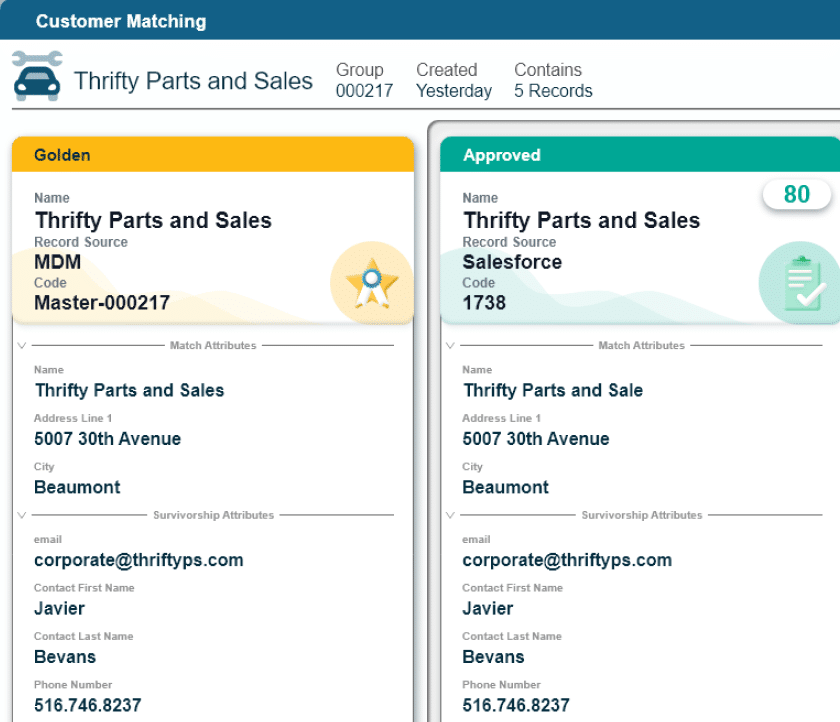
You can do this with a master data management tool like Profisee that brings together master data management, data governance, data stewardship and data quality management in a single platform. Consolidating customer golden record data in an MDM means you push trustworthy data from the MDM back out to source systems and that each source system runs on the same golden record data set.
When you work with an MDM solution to build a unified customer profile, you follow the steps used to create golden record data for any other domain:
- Identify customer data sources from across the enterprise
- Combine and integrate data by bringing all customer data sets from source systems into the central MDM
- Match and cleanse records by deduplicating, correcting inaccurate or incomplete records, matching records and validating all records
- Apply governance rules, ownership and stewardship roles and responsibilities to maintain data quality for new and existing data
How Can You Implement a Unified Customer View in Your Operation?
Implementing a unified customer view at your organization requires cooperation from the departments and teams contributing source data to the initiative as well as a clear data strategy. Follow these steps to begin:
- Identify business priorities that will benefit from the unified customer view. Company-wide initiatives concerning customer satisfaction, revenue growth or organizational efficiency may all apply.
- Find departmental stakeholders and knowledge keepers. Understand who you need to get to buy into the project and who knows about the daily data use and operations of the department. These may be separate people.
- Select the right MDM platform for your needs. Look for a solution that will fit your goals, timeline, budget and scaling requirements.
- Identify a high-priority business process as your pilot. A process-driven approach makes it easier to manage scope, align stakeholders and demonstrate early value before scaling.
- Work with stakeholders and knowledge keepers to identify the data records and formats necessary. Set KPIs and metrics to measure success.
- Launch the pilot on your chosen process and track success against the KPIs established in Step 5.
- Establish governance policies and stewardship relationships across the organization.
- Push golden record data back to source software and listen to end users’ feedback concerning quality and usability. Governance should be flexible enough to account for new department needs but maintain quality.
- Repeat and scale with other high-priority data domains.
How to Measure the Success of a Unified Customer View Implementation?
A unified customer view implementation needs hard data to show success. Be prepared to measure customer data usability KPIs prior to implementing your data initiative and track these metrics as it matures.
| KPI set | Metrics that support it |
|---|---|
| Data quality |
|
| Operations |
|
| Customer experience |
|
| Revenue & retention |
|
| Personalization impact |
|
To ensure that all stakeholders are aware of the unified customer data view project’s success, build a centralized dashboard where stakeholders and business users can see the effect unified data has on these and other KPIs related to the project.
Go Beyond 360º Customer with Profisee MDM for a Truly Unified Customer View
A customer data platform can show you a unified view of a customer’s interactions within the department or team that has access to it, but these tools often live siloed in the marketing or sales team where product, manufacturing, logistics and leadership can’t access their benefits. Profisee Master Data Management can give you a unified customer view that’s usable across the enterprise while packing the scalability to make any master data domain usable and reliable. With advanced data matching and governance, Profisee is an end-to-end solution that provides you with a unified customer view — and so much more. Request a demo today.

Benjamin Bourgeois
Ben Bourgeois is the Head of Product and Customer Marketing at Profisee, where he leads the strategy for market positioning, messaging and go-to-market execution. He oversees a team of senior product marketing leaders responsible for competitive intelligence, analyst relations, sales enablement and product launches. He has experience managing teams across the B2B SaaS, healthcare, global energy and manufacturing industries.