- Why the Magic Quadrant Went Away in 2021
- What Actually Changed in the MDM Market
- MDM’s Role in Modern Data and AI Strategies
- The Shift Toward Converged Data Platforms
- How to Use the Magic Quadrant Effectively
- A Perspective from Inside the Process
- What Comes Next for the MDM Market
- Final Thoughts on the 2026 Gartner Magic Quadrant for MDM
Last week, I hosted a webinar with my colleague Malcolm Hawker, Profisee’s Chief Data Officer, to walk through the recently published 2026 Gartner Magic Quadrant for Master Data Management Solutions.
Malcolm and I came to the discussion from two very different vantage points. He spent years at Gartner and authored the previous Magic Quadrant in 2021. I led Profisee’s submission for this year’s report as part of my analyst relations role, working across product, engineering and customer teams to translate what we’ve built into how Gartner evaluates the market.
That combination gives Malcolm and me two unique perspectives that I hope give buyers a valuable sense of what this report means in the context of the MDM and broader data management market today. We spoke about how the category has evolved, why the Magic Quadrant disappeared in the first place, and what its return means if you’re evaluating MDM today.
If you haven’t read the full report yet, you can download a free copy of the 2026 Gartner Magic Quadrant for Master Data Management Solutions here.
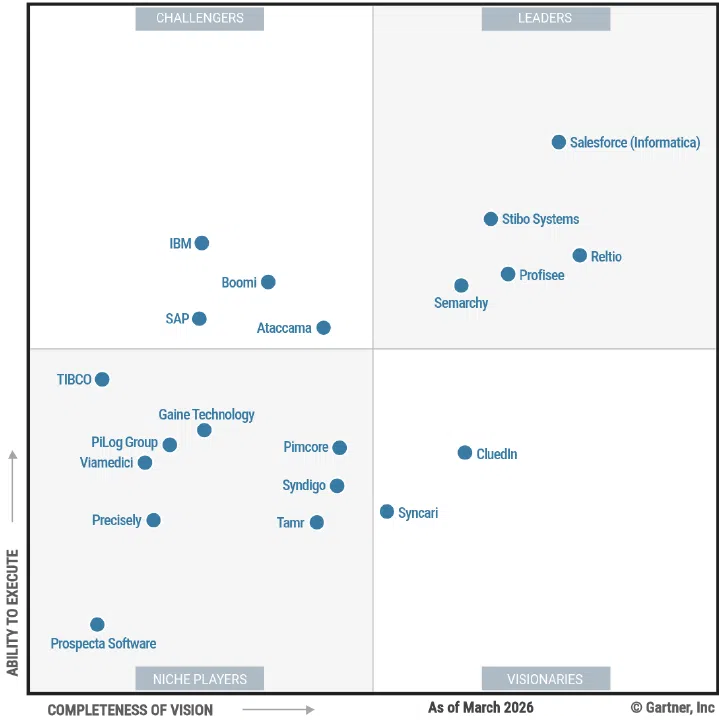
While you can see the actual quadrant graphic with the placement of vendors on this blog and elsewhere online, the real value of this report is not limited to the actual quadrant. So, I’m writing today to give my perspective on what has changed and how buyers and followers of this market should interpret it through their own priorities.
Profisee Named a Leader in the 2026 Gartner® Magic Quadrant™ for Master Data Management Solutions
Why the Magic Quadrant Went Away in 2021
To understand why this report matters now, you have to go back to why Gartner decided to retire the Magic Quadrant for MDM.
When Gartner published the last Magic Quadrant in 2021, the category was at an inflection point. MDM capabilities were increasingly being absorbed into broader data platforms. The expectation was that the standalone category might lose relevance as organizations consolidated around unified data environments.
Malcolm spent time unpacking this during the webinar (see the video embedded below at the 14:05 mark), drawing on his experience as the lead analyst on that report.
At the time, Gartner’s decision made sense. Organizations invested in platforms that combined integration, governance and analytics. Evaluating MDM separately became harder to justify.
What’s changed in the years since are expectations that modern organizations have for their data and the pressure being put on CDOs and other data leaders:
- Cloud adoption accelerated.
- Data volumes expanded.
- AI moved from experimentation into production.
Each of these trends increased the need for consistent, governed definitions of core business entities.
But MDM didn’t fade into the background. Instead, it became a dependency.
And that shift brought the Magic Quadrant back.
What Actually Changed in the MDM Market
When we walked through the report together, one point Malcolm made stood out. The separation between vendors is more pronounced than five years ago.
That’s a reflection of how the market has evolved. In the graphic below, we added a diagonal dotted line from the top-left to the bottom-right of the report.
We did this because it helps visualize how Leaders like Profisee and others have separated themselves from others in the market across both axes of the Magic Quadrant: completeness of vision (on the horizontal axis) and ability to execute (on the vertical axis).
When scanning report this way, it’s clear that no Challengers sit above the dotted line on their ability to execute, and no Visionaries extend past it on their completeness of vision. The Niche quadrant is new and quite crowded, with half of the entire market (9 of 18) vendors falling into that category.
But Malcolm mentioned during the event that being a Niche player is not necessarily a bad thing:
“What Gartner would say is that it’s not a bad thing, per se, to be considered a niche player. Maybe all you want to do is PIM, for example, product information management. You don’t want to as a company be a multidomain MDM. Gartner would say, ‘There’s nothing wrong with that, but your focus on this one specific market area or this one industry or this one use case in this example would limit you to be a niche player.’”
Malcolm Hawker, Profisee Chief Data Officer on the Niche Players in the 2026 Gartner Magic Quadrant for MDM Solutions
Beyond that, the market has changed in a few important ways:
The market expanded and specialized
There are more vendors in this year’s report, and they are highly differentiated. Some are focused on specific domains or industries. Others are building broader platforms that support multiple use cases.
Core capabilities are widely available
Scalability, cloud deployment, integration and data quality are now standard across most platforms. The conversation has shifted from whether these capabilities exist to how effectively they are delivered and adopted across Gartner’s required implementation styles.
AI is part of the baseline
AI-driven matching, classification and stewardship are no longer emerging capabilities. They are expected components of modern platforms.
Architecture is more flexible
Organizations are managing data across multiple systems and domains. MDM platforms are evolving to support distributed models rather than rigid centralization.
If you want a deeper look at how these approaches are implemented, I’ve broken down the different models in this guide to master data management implementation styles.
MDM’s Role in Modern Data and AI Strategies
A question that came up repeatedly during the webinar was whether MDM is still necessary given the rise of modern data platforms and AI.
In practice, those trends increase the need for MDM.
AI systems depend on consistent representations of entities (or domains) like customers, products and suppliers. Without that consistency, outputs vary, and trust breaks down.
Malcolm put it this way during the discussion at the 49:40 mark of the video below:
MDM provides the structure that those systems rely on. It defines entities, resolves duplication and enforces consistency across environments.
This is why organizations investing in platforms like Fabric, Databricks or Snowflake often revisit the same question: How do we ensure our core data is consistent across systems?
The Shift Toward Converged Data Platforms
Another theme that came up in our conversation is how MDM fits into a broader data architecture.
Data management platforms are converging. MDM is increasingly delivered alongside data integration, governance and analytics capabilities.
This was part of the rationale behind retiring the Magic Quadrant in 2021. It is also part of why it has returned. The category didn’t disappear. It became more interconnected.
For buyers, the key consideration is how MDM fits into your environment:
- Is it embedded within your data platform?
- Is it integrated across systems?
- Is it acting as a coordination layer for shared data?
Those decisions shape how you evaluate vendors.
How to Use the Magic Quadrant Effectively
One point Malcolm emphasized is that the Magic Quadrant is most useful when it informs how you evaluate, not who you select.
A more practical approach looks like this.
Start with your use case
Define whether you are solving for a single domain or multiple and whether your focus is operational, analytical or both.
Understand how implementation evolves
Most organizations start with a focused use case and expand over time.
Look beyond the quadrant graphic
The visual gets attention, but the detailed analysis and vendor write-ups are where the real insight lives.
Validate within your environment
Every organization’s data landscape is different. Shortlisting vendors is only one step. Proving how they work in your environment is what drives results.
A Perspective from Inside the Process
Having gone through the submission process this year, what stood out to me was how comprehensive the evaluation has become.
I can only speak to the amount of effort that went into Profisee’s own submissions, which included a detailed RFI response totaling over 100 pages, an hour of recorded software demos and a live briefing with the authors of the document.
With 19 vendors (plus four honorable mentions), I can only imagine the amount of research, analysis and effort went into producing this entire document. I thank Stephen Kennedy, Lyn Robison, Divya Radhakrishnan and the entire Gartner team for their efforts and commitment to this market.
This document extends well beyond features or critical capabilities. It inspects in detail how platforms support real-world use cases across industries, domains and maturity levels.
It also reflects how organizations are adopting MDM today.
Many teams no longer launch large, centralized programs. They start with targeted use cases, prove value and expand from there. That approach is supported by the flexibility of modern platforms and aligns with how the market is evolving.
That alignment between how buyers adopt MDM and how vendors are evaluated is one of the more meaningful shifts in this report.
What Comes Next for the MDM Market
We spent a good portion of the webinar discussing where the market is heading.
MDM is becoming more tightly integrated into broader data ecosystems.
Organizations align MDM with governance, integration and analytics rather than treating it as a standalone capability.

One way that Profisee is responding to this convergence is by staying laser-focused on MDM while integrating with best-in-class platforms across adjacent spaces like data governance, analytics and data fabrics.
In fact, Profisee’s native workload in Microsoft Fabric was explicitly called out in recent Gartner research about the convergence of data management platforms because it allows customers to leverage MDM capabilities natively within the tools their users already work without context-switching or learning another system.
But beyond the convergence of the MDM category within a larger suite of tools, there are several other key changes that Gartner notes in the 2026 report:
Adoption models are becoming more incremental
Teams prioritize faster time to value, starting with focused use cases and then expanding based on results.
AI is being applied within MDM workflows
Automation is improving matching, classification, and stewardship processes, reducing manual effort. Like Malcolm mentioned during the event, Gartner no longer lists ‘Augmented Data Management’ as a standalone Critical Capability; AI is expected to be embedded throughout every step of the MDM user journey.
Multidomain support is expected
Organizations are managing more types of data across more systems, and platforms are expected to support that complexity.
Evaluation is shifting toward outcomes
Buyers are focusing on how quickly they can deliver trusted, usable data to the business and how well platforms support that over time.
You can see Malcolm and me discuss these trends in more detail at the 40:20 mark of the video below.
Final Thoughts on the 2026 Gartner Magic Quadrant for MDM
The return of the Magic Quadrant reflects a shift in how organizations think about data.
MDM is closely tied to broader data and AI strategies. Expectations for these platforms are higher, and their role in the enterprise is more visible.
If you are evaluating MDM or reassessing your current approach, this report provides a useful lens into both the market and its direction.
You can download the full Gartner Magic Quadrant for MDM here — and if you want to hear Malcolm and me speak about this report and more, join us on CDO Matters LIVE.
Benjamin Bourgeois
Ben Bourgeois is the Head of Product and Customer Marketing at Profisee, where he leads the strategy for market positioning, messaging and go-to-market execution. He oversees a team of senior product marketing leaders responsible for competitive intelligence, analyst relations, sales enablement and product launches. He has experience managing teams across the B2B SaaS, healthcare, global energy and manufacturing industries.