








































Ready to Transform Your Data?
Key Takeaways
Gartner’s 2026 Magic Quadrant confirms that AI needs trusted, governed master data to avoid hallucination and act on reliable information.
Leading MDM vendors now package master data as a governed data product that both people and AI agents can draw from with confidence.
Profisee delivers trusted data directly into existing AI tools through Aisey and the MCP Server, with native integrations across the Microsoft ecosystem.
Enterprise AI budgets are climbing. Pilots are everywhere. Nearly every company has a generative AI initiative underway, and many are experimenting with agents that can act on their own.
But production-grade autonomous agents, the kind that can make a decision and act on it without a human checking the work, remain rare. The gap is not ambition. It’s the data underneath. Most organizations are asking AI to act on information it has no reason to trust.
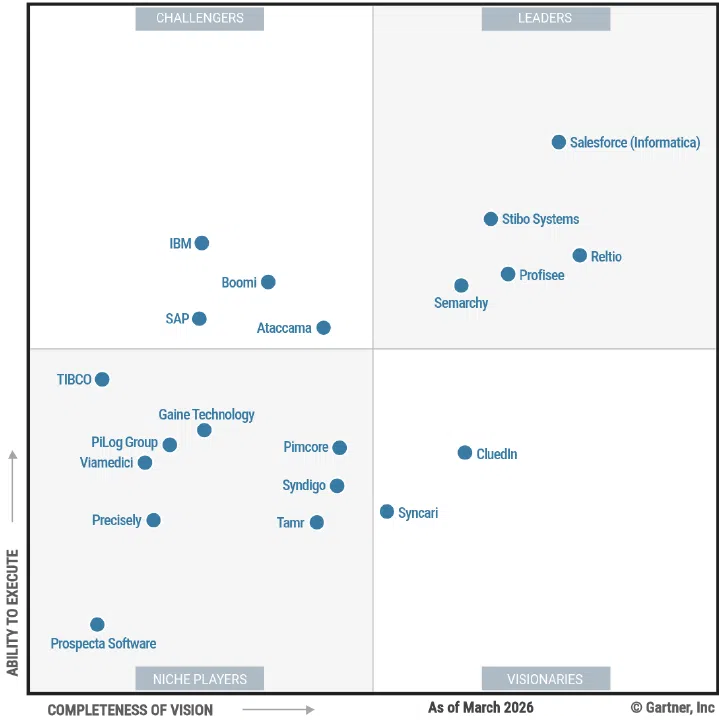
The Gartner® 2026 Magic Quadrant™ for Master Data Management Solutions draws a direct line between the two problems. Master data management (MDM), once treated as a back-office governance exercise, is now widely described as the mechanism that determines whether AI can be trusted to act at all.
If you haven’t read the full report yet, we’ve provided a free copy of the 2026 Gartner Magic Quadrant for Master Data Management Solutions here.
What the Market Is Telling Us: MDM as AI’s Safety Layer
Generative and agentic AI systems need structured, trusted context to function well. Relationships between customers and products. Verified identities. Consistent hierarchies. Without that context, large language models (LLMs) are prone to hallucination, and autonomous agents can take actions based on flawed assumptions about who a customer is or what a record represents.
This argument is now showing up across nearly every vendor evaluated in the 2026 Magic Quadrant. AI capability is no longer a differentiator in MDM. It’s the baseline. Vendors across every quadrant, from Leaders to Niche Players, report embedded AI agents, copilots or AI-assisted stewardship as standard features. Several go further, describing their platforms explicitly as the layer that grounds AI agents in governed data rather than letting them guess.
Profisee Chief Data Officer Malcolm Hawker made a similar point earlier this year, pointing to Salesforce’s acquisition of Informatica and SAP’s pending acquisition of Reltio as evidence that trust in data, not just context, is what enterprise AI strategies are missing: “There is nothing more important than enabling trust in both your data and the AI that depends on it. These acquisitions are proof that MDM can no longer be ignored.”
The market is effectively describing two sides of the same coin. One is using AI to automate the work of stewardship, things like anomaly detection and match tuning. The other is using MDM to make AI outputs trustworthy in the first place. Vendors that lead the category, including Profisee, are increasingly evaluated on how well they execute both at once, not just one or the other.
From Stewardship Automation to AI Activation
Automating data cleanup and grounding an AI agent’s decisions are not the same maturity level, even though both get filed under “AI in MDM.”
The first is largely about efficiency. AI-assisted matching, classification and anomaly detection reduce the manual burden on data stewards and speed up routine cleanup. That work matters, and it’s now table stakes across the category.
The second is about consequence. When an AI agent is deciding which supplier to reorder from, for example, which customer record to update or which claim to flag, the data behind that decision must hold up. That’s a different bar than clean data for a quarterly report. It’s data built to be acted on, not just reported on.
Gartner’s report shows this shift is already happening across the market. Several vendors now package mastered data with governance rules and context built in, so people and AI agents can pull from the same source without the extra engineering work. The “data product” idea is becoming the market’s answer to AI activation, not just a vendor’s pitch.
This is where the idea of a governed master data product comes in. Rather than treating master data as a database that lives in one system, leading organizations are packaging it as a reusable product with defined interfaces, built-in context and lineage that both people and AI agents can draw from at the same time. It’s less a place data sits and more a contract for how data behaves once other systems and agents start relying on it.
Proof Point: Nestlé Purina
Nestlé Purina has spent several years building what it calls “theHive,” an internal center of expertise focused on partnering with the business to implement MDM and data governance as a foundation for broader innovation, including becoming AI-enabled at scale.

Brian Zenk, Nestlé Purina’s vice president of data science, has described the relationship between the two disciplines simply: data governance sets the standards, and master data management enforces them. That enforcement layer is what has allowed Nestlé Purina to move from cleaning up data reactively to using it proactively across predictive analytics and other AI-driven initiatives.
Bringing Trusted Data Into the Tools AI Already Lives In
Knowing that AI needs trusted, governed master data is one thing. Getting that data into the tools people are already using is another.
This is the problem Profisee’s AI assistant, Aisey, and the Profisee MCP Server solve. Rather than asking AI agents to query a separate master data system, the MCP Server exposes governed master data directly to the AI tools and agents an organization already relies on, so trust travels with the data instead of living in a silo.
In practice, that means native integrations with Microsoft Copilot, Power Platform and Azure AI Foundry, so governed data can reach agents and workflows without a separate integration project. It’s an open approach rather than a closed one. Master data stays interoperable with the ecosystem an organization has already invested in, rather than becoming one more system to migrate data into.
Nestlé Purina’s experience is one example of what this looks like when it works: predictive analytics and enterprise AI outcomes built on a data foundation the business trusts, not just one IT has signed off on.
Is Your Data Ready to Ground Your AI?
Before investing further in AI agents, it’s worth asking a direct question: would the data grounding those agents pass Gartner’s bar for a trusted context layer, or is it still hoping for the best?
Not sure where to start? See our guide on preparing master data for AI for practical next steps.
The 2026 Gartner Magic Quadrant for Master Data Management Solutions breaks down how 19 vendors, including Profisee, are approaching this problem, and what separates a platform that merely stores data from one that makes AI trustworthy.
If you’d like to learn more about this report, listen to Malcolm Hawker and Ben Bourgeois, Head of Product and Customer Marketing at Profisee in this CDO Matters LIVE What the 2026 Gartner Magic Quadrant Really Means for CDOs and their webinar on demand, How to Read the 2026 Gartner Magic Quadrant for MDM (and What to Do Next).

Kelly Wasileski
Kelly Wasileski is a Product Marketing Manager at Profisee, where she helps turn complex data management capabilities into clear, compelling stories for buyers and sellers. Her work spans product messaging, analyst relations, sales enablement content and event campaigns. Before moving into product marketing, she spent more than a decade in content marketing, building content strategies that grew brand awareness, search visibility and conversions.