









































- Profisee’s Heritage: A Strong Foundation in Microsoft Master Data Services
- The Urgency to Transition: Why MDS Is No Longer Viable
- What Makes Profisee the Obvious Choice for MDM?
- Migration: A Smooth Path Forward
- Building Relationships and Future-Ready Infrastructure
- Transform Your Data Management Strategy with Profisee
- FAQ: Questions from the Event
Key Takeaways
Microsoft Master Data Services is being removed from SQL Server 2025, so any organization still on MDS needs a supported replacement plan now to avoid operational and compliance risk.
Profisee is uniquely qualified to lead MDS migrations because of its direct lineage from MDS/Stratature and deep alignment with Microsoft’s cloud stack, including Azure, Fabric and Purview.
The built-in Profisee MDS Migration Utility makes moving off MDS fast and low-drama by automatically converting core MDS assets (entities, attributes, hierarchies, relationships, users/groups and data) with minimal disruption.
Businesses need modern data management solutions to remain competitive in the era of advanced integration and AI. To that end, I recently hosted a webinar with Profisee Solutions Consultant Tyler Graham and Principal Product Manager Adam Hanson exploring the transition from Microsoft Master Data Services (MDS) to Profisee MDM.
In this post, I’ll share some of my biggest takeaways from the session, in which Tyler, Adam and I shed light on Profisee’s unique history with MDS, how Profisee makes MDS migration easy and why businesses should embrace the shift away from legacy systems like MDS to modern, agentic MDM tools like Profisee.
Profisee’s Heritage: A Strong Foundation in Microsoft Master Data Services
A lot of people don’t know this, but Profisee traces its roots back to Master Data Services. In 2006, MDS acquired Stratature (the precursor to Profisee) before MDS itself was acquired by Microsoft a year later. MDS became part of SQL Server 2008, and the principals at Stratature went on to create Profisee.
What’s more, my co-host Tyler Graham was one of the original creators of MDS and quite literally wrote the book on it. He was the product manager for at least two MDS release cycles and remains one of the most knowledgeable experts on the topic.

This matters because our shared heritage places Profisee in a unique position to guide organizations as Microsoft transitions away from MDS. Profisee rearchitected its platform in tandem with Microsoft’s move to Azure, ensuring seamless integration with modern cloud environments like Microsoft Fabric.
The Urgency to Transition: Why MDS Is No Longer Viable
If you use MDS today and you haven’t already heard, Microsoft has announced that MDS has officially been removed from SQL Server 2025. MDS has been a great product that provided a way for many Microsoft-centric organizations to master their data, but with the advent of the cloud, generative AI and Microsoft Fabric, it’s time to move on from MDS.
For organizations bound by service-level agreements (SLAs) or requirements to use the latest supported version of critical business software, this announcement is a pressing call to adopt a future-proof data management solution. Without a supported MDM platform, production-level work could face serious risks, including operational disruption and increased vulnerability.
MDS was built in 2006. That’s before the cloud, before Fabric, before GenAI dominated every headline. It was built for reference data management, not enterprise master data.
What Makes Profisee the Obvious Choice for MDM?
While MDS served its purpose, Profisee is the obvious choice for organizations looking to migrate to a multidomain MDM tool for agentic data management. Here are just a few of the reasons why:
- Seamless migration tools: Profisee offers a free, native MDS Migration Utility included in every subscription. Connect your MDS and Profisee instances, select which entities, attributes and hierarchies to migrate and click migrate. Profisee’s MDS migration utility automatically converts nearly everything, including data hierarchies, users and groups.
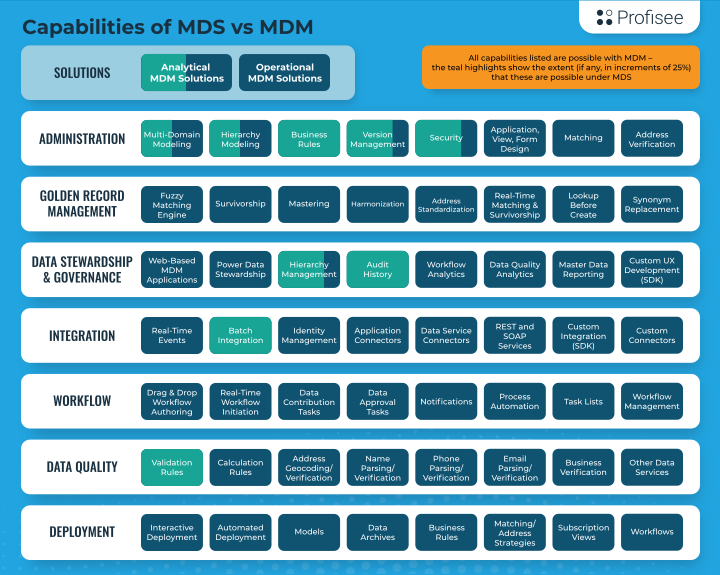
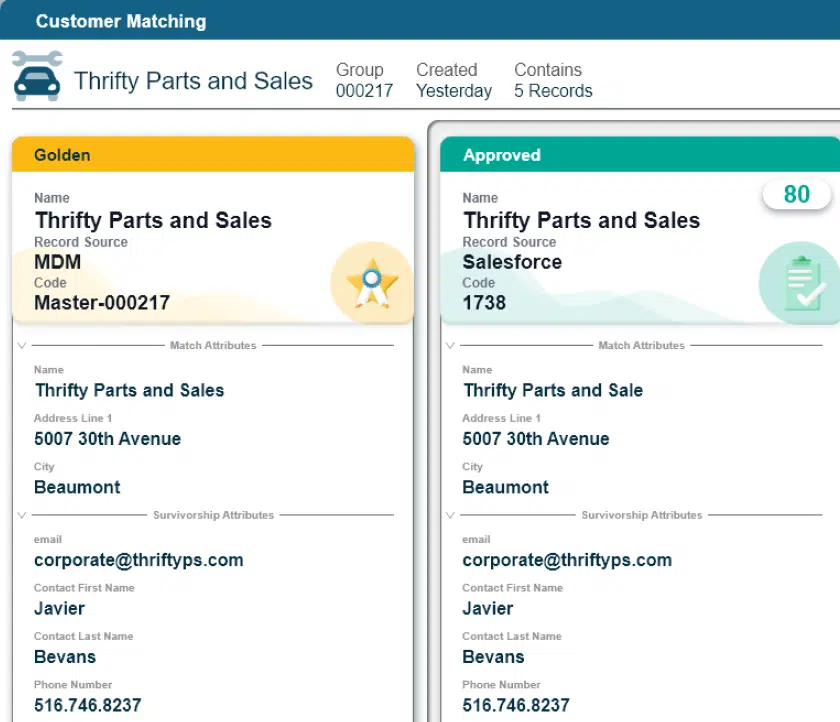
- Expanded MDM capabilities: Profisee unlocks strategic functionalities such as matching, merging, golden record management, enterprise workflows and data governance — all capabilities that MDS users couldn’t access before. Profisee is also deeply embedded in the Microsoft ecosystem, helping customers get the most of their investments in Azure and Fabric.
- Cloud-ready architecture: Profisee uses Kubernetes to offer a fully containerized MDM solution for deployment on Azure, on-premises or any other cloud. This flexibility helps organizations scale their data management solutions based on their unique needs.

Empowering Business Operations with Profisee
Beyond making it easy to migrate to Profisee from MDS, Profisee also enables data practitioners to work efficiently, freeing organizations from the limitations of legacy systems. This is achieved through Profisee’s FastApp portal, which caters to everyday operations for business users.
Beyond data practitioners and stewards, Profisee empowers business users to own the data they work with day-in and day-out. The platform provides a central repository to collect all the tribal knowledge of your business into one place, letting you easily model and understand entity relationships.
With domain-specific FastApps, businesses can tailor Profisee to meet their unique needs. For example, instead of a generic business partner app, organizations can create dedicated apps for onboarding, servicing or deduplication tasks.
Simplified Stewardship Operations & Workflow Automation
Profisee also excels in stewardship operations, providing a robust framework for tasks like approval workflows, record tracking and maintenance.
The workflow engine can handle two-factor approval, parallel approvals, and attribute-level processes. Whatever you need to do, you can do it within the Profisee workflow process. The platform further supports tracking record histories, making it easier for users to audit changes and maintain compliance.
Migration: A Smooth Path Forward
Our mission at Profisee is to make MDM easy. And we’re especially proud of how easy we make it to migrate from MDS to Profisee.
Because Profisee is built off the framework of Master Data Services, all the concepts of entities and attributes — even data quality rules and basic data types — are one-to-one for what you’re used to in MDS.
This ensures MDS users can transition with minimal disruption, leveraging the familiar features they know while enjoying expanded capabilities.
Building Relationships and Future-Ready Infrastructure
MDS customers migrating to Profisee can also rest assured that Profisee is deeply integrated and aligned with Microsoft Fabric and the broader Azure ecosystem. Profisee is available as a native workload in Fabric and was a launch partner for Microsoft Fabric. The Profisee platform supports advanced integrations with services like Azure, making it the ideal choice for organizations using Microsoft’s tech ecosystem.
With Microsoft’s SQL Server 2025 announcement, the company has drawn a line in the sand. If your business relies on MDS, it’s time to find an alternative before it’s too late, and Profisee makes that easier than any other MDM vendor on the market.
Transform Your Data Management Strategy with Profisee
Businesses looking to migrate from Master Data Services can truly transform their data management strategies with Profisee. With a robust migration utility, flexible new capabilities and cloud-native architecture, Profisee is the logical next step for organizations moving on from MDS.
Microsoft’s retirement of MDS isn’t a loss — it’s an opportunity. It’s a chance to step into a modern architecture that aligns with Fabric, Purview, Power BI, ADF, and the next generation of AI-driven workloads.
If you’re looking for the easiest path forward from legacy MDS to cloud-native MDM, Profisee is the right choice. Don’t fall behind on master data management once you update to SQL Server 2025. Start planning your migration today to ensure your data management infrastructure is ready for the future.
FAQ: Questions from the Event
Where did Microsoft announce that MDS is being removed from SQL Server 2025?
Microsoft has formally stated that “Master Data Services (MDS) is removed in SQL Server 2025” on its documentation site. SQL Server 2022 will continue receiving mainstream support through 2028.
Can you share more details on the Profisee MDS Migration Utility (MMU)?
Yes — here is our full MMU datasheet.
During the session, Tyler explained that the MMU automatically migrates entities, attributes, hierarchies, relationships, users/groups and data (excluding data-quality rules). The MMU is included for free in every Profisee subscription.
Where can I get more information on migrating from MDS to full-featured MDM?
Access Profisee’s full MDS resource hub with more on Profisee’s and Microsoft’s shared history, details on the MDS end-of-life, reference data management best practices and migration options.
Do you have more information on Tyler’s MDS book?
Yes, here is an adaption of the book — with the caveat we mentioned during the event: Tyler’s book refers to older versions of MDS and shouldn’t be used as a forward-looking reference. The full text is available for purchase as well.
Does Profisee support full CRUD operations in the UI?
Yes. Profisee’s FastApp UI allows business users to create, update, and delete records based on role-based security — a major improvement over the MDS Excel add-in model.
What interfaces does Profisee support for everyday business users?
During the webinar, we highlighted Profisee’s purpose-built FastApp experiences that allow business users can easily design and configure role- and task-based views to tailor their workspace for their unique workflow.
Can Profisee ingest HL7 ADT messages?
Yes. Profisee regularly masters data that originates in HL7 ADT feeds, which is common in healthcare MDM. While Profisee is not an HL7 interface engine, it ingests the normalized data your integration layer (such as Mirth, Cloverleaf, Rhapsody, or your EHR) produces from ADT messages. From there, Profisee applies matching, survivorship, stewardship workflows, and golden record creation to deliver trusted patient, provider, or location data.
If you have a specific HL7 or clinical integration pattern in mind, speak with a Profisee specialist to walk through your use case.
Can clustering rules and survivorship logic be customized?
Absolutely. Tyler emphasized that matching, survivorship, standardization, and rule-based scoring are all configurable based on your business rules and can vary by domain.
Is Profisee an operational MDM, analytical MDM, or both?
Both. The platform supports all mainstream implementation styles across both analytical and operational deployments. Profisee can remediate data quality issues directly at source, publishing golden records and reference data directly to Microsoft Fabric, Synapse, Databricks or downstream analytics systems.
Can we model complex hierarchies in Profisee?
Yes. Profisee supports complex hierarchies including parent-child relationships, recursive relationships and many-to-many relationships.
How long does a typical MDS migration take?
Most migrations run between 4-12 weeks, depending on:
- Number of domains
- Stewardship requirements
- Data quality rules
- Workflow complexity
Profisee deployments are intentionally fast — many customers achieve value in 90 days.

Benjamin Bourgeois
Ben Bourgeois is the Head of Product and Customer Marketing at Profisee, where he leads the strategy for market positioning, messaging and go-to-market execution. He oversees a team of senior product marketing leaders responsible for competitive intelligence, analyst relations, sales enablement and product launches. He has experience managing teams across the B2B SaaS, healthcare, global energy and manufacturing industries.