








































- What Is Machine Learning in Master Data Management?
- The Role of Master Data Management in Machine Learning
- Benefits of Using Machine Learning for Master Data Management
- AI MDM vs. Traditional MDM: Key Differences
- Machine Learning Use Cases in Master Data Management
- Challenges in AI and MDM Integration
- 5 Best Practices for Implementing Machine Learning in Master Data Management
- Leverage Master Data Management Machine Learning with Profisee
Key Takeaways
Machine learning and master data management complement each other. High-quality master data improves ML accuracy, while ML automates MDM tasks, reducing stewardship effort.
Machine learning in master data management helps data matching, merging, classification, anomaly detection and relationship discovery.
An AI-powered MDM platform like Profisee operationalizes machine learning in master data management, continuously learning from steward actions.
Updated on January 5, 2026
Master data management (MDM) and machine learning (ML) are both data-intensive technologies that enhance and enable each other. MDM improves the accuracy and reliability of the data feeding machine learning models by ensuring consistent, high-quality master data.
Conversely, machine learning automates MDM, reducing the burden on administrators and data stewards. In this blog, we’ll help you understand how you can leverage machine learning and master data management to create reliable, trustworthy data that drives positive business outcomes.
What Is Machine Learning in Master Data Management?
Machine learning in master data management refers to using algorithms within an MDM tool to support core functions like matching, merging, classifying and detecting anomalies in your master data.
ML algorithms analyze historical and incoming data, complementing traditional rule-based MDM processes. The machine learning technology handles complex or large-scale data relationships that are difficult to manage manually, allowing MDM tools to continuously refine data quality and consistency as new information is added.
The Role of Master Data Management in Machine Learning
Machine learning and artificial intelligence applications are powerful additions to an analyst’s arsenal, allowing inferences to be drawn from large datasets with more speed and accuracy than is possible with only human analysts. But ML needs MDM because:
Machine Learning Is Only as Good as Its Data
Machine learning relies on good data quality. If “normal” data management is a garbage-in, garbage-out proposition, then data management for machine learning/AI is garbage-in, garbage-out on steroids. If the incoming data is inconsistent or incomplete, training will produce inaccurate models.
Data Scientists Spend Too Much Time on Data Prep
The common solution to the poor data quality problem is increasingly sophisticated “data prep,” which is where data scientists spend most of their time.
While some data prep is necessary, much of it is invested in redundant efforts to mask master data quality issues, rather than focusing on analysis.
MDM Offers a Scalable Solution to the Data Quality Problem
The better and more scalable solution is to create a managed set of high-quality, trusted master data as a cornerstone to machine learning. By mastering critical data domain-by-domain, inconsistent, missing and duplicated data can be systematically eliminated, leaving data that is the ideal foundation for ML and AI applications.
Read more: Master Data Management (MDM) Best Practices
Benefits of Using Machine Learning for Master Data Management
As much as MDM can assist machine learning, machine learning can also assist MDM to simplify administration and reduce the burden on data stewards. Here’s how using machine learning for master data management helps.
Data Matching
Data matching is one of the most critical capabilities of an MDM solution. Most modern MDM tools use sophisticated machine learning techniques to intelligently match data between and across systems.
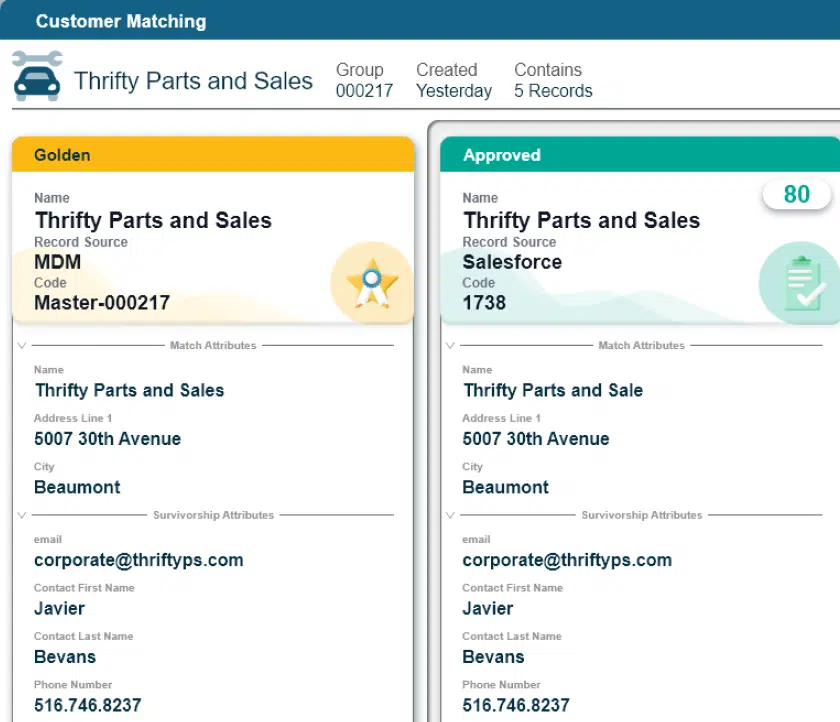
For example, Profisee’s data matching solution is built on a proprietary machine learning matching engine, using a sophisticated similarity calculation for data matching to efficiently process large sets of data.
This not only helps data practitioners work more efficiently, but it also allows data stewards to provide much-needed human oversight. To that end, ML-generated matching results in Profisee provide an explanation, and the platform’s ML algorithm learns from data stewards’ actions to improve matching results over time.
Read more: Build AI-Ready Data with Profisee MDM
Data Stewardship
Machine learning can be used to actively assist data stewards in resolving data issues by “learning” from previous manual corrections and suggesting future corrections, thus saving time and effort from human experts.
And of course, the faster and more effective the data stewardship, the more data and domains can be mastered, and the better the overall data available to drive business intelligence, operations, and, of course, ML-based predictive analytics.
Read more: Fast track AI, ML and IoT Initiatives with Master Data Management
Uncovering Hidden Data
Profisee’s AI Assistant can scan enterprise data to detect previously unrecognized entities, attributes and patterns. It automatically flags records that fall outside known data structures, helping stewards ensure that all relevant master data is identified, cataloged and incorporated. Stewards can also use the Profisee AI Assistant to take unstructured data and structure it to pair it to the right entities.
Data Lineage
Implementing master data management using machine learning tracks how data flows through multiple systems, including transformations, merges and splits. This automated lineage mapping allows stewards and analysts to quickly understand dependencies, audit processes and troubleshoot inconsistencies without manually tracing complex pipelines.
Data Modeling
ML supports data modeling as it analyzes relationships and patterns in master data to suggest or refine data models. It identifies dependencies and hierarchies between entities like customers, products and suppliers, for more consistent and scalable data structures across systems.
Acquisition and Categorization
ML classifies incoming records according to predefined categories and recommends labels for uncategorized or ambiguous data. The automated classification speeds up data onboarding, reduces misclassification and ensures new data aligns with the existing golden records.
Data Quality
ML continuously monitors master data for anomalies, missing values and inconsistencies. By flagging potential errors and, in some cases, automatically correcting them, ML ensures high-quality, trusted data that can be confidently used for reporting, analytics and operational processes.
Data Governance
ML enforces data governance rules by detecting violations and recommending corrective actions. By continuously monitoring data for compliance with internal standards and external regulations, ML reduces risk and aligns stewardship actions with policies.
AI MDM vs. Traditional MDM: Key Differences
AI-powered MDM differs from traditional MDM in how it manages, maintains and improves master data. Traditional MDM relies on manual rules, predefined workflows and human intervention to enforce data quality. On the other hand, AI MDM uses machine learning to automate matching, classification, anomaly detection and relationship discovery.
| MDM Feature | Traditional MDM | AI-Powered MDM |
|---|---|---|
| Automation | Relies on manual rules and workflows | Uses ML to automate matching, classification and anomaly detection |
| Adaptability | Requires manual updates to rules and corrections | Learns from new data and stewardship actions, adapting automatically |
| Scalability | Limited by manual processes and static rules | Handles large, complex datasets efficiently with ML algorithms |
| Data Accuracy | Enforces consistency based on static rules; may miss duplicates or anomalies | Detects subtle variations and patterns, improving overall data quality |
| Insights | Primarily supports operational consistency | Identifies relationships, trends and actionable insights for analytics |
| Stewardship Efficiency | Data stewards spend significant time on repetitive tasks | ML suggests corrections and prioritizes issues, reducing manual effort |
Machine Learning Use Cases in Master Data Management
Machine learning approaches can improve outcomes in a wide variety of situations, such as:
- Personalized e-commerce: Boost loyalty and engagement with customized interactions based on previous purchases.
- Anti-money laundering (AML) compliance: Detect anomalies in spending patterns and alert to possible fraudulent or illegal activity.
- Healthcare outcomes: Determine which patients are more likely to develop complications based on medical records.
- Supply chain MDM optimization: Identify patterns in demand, detect anomalies in shipments and predict potential disruptions.
- Cross-sell and up-sell: Analyze product master data and customer interactions to get complementary product recommendations, optimize catalog structure and identify gaps or redundancies in offerings.
Challenges in AI and MDM Integration
Data teams often struggle with inconsistent or incomplete datasets, while stewards worry that AI recommendations might introduce new errors rather than solve existing ones. Understanding the following challenges of implementing master data management using machine learning will help you plan for smoother integration:
- Lack of labeled data: ML models require quality training data to function accurately. Many organizations lack sufficient labeled or standardized data, especially for complex data domains.
- Performance and scalability: AI MDM needs to process large volumes of master data across multiple sources in real time. High data volumes, complex relationships and frequent updates can create performance bottlenecks if models and data infrastructure aren’t designed for scale.
- Explainability: Data stewards and business users need to trust ML-driven recommendations. If models act like a “black box,” it’s hard to validate matches, correct errors or justify automated decisions.
- Change management: Introducing AI into MDM requires team training on new workflows and stewardship responsibilities. Existing MDM implementations need adjustments to integrate ML capabilities effectively.
5 Best Practices for Implementing Machine Learning in Master Data Management
Automating master data management requires careful planning to get the models to deliver accurate, trusted results. Follow these five best practices to maximize the value of machine learning in master data management:
1. Start with High-Quality Master Data
AI models are only as good as the data they learn from. Begin by consolidating, cleansing and standardizing critical master data domains, like the vendor master file, so that ML algorithms have a reliable foundation.
2. Use Incremental and Iterative Learning
Deploy ML models gradually and allow them to learn incrementally from new data and stewardship actions. Iterative learning ensures that AI recommendations improve over time while minimizing risk from initial errors.
3. Align AI with MDM Workflows
Integrate AI into existing stewardship and governance processes rather than replacing them entirely. Ensure that model outputs are visible, actionable and easy for stewards to validate and act upon.
4. Monitor and Measure Performance
Track the accuracy of AI-driven recommendations, match rates and data quality improvements. Use these metrics to refine models, adjust thresholds and validate that AI is delivering measurable benefits.
5. Focus on Key Use Cases First
Start AI implementation with high-impact domains or data challenges, such as creating a customer 360 or product catalog management. Having early success will build momentum and support broader adoption.
Leverage Master Data Management Machine Learning with Profisee
To fully realize the benefits of machine learning master data management, you need to select a platform that can keep pace with evolving technologies. The MDM tool should operationalize the ML principles to support intelligent, scalable data management.
Profisee’s MDM platform integrates machine learning directly into your MDM workflows, continuously learning from steward actions to maintain high-quality data at scale. The platform’s ML-assisted matching enables high performance and accuracy.
To see how Profisee can help you get ahead with machine learning master data management, request a demo today.

Forrest Brown
Forrest Brown is the Content Marketing Manager at Profisee and has been writing about B2B tech for eight years, spanning software categories like project management, enterprise resource planning (ERP) and now master data management (MDM). When he's not at work, Forrest enjoys playing music, writing and exploring the Atlanta food scene.