
























- What Is Financial Data Quality Management?
- Importance of Data Quality in Financial Services
- What Are the 5 Financial Data Quality Dimensions?
- Key Components and Practices of Financial Data Quality Management
- 8 Challenges of Data Management in Financial Services
- How to Build a Financial Data Quality Management Program
- Practical Use Cases of Financial Data Quality Management
- 7 Strategies to Sustain High-Quality Financial Data
- Advance Financial Data Quality Initiatives with Profisee
- Frequently Asked Questions
Key Takeaways
High quality data is data that aligns with the organization’s defined data standards and governance policies and can be reliably used for reporting, analytics and regulatory purposes.
Obtaining high-quality data is an ongoing, iterative process that requires clear goals and analysis.
Companies with quality data management programs manage compliance and fraud risks while gaining a more complete customer view suited to increase share of wallet.
Data quality management initiatives that automate data cleansing, validation, governance and ingestion with a robust MDM solution like Profisee are better positioned to sustain data quality management success.
IT and business departments across financial services industries have seen a sharp increase in compliance-related tasks just to stay in business. According to the Bank Policy Institute, the compliance portion of bank IT budgets grew from 9.6% in 2016 to 13.4% in 2023 — a growth of 40%. Much of that budget increase is due to personnel and labor hours devoted to data gathering and parsing for audits. To stay competitive and lower regulatory risk, financial services companies must pursue quality data across the business through financial data quality management.
By organizing, standardizing and governing financial data so it’s consistently audit-ready, financial services companies can reduce compliance effort while improving reporting and analytics. In this context, mastering data means applying defined data quality standards, governance rules and controls so that critical financial data is accurate, consistent and trusted across systems. This article provides a practical framework for financial data quality management in banking, asset management and financial services, with a focus on making governed, high-quality data usable for compliance, reporting and decision making.
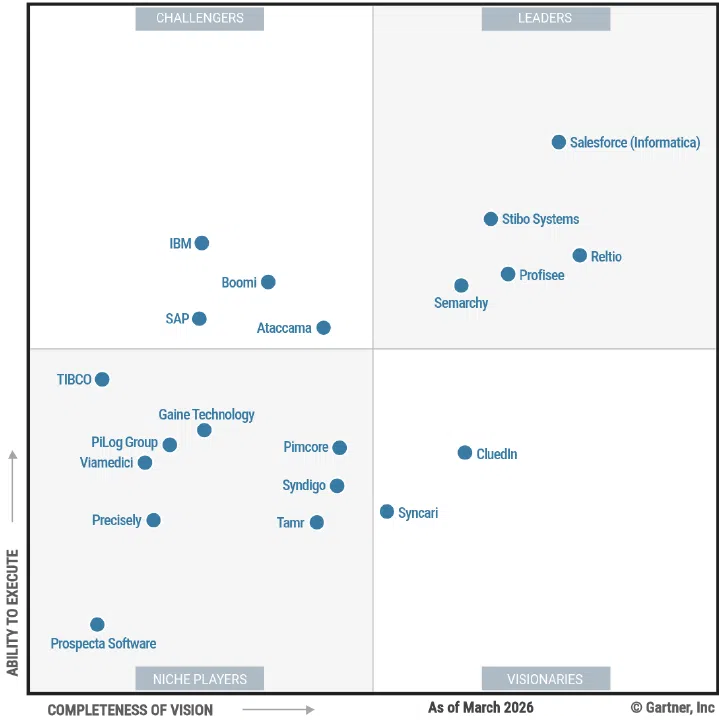
Profisee Named a Leader in the 2026 Gartner® Magic Quadrant™ for Master Data Management Solutions
What Is Financial Data Quality Management?
Financial data quality management (FDQM) encompasses the processes, standards and governance required to ensure financial data is audit-ready, regulatory-compliant and consistently reliable across the enterprise. Effective FDQM ensures financial data can support regulatory reporting, audits, financial close and risk management with confidence. Without FDQM, organizations face reconciliation effort, higher compliance risk and reduced trust in financial reporting and forecasts.
Effective FDQM prevents errors driven by inconsistent data definitions, metadata gaps and poor data handling, all of which compromise reporting and decision-making. High quality data can be defined as:
- Data that is fit for its intended use or purpose
- Data that correctly represents the real-world construct it describes
FDQM ensures data is accurate, complete and trustworthy. The impact of bad data shows up in financial statements, audit reports, regulatory compliance and enterprise financial forecasts, as inconsistencies or errors in financial data reduces the reliability and usefulness of that data.
Importance of Data Quality in Financial Services
Data quality in financial services industries ensures the accuracy of reporting, provides a 360-degree view of the customer and improves efficiencies. These all contribute to the bottom line and improve finance quality outcomes including revenue.
Major benefits of a good data quality process for financial services include:
- Regulatory compliance and decreased audit expenditures for federal and regional regulations including AML, KYC, GDPR, DORA and SOX.
- Operational efficiency throughout the organization by reducing reconciliation errors, manual error correction and validation and speeding up time to financial close.
- Risk management with a usable data view that helps detect credit risk, aids in fraud prevention and promotes audit readiness.
- Enabling modern data infrastructure for financial services with clean data as the foundation for AI and advanced analytics.
These benefits improve outcomes for customers and financial services institutions, allowing for increased time working on the improvements that matter and less time spent validating data across systems.
What Are the 5 Financial Data Quality Dimensions?
These five dimensions assess whether financial data is of a usable quality. Assessing your financial data on these dimensions will help you understand what types of governance and quality processes are necessary.
1. Data Accuracy
Accurate data aligns with real-world values or verifiable sources. A consistent practice of checks that compare data against third-party sources and business use cases will help verify accuracy. Automate data accuracy by implementing validation rules, workflows and checks that compare data with its source material and ensure consistency between entities and attributes.
2. Data Consistency
Financial services organizations need consistent data across systems to get a true view of customers and understand share of household. For example, location data for international financial services companies may differ in company systems due to regional address formatting. But implementing standardized formats, validation checks and third-party tools like Dun & Bradstreet can reduce confusion.
3. Data Timeliness
Timeliness refers to whether data is available when needed, which goes beyond the time required to fetch data. Timely data will have the most up-to-date information possible, preferably real-time. Data monitoring tools that can alert you to delays and setting regular data refresh intervals can ensure fresh, quality data.
4. Data Completeness
Some data domains like location or contact information rarely experience gaps in data, but maintaining quality product data without a data quality solution is difficult due to the variety of criteria. Establishing collection standards and automating validation checks can help maintain data completeness.
5. Data Relevance and Governance
Maintain data quality by enacting strict relevance and governance standards. Some financial regulations require strict data governance, like AML (Anti-Money Laundering), which requires complete and accurate customer data to identify fraud risks. Ensuring that the organization only stores data necessary to its needs and maintains strict control over that data can keep financial services businesses compliant while improving efficiency.
Key Components and Practices of Financial Data Quality Management
To obtain data quality across the five dimensions, these practices and components must be established and maintained.
- Data governance: The policies, roles and decision making structures that define what good financial data looks like and how it’s managed across the organization.
- Data quality dimensions: The specific standards (accuracy, completeness, consistency, timeliness and relevance) used to operationalize governance policies and measure whether financial data meets business and regulatory requirements.
- Data validation: Checks that verify the accuracy of data against internal and third-party sources.
- Data cleansing: Consolidation, deduplication, correction and standardization of financial data to ensure consistency and usability
- Standardization and integration: Applying consistent formats, definitions and reference data across systems and integrating cleansed data back into source and downstream applications so all users rely on the same governed data.
- Continuous monitoring: Automated monitoring of data ingestion and changes that flags incorrect or suspicious data inputs or activities.
- Automation and AI/ML: Automation reduces manual labor by data stewards and ensures accurate data ingestion. AI and ML can assist in “fuzzy matching” domain entries and identifying inefficiencies, among other uses for analytics and forecasting.
- Data lineage and auditability: The metadata associated with data that provides it context and tracks changes, which is necessary for regulatory compliance.
8 Challenges of Data Management in Financial Services
Financial services have heightened challenges in data management compared with other industries because of the special mix of regulatory oversight, need for real-time data and sheer volume of data produced every day. These circumstances create complexity that must be addressed in pursuit of usable, reliable data.
1. Disparate Banking and Trading Platforms Create Customer and Account Data Silos
Both financial services organizations and individual clients may use several different banking and trading platforms that may not communicate with one another and process and store data in unique formats. Accessing data from across the organization’s applications and centralizing it can provide deeper insights into share of wallet and sales opportunities.
2. Data Format Variety Complicates Integration and Standardization
When the organization is able to integrate data from across the enterprise through direct integrations or API connections, this data must be standardized, corrected and deduplicated. The processes of data cleansing and normalization reduces confusion between customer records, for example, which contributes to a 360-view of the interactions with a customer account.
3. High Transaction Volumes and Diverse Data Formats Overwhelm Reconciliation Efforts
High transaction volumes on their own could quickly overwhelm manual reconciliation efforts, making real-time or timely reporting and insights difficult. When that raw transaction data requires manual transformation to parse, reconciliation is near impossible.
4. Constantly Evolving Finance Regulations Drive Compliance Complexity
Finance regulations need auditable, reliable data records, reference data and lineage tracking — advanced meta data tools that cost hundreds of hours in manual spreadsheet work that should be automated to support complete and accurate records.
5. Manual Journal Entry and Ledger Reconciliation Slow Financial Close
Financial services companies that manually enter transaction or ledger data are at a competitive disadvantage to their industry peers that automate journal and ledger accounting. Slower financial closes have a ripple effect that in turn slows reactions to changing business needs and market forces.
6. Unclear Ownership of Customer and Counterparty Data Weakens Governance
Without clear data ownership of customer and partner data, the standards that define data quality quickly begin to bend and break. Naming individuals as data owners and data stewards who define and enforce governance policies keeps everyone honest by upholding standards or coming to consensus when policies need to change.
7. Mergers and Acquisitions Create Persistent Data Silos
Mergers and acquisitions introduce overlapping customer, account and product data from disparate systems, often with incompatible standards and governance models. Without a structured approach to data quality and master data management, M&A activity significantly increases reconciliation effort and compliance risk.
8. Variability in Global and Regional Regulatory Environments Increases Oversight Complexity
Large and mid-sized financial institutions must comply with multiple regulatory frameworks across regions, each with distinct reporting and data requirements. Even within the United States, state-level regulatory variation is increasing. This variability drives the need for centralized data governance, consistent quality controls and transparent data lineage to support compliance across jurisdictions.
How to Build a Financial Data Quality Management Program
Managing data quality requires an ongoing program of planning, implementation, analysis and iteration. Remember that you’re setting the foundation for long-term data reliability so build your plan to support business priorities and long-term goals.
Step 1: Assess the Current State of Financial Data Quality
Review all available financial data within the organization, including profile customer, account and transaction data to identify gaps in completeness, accuracy and timeliness. Then benchmark the state of the current data quality against regulatory requirements including AML,KYC, SOX, DORA and GDPR.
After regulatory compliance, look out for data quality issues like those listed in the table.
| Data Quality Problems | Impact on Your Organization |
|---|---|
| Inaccurate records | Erodes customer trust and slows business processes to correct |
| Duplicate records | May allow for duplicate product sales or prevent customer 360 |
| Incomplete records | Missing records may result in fraud or poor business decisions |
| Irrelevant records | Confuses employees and slows processes with unnecessary information |
| Outdated records | Reconciliation and complete customer view slowed or inaccessible |
| Varying data formats | Data from one application may not appear because the format is not recognized |
| Siloed records | Diminishes a true customer 360 view and personalization |
| Inconsistent records | Records from different countries are listed in local currency rather than standard |
Step 2: Define Data Governance Roles and Regulatory Responsibilities
For each financial data domain (customer, product, location, etc.), assign data stewards and owners. Data owners will be ultimately responsible for oversight of their assigned domain. Data stewards work with the owners and business users to uphold policies. Once these roles are assigned, establish policies that ensure compliance reporting and audit readiness across the enterprise.
Step 3: Standardize and Consolidate Data across Financial Systems
Decide upon the most useful data formats and harmonize those across ERP, CRM, core banking and trading platforms and document your data quality rules. Include all vital record types for these domains and consider excluding irrelevant data. Once data is standardized, use automated data cleansing tools to bring all new data into alignment with these standards and use data integrations to push cleansed data back to source applications. When done correctly, data consolidation will eliminate silos between front-, middle- and back-office operations.
Step 4: Create Golden Records with Master Data Management (MDM)
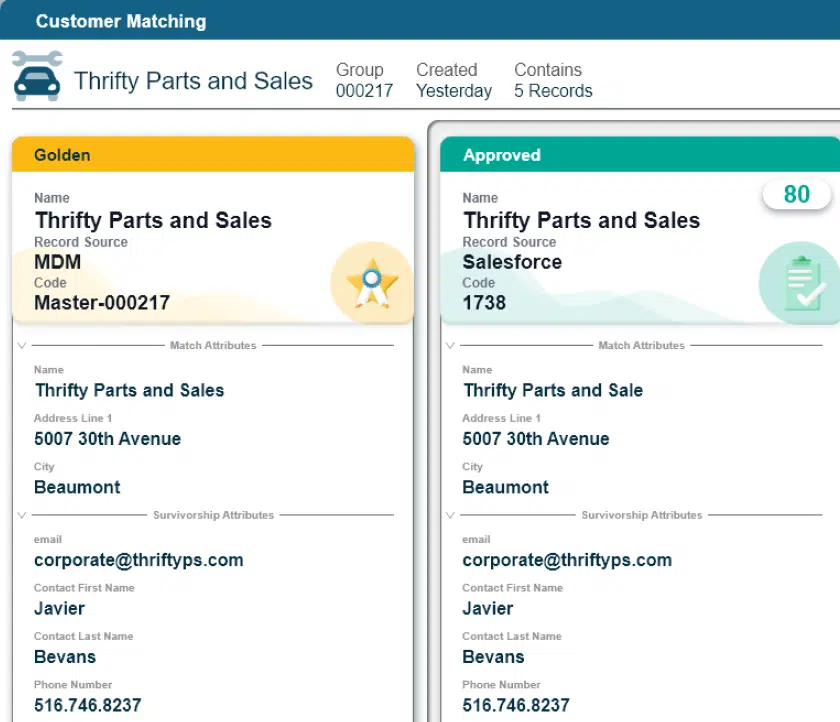
Consolidated and standardized data that rarely changes can become golden record data that’s stored in a master data management (MDM) solution. Resolve duplicate client and account records and use an MDM with automated data cleansing capabilities to speed the process. Using an MDM to automate your data governance ensures a single source of truth for customer identification and transaction history.
Step 5: Automate Financial Data Validation and Reconciliation
Next, deploy rule-based validation to automate data validation when the information is entered into the source systems. For example, you can set alerts or required fields to prevent missing KYC details or run account searches to flag invalid account numbers. Extend your automation to reconciliation across ledgers and trading systems to accelerate financial close.
Step 6: Build Financial Data Lineage and Transparent Audit Trails
In order to comply with regulations and provide deeper insights into customer behavior, map the flow of financial data from source to regulatory report. When you use logs and reference data to store vital customer and transaction data you’re in a better position to detect fraud automatically and audit requests are no longer a hassle. These tools provide full traceability for internal and external audits.
Step 7: Detect Anomalies with AI-Driven Financial Monitoring
With context from meta data and reference logs, you can use machine learning to flag unusual transaction patterns, duplicate payments, or reconciliation mismatches. Standardized and structured data is more easily monitored, as it can be used to train AI models to look for outliers. When planning your AI-driven monitoring solution, prioritize issues that pose compliance or financial risk, as these projects are universal and reduce corporate risk.
Practical Use Cases of Financial Data Quality Management
Financial data quality management initiatives do far more than organize and standardize the data. When data is reliable, it can be used for consistent reporting and forecasting across the organization. When data is usable, it enables collaboration and drives innovation across the enterprise. Because it touches the very data that businesses run on, FDQM use cases show how data management addresses data quality issues across compliance, risk and performance.
Investment Analysis and Portfolio Modeling
According to PWC, investment companies can increase their return on investment by 70% when they grow their share of wallet for existing customers. Data quality management through MDM improves customer 360 views, making sure vital information about what products customers have purchased and what opportunities remain. Hancock Whitney Bank used Profisee to improve their customer data, resulting in highly targeted lead generation and unique customer forecasting. With these improvements, they better understand their customers and can more accurately identify and grow opportunities for share of wallet growth.
Risk Assessment, Credit Scoring and Fraud Management
A credit check and a conversation is no longer enough to assess risk and comply with regulations like CECL. Quality customer data with enough depth to build a reliable forecast is required to accurately and completely meet regulatory standards and guard against fraud and risk. Financial services companies that hrough data quality management are better positioned to assess their risk and take action quickly.
Regulatory Compliance and Audit Readiness
Financial services companies need quality data management to adhere to regulations and quickly respond to records audits. Data quality management ensures that logs, metadata and contextual data is in place to clearly understand compliance risk. First Horizon Bank was able to organize customer data and establish policies that removed customer data entry errors through master data management that produced reliable customer data that creates advanced customer profiles and is ready for audit.
7 Strategies to Sustain High-Quality Financial Data
High-quality financial data needs to be achieved and then sustained to continue to reap the benefits of quality data initiatives. These strategies give stability to quality initiatives that support business operations across the organization.
1. Build a Culture of Data Quality Across the Organization
Data culture is built through consistent reinforcement that quality data is everyone’s responsibility and everyone benefits from it. Back up cultural messages with accountability and automation that keep quality data front-of-mind.
2. Promote Cross-Departmental Collaboration Between Finance and IT
As enterprise data quality is everyone’s job, IT and finance teams must collaborate to identify the data domains that are the most important to focus on, ensure data quality with governance policies and analyze the effectiveness of programs. Executive-supported collaboration with high visibility and published outcomes is more likely to succeed than unsupported efforts.
3. Tie Data Quality Metrics to Business and Compliance Outcomes
The success of data quality initiatives depends on organizational support, which you’re more likely to get by tying the data project to larger business or compliance needs. Identify and track metrics that support business needs to show the data quality project’s ability to support long-term enterprise success.
4. Invest in Ongoing Training for Data Stewards and Analysts
Data quality management requires ongoing knowledge acquisition and consistent training to keep skills sharp and keep up with the latest advancements in technology. Plan to invest in ongoing training so your data stewards and data analysts continue to lead the industry.
5. Establish Incentives and Accountability for Data Accuracy
Incentives and accountability help support cultural data quality initiatives in that they give an immediate reason for accuracy instead of relying on vague goals like operational efficiency or regulatory compliance. Make incentives worthwhile for departments to maintain quality.
6. Adopt Continuous Feedback Loops to Improve Data Processes
Plan, communicate, act and analyze loops built into daily and periodic processes help teams understand how their data quality management efforts perform and generate ideas for further improvements.
7. Integrate Data Quality Goals Into Digital Transformation Initiatives
Data is the building block of digital transformation initiatives, and it should be built into the foundation of these initiatives. Set reasonable quality goals with measurable results that contribute to the business digital transformation.
Advance Financial Data Quality Initiatives with Profisee
Master data management supports data quality management initiatives by organizing, centralizing and standardizing master data domains like customer and product information. These domains ground transactional data initiatives with structure and context. Profisee is the go-to platform for financial institutions that need to improve data quality, meet compliance requirements and modernize their data infrastructure.
If you’re ready to move from fragmented systems to a unified, compliant data foundation, request a demo to see how Profisee can support your financial data quality management strategy.
Included here, but I’m really not sure that the insertion of Azure in this conversation makes sense, as the rest of the article is agnostic.
Frequently Asked Questions
The top operational data quality problems in finance include:
- Inaccurate records
- Incomplete records
- Missing records
- Irrelevant records
- Outdated records
- Varying data formats
- Siloed records
- Inconsistent record formats
Tools to support financial data quality management range from full-service data management solutions like Profisee MDM that combines nearly all possible individual software tasks in the data quality management lifecycle, or individual tools that support:
- Master data management
- Data integration
- Data cleansing and validation
- Data governance
- Data observability and anomaly detection
- Records and lineage tracking
Some tools like Profisee MDM include tools to automate and build workflows that remove much manual labor from data quality management processes. Whether you choose individual tools or a larger data quality management platform will depend on your financial service company’s individual needs and goals.
Accuracy and reliability in financial data comes from clearly defined policies and processes that support data uniqueness, completeness and accuracy. Using a tool like Profisee MDM helps you consolidate records from across the organization into reliable golden records and then supports that work with automated systems that maintain the accuracy and reliability of newly entered data.
MDM supports financial compliance by organizing and standardizing records and building audit-ready lineage tracking and reference data that clarifies data context and reduces risks.
Nearly all financial services-focused regulatory requirements impact finance data management for financial services, including but not limited to:
- SOX
- GDPR
- Dodd-Frank Act
- Gramm-Leach Bliley Act
- Basel III
- BCBS 239
- MiFID II
Tamara Scott
Tamara Scott is a writer, editor and content strategist with over a decade of experience located in Nashville, TN. Tamara holds a Master's in English from Belmont University, formerly served as Director of Content for TechRepublic, and her work has appeared in ServerWatch and EPI-USE.com, among others. When she's not crafting SEO-informed and conversion-ready content for SaaS and IT service companies, she's probably at home on her pottery wheel. Connect with her on LinkedIn.