






























Table of Contents
- What Is Master Data Management?
- Why Is Master Data Management Important?
- 9 Master Data Management Benefits
- Why Master Data Management Matters to Your Customers
- The Advantage of Centralized Master Data Management
- How to Maximize ROI with Master Data Management
- Experience the Benefits of MDM with Profisee
Key Takeaways
Companies use more software than ever, meaning the data team has more data sources to consolidate.
The benefits of master data management include higher efficiency, greater compliance and improved positioning for growth — benefits that improve customer experience and the bottom line.
Profisee MDM is built to support enterprise data initiatives with a lower total cost of ownership and faster time to value.
Data-driven companies falter without enterprise-wide reliable data, losing out to competitors that prioritize data quality across the organization. The benefits of master data management pay dividends in operational efficiency, compliance, supply chain effectiveness, customer experience and more.
What Is Master Data Management?
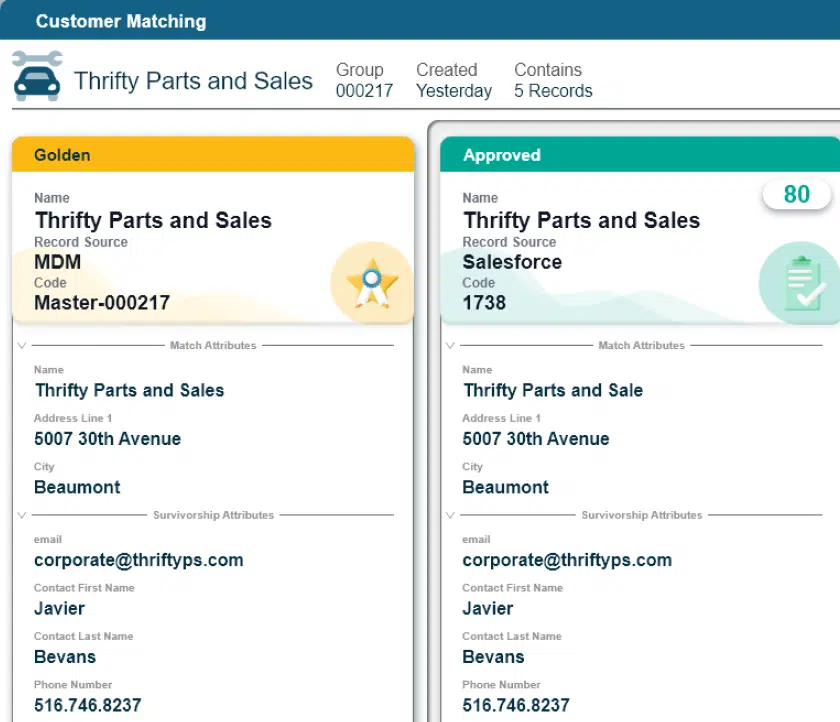
Master Data Management (MDM) is the technology, tools and processes that ensure master data is coordinated across the enterprise. MDM builds a single source of data truth for areas critical to operations, like customer, product, supplier or equipment. When the entire enterprise has reliable and up-to-date versions of this crucial data, it can run more efficiently and effectively.
Why Is Master Data Management Important?
As operations become more reliant on digital systems, master data management matters more than ever because it forms the organizational foundation the entire enterprise runs on. Companies use more software applications than ever, with the typical department using 40-60 apps, according to a survey from Productiv, making the essential data within just a single department difficult to wrangle at best and unreliable as a standard.
Unreliable data causes confusion between departments and apps: when finance departments execute against the Q2 product list but logistics works with the Q3 product list, mistakes will happen. Bad data causes bad decisions from skewed forecasts and misleading analyses. Unreliable data disrupts production and causes operational slowdowns. Poor data organization also leads to compliance risks like fines or shutdowns.
Consistent, trustworthy data across systems minimizes these issues by ensuring that all departments use the same reliable and updated data for key decisions and day-to-day operations.
9 Master Data Management Benefits
Reliable, useful data feels like it could sell itself, but business users and departmental stakeholders will want to hear about tangible benefits they can expect from this new company priority. Align these 9 benefits with key corporate business objectives to build consensus and buy-in.
1. Improved Data Quality and Accuracy
In a recent survey conducted by Profisee and Marketing Strategia, 66% of manufacturers who employ MDM reduced data errors and inconsistencies, the most-reported of all benefits from this group. MDM projects seek to consolidate the different data versions from across the company, positioning it to make better use of that data.
2. Operational Efficiency and Cost Reduction
In the same manufacturing survey, 39% of respondents reported increased operational efficiency and cost reduction as a key motivator for their MDM initiatives. Enterprise MDM takes care of manual tasks like record deduplication and reduces the amount of siloed data, making for more streamlined operations and reducing labor costs related to data upkeep.
3. Stronger Regulatory Compliance
Regulatory compliance is not optional, but struggling to gather reliable data is. In our survey of financial services corporations using enterprise MDM, 20% of leaders report improved compliance as a main driver of their MDM projects. Reliable data across systems, clear audit logs and organized customer information are key to regulatory ease, and MDM delivers. With a solution that automates master data management, regulatory compliance takes less time, freeing data practitioners to focus working on strategic data initiatives.
4. Better Customer Experience and Insights
Clean, reliable customer records that show the complete picture of your relationship can mean the difference between today’s sale and tomorrow’s apology email for a poor experience. Forty percent of financial services organizations adopt MDM to get a 360-view of customer data that allows for more effective cross-sell and loyalty strategies. Trouble growing existing accounts may be one of the signs you need MDM.
5. Scalable, Future-Ready Integrations
Business units chasing the latest innovations and a competitive edge will change software more frequently than any IT team wants. An enterprise MDM platform that’s designed for flexible integrations is always ready for those changes. By connecting data sources with MDM integrations, your teams can quickly swap data sources and populate those sources with existing golden record data for faster and more reliable software upgrades.
6. M&A Readiness
Mergers and acquisitions require change management across both businesses, but MDM reduces stress and time spent on consolidating complex systems like ERP, CRM or PIM. A robust MDM solution and mature golden record management across the organization means a single source of master data ready to combine and coordinate with other new systems. Integrating source software with an MDM (and using the appropriate MDM implementation styles) eases transitions to new software to unify systems across the organization.
7. More Reliable Reporting, Analysis and Forecasting
Within complex organizations with multiple locations, thousands of customers and hundreds of vendors, obtaining reliable reports across departments is a recipe for confusing data and inaccurate analysis. Our survey showed 73% of healthcare providers report improved analytics as a driver for MDM adoption in their organization. That’s because MDM solutions create golden records that allow unified reporting, analysis and forecasting from the same data views across the organization.
8. Improved Supply Chain Visibility
Any supply chain is complex, and for enterprise manufacturing companies, managing master data for key domains like locations, products and suppliers is a distinct competitive advantage. A company that produces 100 products from 50 suppliers across 10 locations and adhering to 5 quality standards would need to track 250,000 potential data relationships. The scope of complexity quickly outgrows manageability from a custom, in-house solution. For large projects, Profisee MDM can be implemented up to 72% quicker than a homegrown solution.
9. Data Stewardship Independent from IT
In addition to operational efficiency and cost savings, implementing an MDM solution can actually free up time for IT. Business users trained in new standards and informed of the tangible benefits of MDM are empowered to manage golden records without IT intervention, which saves time on upkeep and helps retain data quality for the long-term.
Why Master Data Management Matters to Your Customers
Your company has touchpoints with thousands of customers each day, while each of your customers has only a few touchpoints with you every month or quarter. This makes every interaction memorable to your customers. A complete record of the customer’s history with the company provides context that makes the customer’s service, marketing, sales and advertising interactions personalized.
Imagine having a complete record of good and bad customer interactions alongside full visibility into purchases and returns. With defined customer MDM best practices:
- Cross-sell opportunities become easier to pinpoint
- Service is more nuanced and faster
- Customer experience stays the same, no matter the channel
Reliable, unified customer data within an enterprise MDM brings together a complete picture of the customer’s needs over time and how your team can best serve them, which is the true definition of customer personalization.
The Advantage of Centralized Master Data Management
Centralized MDM brings data from across the organization — finance, marketing, operations, product — into one single location to build truth. Fragmented data management allows for different rules and governance contexts for different parts of the organization, changing definitions and what’s counted as important data from department to department.
As Former Gartner Analyst and Profisee CDO Malcom Hawker said in a recent post, “MDM doesn’t create truth; it reconciles it. It builds bridges between siloed systems and disparate business definitions. It allows an enterprise to recognize that sales may define a ‘customer’ differently than finance and then resolves those differences when needed — without demanding that one function change its internal processes.”
Read more in Profisee’s The State of MDM 2025 Report by Malcom Hawker.
The benefits of centralized master data management are clear: central data reconciliation builds a database that is reliable across the organization. When everyone works from one database, control and governance are consistent for every context. Departments can move faster and collaborate with one another better because everyone is looking at the same data.
How to Maximize ROI with Master Data Management
Master data management, if implemented consistently and tied to key business objectives like improved customer experience or increased operational efficiency, can quickly show a return on investment. Even small MDM projects within a centralized MDM solution like Profisee show a 67% lower TCO over three years than in-house DIY data management projects. To replicate this, follow these three MDM best practices and their associated MDM use cases:
1. Align Your MDM Initiative with Key Company Objectives
Tie your MDM project to company-wide objectives that improve the day-to-day work of as many employees and customers as possible. By doing this, you connect the expected outcomes of the data project to tangible results that serve focused business objectives, making the purpose and intended results of the project more concrete for stakeholders.
Aker BP partnered with Profisee, and chose to improve visibility and reliability of inventory across the company to align with the company objective of streamlining operations with AI-assisted applications. Within the first twelve months of the project, Aker BP shipped over 70 data products that the organization can rely on for consistency within their AI tools while also making their data systems ready for the future of MDM.
2. Start With 1 Domain for Accelerated Time-to-Value
Choose one data domain to master first. That domain should have the largest impact across the organization. By focusing on this single domain, you can achieve faster time to value with reduced rework in the initial stages. WSP Global chose customer data to master, and achieved a 29% improvement in their customer data health score in just 13 weeks by consolidating duplicate records across several global locations. A singular domain brought focus to the team and allowed for faster implementation with fewer distractions.
3. Strong Governance for Reporting, Compliance, and Efficiency
Improve your outcomes by backing up centralized data with strong data governance and a master data management framework for the entire organization. Strong governance improves analytics and reporting by ensuring teams start with the same data in all their systems, and it ensures regulatory compliance by default when the governance is built to regulatory standards. Further, business users increase efficiency because data can be found and trusted.
A regional community healthcare company worked with Profisee to master its payer and patient data across its multiple locations, insurance systems and EMR software. By mastering these two data domains, that healthcare provider can now process 12-14 claims per hour, a four-fold increase over previous Python and SQL-based consolidation systems.
Profisee’s robust MDM solution and deep experience can increase your company’s time-to-value over DIY systems while also improving operations and customer experience.
Experience the Benefits of MDM with Profisee
Profisee MDM works for enterprise companies because it simplifies master data management projects and helps you build reliable, usable data. The benefits of cloud-based MDM are clear:
- Improved Data Quality and Accuracy: Profisee helps companies build reliable, centralized data with AI-assisted fuzzy matching and clear data governance.
- Operational Efficiency and Cost Reduction: When everyone works from the same golden record data in Profisee’s adaptive MDM, work efficiency goes up while costs go down.
- Stronger Regulatory Compliance: Reliable golden record data makes reporting easier and audits less painful.
- Better Customer Experience and Insights: Profisee enables a 360-degree view of customers, improving experience and personalization.
- Scalable, Future-Ready Integrations: Profisee is built to grow with your company’s changing software needs and is integration-ready.
- M&A Readiness: Organized and reliable data makes mergers and acquisitions less complicated.
- More Reliable Reporting, Analysis and Forecasting: With Profisee, everyone’s working from the same database and reporting across departments doesn’t conflict or confuse.
- Improved Supply Chain Visibility: Profisee makes supplier, logistics, and customer data reliable and ready for shipments.
- Data Stewardship Independent from IT: With quality data and a little bit of training, the entire organization is empowered to contribute to the reliability of your data.
See how Profisee captures all the major benefits of master data management. Book your demo today.

Tamara Scott
Tamara Scott is a writer, editor and content strategist with over a decade of experience located in Nashville, TN. Tamara holds a Master's in English from Belmont University, formerly served as Director of Content for TechRepublic, and her work has appeared in ServerWatch and EPI-USE.com, among others. When she's not crafting SEO-informed and conversion-ready content for SaaS and IT service companies, she's probably at home on her pottery wheel. Connect with her on LinkedIn.