









































Generative AI can help you improve production schedules and reduce machine downtime. But when you scatter data across different factory systems, many gen AI initiatives underdeliver. This is because inconsistent spreadsheets and siloed ERP data do not provide the that chatbots and other LLM-based agents need to deliver results.
Manufacturers can create AI-ready data for manufacturing by integrating operational technology (OT) and information technology (IT) systems and by automating data cleaning. In this article, we’ll share a six-step plan to turn raw machine data into real business value using master data management (MDM).

Why You Need Manufacturing Data Readiness for AI
It’s important to have AI-ready data in manufacturing because AI models need accurate, unified and organized data to work well. Predictive maintenance, demand forecasting and production optimization all depend on standardized data from enterprise resource planning (ERP), manufacturing execution (MES), product lifecycle management (PLM) and OT systems.
Well-managed data is key to AI success. Without it, manufacturing master data can become fragmented, leading to inconsistent models, duplicate supplier records, mismatched part numbers and disconnected asset histories.
How to Build Manufacturing Data Quality for AI: 6 Steps
To prepare your manufacturing data for AI, follow these six steps to build a strong foundation that gen AI models need to deliver real business value:
Step 1: Map AI Use Cases to the Master Data Domains That Drive Value
Begin by connecting each AI project to the master data it needs. Every AI use case relies on certain types of data. For example:
- Predictive maintenance needs well-managed asset data.
- Supply chain resilience depends on having accurate supplier and location records.
- Inventory optimization requires accurate product and material data to reduce duplicate maintenance, repair and operations (MRO) items.
- Quality control automation works best with consistent product and batch definitions.
- Demand forecasting requires customer and product data that aligns.
Step 2: Establish a Unified Semantic Layer Across OT and IT Systems
A unified semantic layer helps AI understand data the same way across both factory and office systems. This is achieved through master data management, a discipline and tool that consolidates master data from across the enterprise, matches similar records across disparate systems, merges them and standardizes them according to data governance policies to create golden records.
In many plants, tools such as supervisory control and data acquisition (SCADA) and programmable logic controllers (PLCs) are typically separate from IT platforms, including ERP and PLM. As a result, raw machine data often lacks the business context needed for accurate modeling.
Use managed data pipelines to connect these three types of data:
- OT telemetry
- IT cost and product records
- Relevant external data, including supplier inputs
By using MDM to standardize definitions and relationships across these systems, you can connect machine performance to financial and operational results. This way, you turn scattered data into reliable, AI-ready information for manufacturing.
Step 3: Automate Profiling, Deduplication and Golden Record Creation
Manual data cleaning does not scale well. Automated profiling quickly finds inconsistencies across millions of records and deduplication stops AI from counting the same assets, parts or suppliers more than once. Automation helps prevent errors, ensuring manufacturing data quality for AI. Steps include:
- Data profiling: Find missing, invalid or inconsistent values before they cause bigger problems
- Matching and deduplication: Connect records that reference the same physical item across different AI systems using entity resolution software to automate that reconciliation at scale
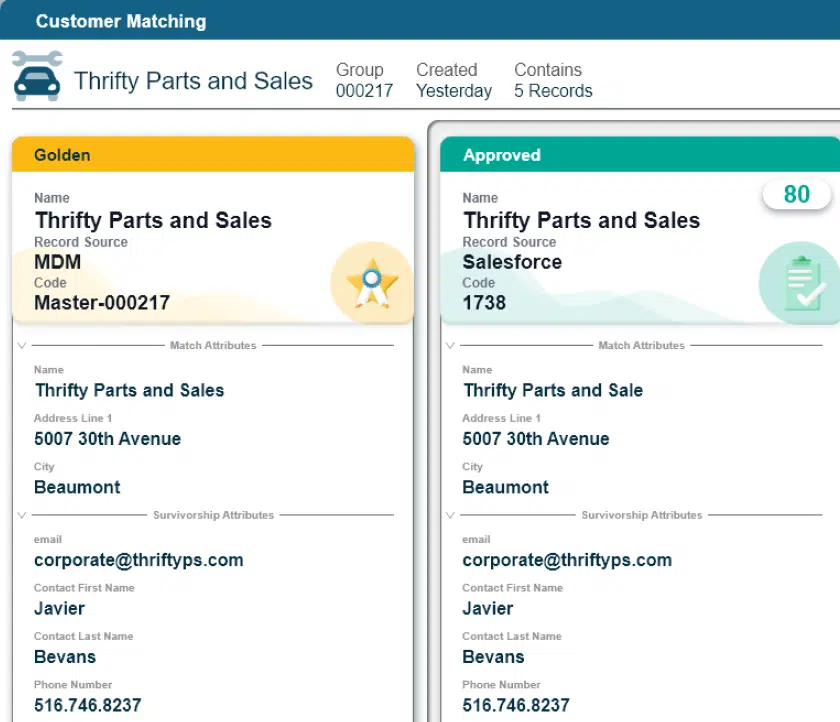
- Survivorship rules: Choose the most accurate details to build a master record
The result is a golden record, which serves as the main source of truth for each item. This record organizes manufacturing data for AI and provides reliable input to machine learning models.
Step 4: Govern Relationships Across Multiple Manufacturing Domains
AI effectiveness depends on governed relationships across domains — not just clean records. Production optimization requires clear links among machines, the parts they produce, the materials they consume, suppliers and locations. Managing these dependencies demands a multidomain approach that goes beyond simple matching to maintain context across the manufacturing lifecycle.
With proper data governance, changes propagate consistently across systems:
- Supplier updates sync with procurement and planning
- Asset-to-product mappings define equipment outputs
- Material hierarchies connect raw inputs to finished goods
Step 5: Enrich OT and Time-Series Data with Business Metadata
Raw sensor data alone does not indicate which product, asset, supplier or cost center it affects. To make this data useful, add master and business metadata so AI models can connect performance signals to cost, risk and quality outcomes. Focus on these key areas:
- Asset metadata: Include details such as equipment age, maintenance history and acquisition cost
- Cost center mapping: Connect production activities directly to their financial impact
- Product specifications: Tie outputs to quality and regulatory standards
- Supplier classifications: Add risk profiles and lead times for each supplier
A master data management (MDM) tool like Profisee can add this metadata to time-series data, making sensor readings ready for AI and connecting them to measurable business results.
Step 6: Sustain AI-Ready Data with Active Governance and Continuous Monitoring
Manufacturing data quality for AI requires continuous control, not a one-time cleanup. Without ongoing oversight, errors accumulate, definitions drift and AI performance declines. Case in point: McKinsey reports that 47% of organizations have experienced negative outcomes from AI, often linked to poor data quality.
To identify and correct issues before they affect models, forecasts or operational decisions, you should implement:
- Data quality dashboards: Monitor completeness, accuracy and consistency across domains.
- Automated alerts: Notify stewards when records fail validation rules or exceed thresholds.
- Audit trails: Track all changes to master data to ensure accountability and traceability.
This governance framework helps to maintain data quality, so AI outputs remain reliable as manufacturing operations scale.
Get AI-Ready Data for Manufacturing with Profisee MDM
When you centralize your manufacturing master data with a single platform, you eliminate fragmentation and silos that can hinder AI projects. With Profisee’s MDM for manufacturers, you get all your needs sustain AI-ready data:
- Data stewardship and governance tools that give manufacturing teams clear ownership and accountability for master data quality
- Cloud-native master data management that supports MDM-as-a-service, platform-as-a-service (PaaS) or on-premises deployment models
- Built-in governance enforcement to apply data standards consistently across asset, product, supplier and customer domains
- Aisey, an AI assistant that helps teams resolve data quality issues faster and at scale across the entire enterprise
Book a demo to see how Profisee empowers manufacturing plants with AI-ready data.