





















Key Takeaways
CDMPs aim to unify core data management disciplines, with master data management serving as a key enabling capability for governance and data quality across the platform.
Gartner predicts fragmented data management markets will continue converging around ecosystem-driven platforms.
Convergence reduces tool sprawl, but specialized disciplines such as master data management still require depth and operational rigor.
As data management converges, MDM is not left behind — it’s a foundational discipline that should be embedded within any mature CDMP strategy.
You’ve probably heard more tech predictions in the last two years than you can count. I know I have. But thankfully for both of us, dear reader, I’m not here to make predictions but to comment on current observable market trends. You can relax.
Last May, Gartner published a report by Sharat Menon, Robert Thanaraj, Ehtisham Zaidi and Adam Ronthal titled “Emerging Tech: Data Management Evolves From Stand-Alone Tools to Converged Platforms” in which the authors commented on the growing trend of what they call “converged data management platforms” (CDMPs). And while they did make some predictions (they are analysts, after all), they spent a good chunk of the report making recommendations on how data leaders should adapt.
You can download a free copy of the report below or read on to learn about some of our takeaways for what this means for data management in general and master data management (MDM) in particular.
What’s a ‘Converged Data Management Platform,’ and How Did We Get Here?
First things first — let’s take a quick ride on the proverbial Wayback Machine and get a little more background on why we now have yet another tech acronym, CDMP.
The software market for data management was historically comprised of standalone, monolithic tools. With the rise of Big Data, we saw an explosion of data management and analytics tools — again, all mostly standalone tools purpose-built for specific, discrete data management functions created to meet the demands of working with large volumes of data and then to make that data usable.
Data teams saw a huge increase in the number of different tools they had to use as part of a modern data stack. To wit:
- Data transformation tools for building data pipelines to integrate or ingest data from source systems to data storage systems
- Data storage systems like NoSQL databases, data lakes and data warehouses to store data captured by source systems like POS, CRM, IoT and ERP
- Data management tools like data quality, data governance and master data management to create a single version of truth for use in analytics and business operations
- Business intelligence tools to create descriptive analytics for data initiatives like product master data management (PMDM) and customer 360
This caused data management tech stacks to sprawl quite a bit. According to Gartner, mid- to large-sized organizations regularly work with 10 or more data management tools. That’s not so bad if you’re concerned about vendor lock-in, but it starts to become a problem when you need to integrate all those systems — especially if you, like many CDOs and data leaders, have been tasked with enabling AI across the enterprise.
In a mature software market like data management, software vendors started doing what companies in every industry do — they started to vertically integrate, usually through mergers and acquisitions that resulted in bigger, platform-style companies or products. Thus, the converged data management platform, or CDMP, was born.
CDMPs try to take a best-of-both-worlds approach to data management software, aiming to consolidate many core data management functions into one tool while also being extensible by supporting integration with more specialized, standalone data management tools. This begs the question, what’s the difference between core and specialized data management functions?
What a CDMP Can Do and What a CDMP Should Do
At a practical level, a converged data management platform is meant to consolidate a range of core data management capabilities that historically required separate tools.
These typically include:
- Data integration and transformation
- Metadata management
- Data governance frameworks
- Data quality monitoring
- Master data management
By bringing these functions together under a shared architecture, a CDMP can reduce redundant tooling, centralize metadata and governance controls and streamline user experience. For organizations struggling with tool sprawl, that consolidation can lower integration overhead and reduce operational friction.
That is what a CDMP can do. What a CDMP should do is slightly more important. A CDMP should:
- Meaningfully reduce technical debt rather than simply shifting it into a larger platform
- Provide consistent governance and metadata controls across domains and environments
- Improve interoperability with third-party systems rather than discourage it
- Automate across functions in a way that makes data integration, quality and governance work together instead of in isolation
- Break down data management silos by treating MDM as a core discipline, not an afterthought, to ensure consistent, authoritative data across domains and systems.
In other words, a CDMP should function as a coordination layer for core data management capabilities, not as a closed ecosystem that attempts to replace every specialized discipline. That distinction becomes especially relevant when we talk about master data management.
Where Does MDM Fit Into a CDMP?
A mature converged data platform should consider MDM as an enabling capability, per Gartner. Shared metadata services, governance frameworks and integration pipelines all contribute to creating consistent, well-managed data. However, master data management is not simply a feature set.
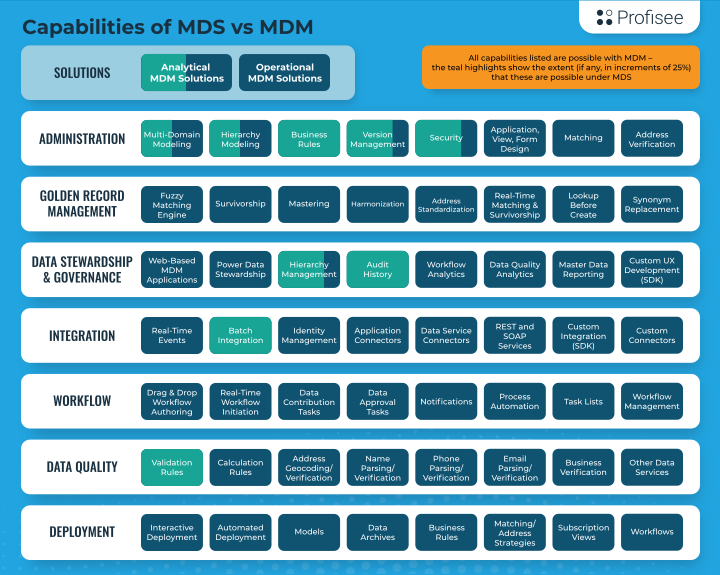
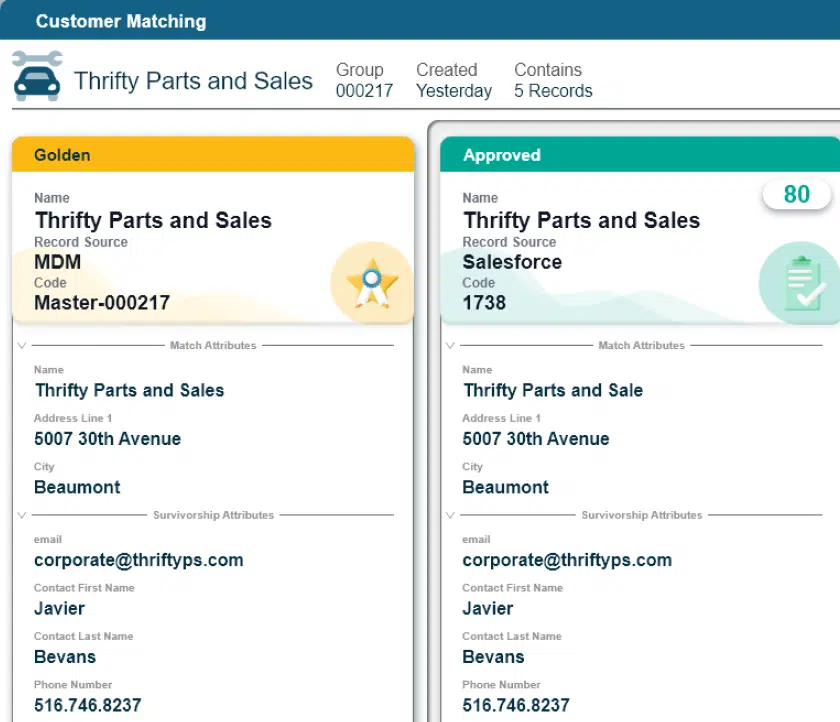
Operational MDM (which, of course, is the MDM function we’re talking about when we talk about AI enablement) involves probabilistic, rules-based matching and survivorship logic, golden record creation across domains, cross-system synchronization, hierarchy management and clearly defined stewardship workflows. It requires defined ownership models and governance accountability. These are not superficial capabilities but operational disciplines that demand configurability and depth.
Critically, a CDMP needs MDM to enforce quality and governance policies at the individual record level. For instance, this would resolve a situation where one system has a customer record for a “John Smith” and another system has a customer record for a “Jon Smith.” Are these systems talking about the same person or two different people? MDM is the function that answers this question by enforcing data governance policies to use the most accurate information.
Complementary Roles, Not Competing Ones
As organizations move toward converged platforms, the architectural position of MDM may shift, but its importance does not diminish. Quite the contrary.
In a mature environment, a CDMP can provide the broader coordination layer across integration, governance and analytics, while MDM — as a core discipline within that ecosystem — ensures authoritative, governance-enforced records across critical business domains. The two are not mutually exclusive. They serve different roles within the same ecosystem.
The effectiveness of that relationship depends on integration. Specialized MDM platforms must connect cleanly into broader environments through robust APIs and modern integration patterns. They should operate within cloud-native architectures and support experiences embedded inside platforms such as Microsoft Fabric without requiring organizations to abandon their broader ecosystem strategy.
Convergence changes how systems interact, but it doesn’t eliminate the need for specialization where depth and precision are required.
Claim Your Free Copy of Gartner’s Report for the Full Analyst Perspective
Gartner’s report reflects a broader shift already underway in the market. As data environments become more complex and AI initiatives place greater demands on consistency and governance, managing large collections of disconnected tools becomes increasingly difficult.
Converged data management platforms are a rational response to that pressure. They aim to reduce fragmentation, simplify coordination and centralize core capabilities. At the same time, specialization remains necessary for disciplines that require operational rigor and domain-level precision. Master data management is one of those disciplines.
If you would like a more detailed perspective on where Gartner believes this market is heading and how data leaders should respond, you can download the full report below.
Emerging Tech: Data Management Evolves From Stand-Alone Tools to Converged Platforms

Forrest Brown
Forrest Brown is the Content Marketing Manager at Profisee and has been writing about B2B tech for eight years, spanning software categories like project management, enterprise resource planning (ERP) and now master data management (MDM). When he's not at work, Forrest enjoys playing music, writing and exploring the Atlanta food scene.