









































- Why Financial Institutions Need a Modern Data Infrastructure Now
- Components of a Modern Financial Data Infrastructure
- Steps to Create a Data Modernization Strategy for Financial Services
- How Modern Data Infrastructure Powers AI Use Cases in Finance
- Build an AI-Ready Financial Data Infrastructure with Profisee
- Frequently Asked Questions
Ready to Transform Your Data?
Key Takeaways
In an AI-first world, success depends less on how much data you have and more on how trustworthy and governed that data is.
Financial institutions don’t need to rip and replace legacy systems; a layered, modular approach lets them modernize incrementally and deliver value along the way.
Master data management sits at the core of a modern financial data architecture, ensuring trusted records flow consistently across analytics, AI and operational systems.
You’ve probably heard a million times that the world is powered by data, that data is the new oil. While that’s still true, the meaning behind it has changed. Financial services companies should take notice.
In an AI-first world, success depends less on how much data you have and more on how usable, trustworthy and governed that data is. Financial services organizations need a modern data infrastructure built on modular, cloud-based technologies that unify ingestion, storage, governance, analytics and observability under a cohesive framework.
In this article, we’ll explore why modern data infrastructure matters now, what it looks like in practice and how financial institutions can build an AI-ready foundation without disrupting critical operations.
Why Financial Institutions Need a Modern Data Infrastructure Now
Today, the focus has shifted from hindsight to foresight. Decision intelligence, predictive analytics and AI-powered automation require data that is not only accessible but also accurate, consistent and well-understood. What’s more, financial services companies accumulating so much data and storing it in large silos also led to an increased demand for better data privacy and stricter regulatory compliance.
Legacy data infrastructure struggles under these demands. It’s often siloed, slow to adapt and difficult to govern at scale. Modern data infrastructure addresses these challenges and others highlighted in the table below by emphasizing modularity, integration and governance by design.
| Legacy Data Infrastructure | Modern Data Infrastructure | |
|---|---|---|
| Driving forces | BI, descriptive analytics | Decision intelligence, AI, operational efficiency, data privacy, regulatory compliance, digital transformation, increased market competition and emerging alternatives to traditional banking (such as cryptocurrency) |
| Meaning making | Dashboards and reports | AI copilots, automation, predictive models |
| Focus | Insight generation | Action enablement |
| Architecture | Rigid, siloed | Modular, integrated |
| Core components | Ingestion, storage, analytics | Ingestion, governance, storage, AI |
Core Business Drivers in Financial Services
Several business pressures are accelerating the need for modernization:
- Customer 360: Customer data is fragmented across onboarding systems, transaction platforms and third-party sources. A modern infrastructure enables a unified, trusted customer view that supports personalization, service and risk analysis.
- Regulatory compliance: Regulators increasingly expect financial institutions to demonstrate data accuracy, lineage and control. Embedding governance and auditability into data pipelines reduces compliance risk and manual reporting effort while improving data privacy protections.
- Fraud and risk management: Effective fraud detection and risk modeling depend on timely, consistent data. Unified data platforms improve signal quality and reduce false positives.
- AI-driven decision making: AI initiatives require clean, governed data products. Without a modern foundation, AI models struggle to scale or produce reliable outcomes.
- Operational efficiency: Legacy environments drive duplication and rework. Modular architectures reduce cost by enabling reuse and faster delivery.
- Digital transformation: The COVID-19 pandemic of 2020-2022 forced many financial services companies to digitize their processes and systems. This trend continues to this day, adding even more pressure on already-strained legacy data infrastructure.
- Increased market competition: To add to the near-laundry list of business drivers for financial data infrastructure modernization, banks also face increased competition from alternatives to traditional banking and financial services such as cryptocurrency wallet and electronic trading platforms.
Components of a Modern Financial Data Infrastructure
A modern financial data infrastructure is not a single platform but an integrated ecosystem of capabilities.
- Master Data Management (MDM): MDM establishes trusted, authoritative records for critical domains such as customers, accounts and products. It ensures consistency across systems and provides the foundation for analytics, AI and regulatory reporting.
- Data governance framework: Governance defines ownership, standards, policies and controls. In modern architectures, governance is embedded into workflows rather than enforced after the fact.
- Data quality: Data quality tools monitor, measure and remediate issues such as completeness, validity, accuracy and timeliness across data pipelines. In a modern architecture, data quality is operationalized and continuously enforced, with MDM serving as the system of record that solves for identity, hierarchy and survivorship management.
- Cloud data platforms and storage: Cloud-native data lakes and warehouses provide scalable, flexible storage while supporting advanced analytics and AI workloads.
- Integration and interoperability layer: APIs, streaming platforms and integration tools connect source systems and downstream consumers, enabling near real-time data flows.
- Analytics and AI engines: BI tools, machine learning platforms and AI services consume governed data products to drive insights and automation.
- Security and compliance tools: Access controls, encryption and monitoring protect sensitive financial data and support regulatory requirements.
- Monitoring and observability: Data observability tools track quality, freshness and usage, helping teams identify and resolve issues quickly.
Steps to Create a Data Modernization Strategy for Financial Services
A successful data modernization strategy balances ambition with realism. Financial institutions can’t rip and replace core systems, and they don’t need to. The goal is to modernize in layers, delivering value early while building toward an AI-ready foundation.
1. Assess Data Maturity and Identify Bottlenecks
Start by understanding where data friction exists today. Common issues include inconsistent customer records, manual reconciliations, delayed reporting and limited data lineage.
Quick wins:
- Establish baseline data quality metrics
- Identify high-risk data domains tied to compliance or revenue
Long-term investments:
- Enterprise data maturity assessments
- Standardized data quality monitoring across platforms
2. Focus on High-Value Data Domains First
Not all data deserves equal attention. Customer, account and transaction data typically deliver the fastest returns because they support multiple business and regulatory use cases.
Quick wins:
- Consolidate customer identifiers across systems
- Define canonical data models for priority domains
- 360 views of any critical business domain
Long-term investments:
- Domain-based data ownership models supported by more federated data architectures
- Added layers of automation for product, counterparty and reference data
3. Establish Governance Roles and Audit-Ready Workflows
Governance only works when accountability is clear. Define data owners, stewards and approval workflows early to prevent downstream chaos.
Quick wins:
- Assign data owners for critical datasets
- Document governance policies and escalation paths
Long-term investments:
- Automated governance and stewardship workflows
- Integrated lineage and impact analysis
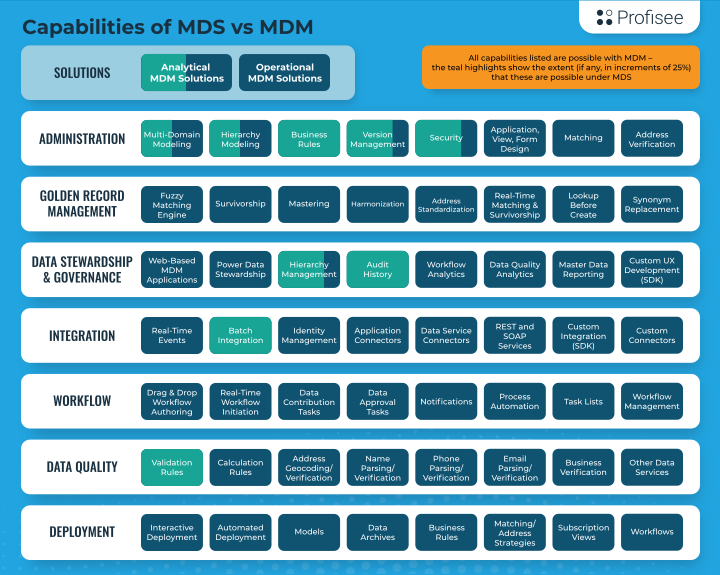
4. Deploy Operational Master Data Management as a Foundation
While many financial institutions begin with analytical MDM to support customer 360 initiatives, long term value comes from operationalizing mastered data. Operational MDM extends trusted customer, account and product data into downstream operational systems, ensuring consistency not just in analytics, but in day-to-day business processes.
Quick wins:
- Implement analytical MDM to deliver a trusted customer 360 for analytics, risk and reportingStandardize identifiers and matching rules across priority domains
Long-term investments:
- Operationalize MDM to sync mastered data with core banking, CRM and downstream systemsEmbed survivorship, hierarchy management and governance rules directly into operational workflows5. Start with AI Use Cases That Deliver Measurable Value
Avoid abstract AI initiatives. Choose use cases with clear success metrics and operational impact.
Quick wins:
- Fraud detection enhancements
- Automated onboarding and KYC checks
Long-term investments:
- AI copilots for operations and service
- Predictive risk and portfolio optimization
6. Embed Security, Compliance, and Lineage From the Start
Security and compliance cannot be retrofitted. Modern data architectures bake them into every layer.
Quick wins:
- Automated lineage tracking
- Role-based access controls
Long-term investments:
- Continuous compliance monitoring
- Proactive risk and anomaly detection
7. Measure, Learn, and Refine Continuously
Modernization is iterative. Track outcomes, gather feedback and adjust.
Quick wins:
- Data quality and usage dashboards
Long-term investments:
- Outcome-based data KPIs tied to business performance
How Modern Data Infrastructure Powers AI Use Cases in Finance
A modern data foundation enables real-world outcomes:
- Faster KYC onboarding through AI-driven identity resolution
- Reduction in counterparty risk
- Reduced AML false positives with unified customer data
- Real-time fraud detection using anomaly detection models
- Personalized cross-sell and upsell offers
- Improved credit risk assessment with machine learning
- Automated, audit-ready regulatory reporting through data lineage
Each use case depends on trusted, governed and well-integrated data.
Build an AI-Ready Financial Data Infrastructure with Profisee
A modern data infrastructure for financial services requires more than analytics tools or cloud storage. It requires trusted data at the core.
Profisee helps financial institutions establish governed, high-quality master data that supports analytics, AI and compliance initiatives. By connecting business drivers to reliable data foundations, Profisee enables organizations to modernize with confidence.
Request a demo to see how Profisee supports financial data modernization and regulatory compliance.
Frequently Asked Questions
A modern data infrastructure is a modular, cloud-based architecture that integrates data ingestion, governance, storage analytics, and AI. It emphasizes trusted data, scalability and embedded compliance rather than standalone tools.
MDM sits at the core. It creates authoritative records for critical data domains and ensures consistency across operational, analytical and AI systems. Without MDM, downstream analytics and AI rely on unreliable inputs.
A realistic roadmap starts with high-value domains, embeds governance early and delivers incremental wins. It prioritizes customer and transaction data, deploys MDM and gradually expands to enterprise-wide data products.
Start with clearly defined data domains, automate data quality checks, maintain lineage throughout migration and avoid one-time “big bang” moves. Hybrid architectures are often the most practical approach.
When data is trusted and accessible, financial institutions can make faster decisions, reduce risk, improve customer experiences, meet regulatory demands and safely scale AI-driven innovation.

Benjamin Bourgeois
Ben Bourgeois is the Head of Product and Customer Marketing at Profisee, where he leads the strategy for market positioning, messaging and go-to-market execution. He oversees a team of senior product marketing leaders responsible for competitive intelligence, analyst relations, sales enablement and product launches. He has experience managing teams across the B2B SaaS, healthcare, global energy and manufacturing industries.