






































Episode Overview:
Episode Links & Resources:
Welcome to the CDO matters podcast. I’m Malcolm. I’m your guide, your Sherpa, your host.
On today’s episode. It’s just gonna be me flying solo. I haven’t done one of these in a while.
I’d it’s probably been about twenty or plus episodes ish where I haven’t where I’ve been just going guest after guest after guest, which is great, which is amazing. But today, it’s gonna be me and me alone because it’s a special episode. This is our twenty twenty five year in review. Top trends in data and analytics.
These these episodes are fun. I do these every year. And I do the kind of what was the retrospective, the year in review type stuff. And then I’ll do another one probably in two weeks from now.
If not, maybe four weeks, probably two weeks, where we’re gonna talk about top predictions for twenty twenty six. What is he coming around the corner? It’s that time of year. Right.
It’s that time of year. We’re getting towards the end of the year. So these kind of retroactive things, these retrospectives, they’re natural and they’re fun. Help us take some stock.
Help us maybe learn some lessons about what we should be doing differently. Maybe take a moment to celebrate about some of the things that we did well. That’s an important part of, I think, the holiday season, which is nigh, which is upon us. We’ll air this episode probably twenty second of December ish.
So with that, happy holidays. Happy Hanukkah. Merry Christmas. Happy Kwanzaa. Happy your chosen way to celebrate with friends and family because that’s what it’s all about.
Getting together, giving thanks, being together, celebrating with friends, with family, taking a moment away from the daily grind, and just be and celebrating and hanging up and maybe watching football. That’s a big American thing. Canadians don’t do that. We don’t watch football.
We watch hockey. Maybe get you catching a great game. Hopefully, make it maybe get to see your hometown team play.
My bit beloved Edmonton Oilers are playing okay this year. Will they get to a third straight Stanley Cup final?
I don’t know. Gotta solve the netminding problem, but I’m probably talking to an audience of, like, three here of other folks from Edmonton who find the are excited by the Oyler’s progress. But you didn’t turn into this podcast to listen to a hockey commentary. You came to talk about data or to listen about somebody talking about data.
That’s yours truly. We’re gonna do that today. We’re gonna talk about the year that was. Well, what a year.
Boy, when I look back, kind of a do look at some of the macro forces, like, kind of a little tenuous.
Not bad, but not great either. Really kind of just maybe treading water.
You know, a lot of I think we started the year with a lot of maybe excitement, potentially with a new administration coming in. Excitement for some. Excitement for, like, fifty one percent of the country. Forty nine percent dread.
And there’s been you know, I I think some things are are certainly a little better. Right? I think some of the macro high level economic forces, there there are signs that things are slowly getting better.
You know, interest rates are starting to slowly come down. There’s some signs the economy is doing okay.
If you factored out all the spending on data centers and AI, maybe the story wouldn’t be so rosy, but the spending is there.
If you look, you know, beyond the the mag seven, are are companies doing well? They’re not doing amazing, but they’re not struggling either. I think there’s there’s a lot to be positive about about twenty I mean, looking back in twenty twenty five. This is America.
You know, Europe, I I think, is is in a little bit more of a tenuous position. You know, high energy costs, other issues going on at a macro level in Europe, I think, are making our friends overseas a little more conservative.
Spending is a little I think is a little tighter. Over there, it’s certainly been what I’ve seen. I was in Europe six times this year. Five or six, I think, my estimate. I I a lot.
You know, there’s there’s wars are happening a lot closer over there. You know, what’s happening in Ukraine, what’s happening in Gaza.
Still, you know, obviously a lot closer than than than North America. So I think those things have a little bit more of a palpable effect when it comes to to the economy, when it comes to optimism about about the world and about the way things are. So when I look at twenty twenty five at a very, very high level, a macro level, okay. Right?
That’s that’s kind of like my my it’s okay. Right? I got a six out of ten. Right?
Wasn’t a train wreck. We didn’t fall into deep recession at all. A lot of people were were talking about that. Certainly, a lot of people were talking about that as a result of tariffs.
Remains to be seen. I think some of the impacts there are long tail impacts, but things didn’t go completely sideways. Right? At least from a corporate perspective, companies seem to be doing okay. Companies continue to invest in data and analytics. Companies are investing in AI. They’re investing in software and technology and services.
But are they investing, you know, the way that they did, you know, say three or four years ago? Well, probably not. Right? But things are things I think are generally okay. Now when it comes to the finances of individual families, I think there’s a lot to be concerned about. Yeah. Inflation remains relatively high.
Employment does remain unemployment remains reasonably low, so that’s pretty good. But costs are boy. Boy, they’re high. They are high.
Childcare costs, housing costs, energy costs, fuel costs, food costs. My goodness. They’ve been in a grocery store recently? Wow. So, yeah, again, not horrible per se, big picture.
People have jobs, but there’s certainly some things to be concerned about. And that that’s kind of that’s what I’m gonna walk away from twenty twenty five with was is I I started the year optimistic, and I remain cautiously optimistic. I I see I see good things on the horizon. That’s my nature.
And I certainly see good things on the horizon on in in the data and analytics space. There’s a lot of things to be very optimistic about. I think we are in a little bit of a trough of disillusionment around AI. We’re talk we’ll talk about that in a little bit.
Trough of disillusionment is is a is a Gartner term. It’s the Gartner hype cycle. I think last year, maybe arguably, we were peak hype on Gen AI, and I think we’ve kind of come down. And we’re and I think we’re I think there’s a bit more to to to to go.
I think there’s more trough when it comes to Gen AI. I think there’s more doom and gloom. There’s more negative high headlines around overspending bubbles.
So I think we’re most certainly in a in a trough. Excuse me. But but what’s on the other side of the trough?
The path of enlightenment.
The plateau of productivity, as my old employer, Gartner, would call it. So I do think that in twenty twenty six, this gets into my predictions, we’ll start to see more real returns from investments in Gen AI. Will we continue to will some companies continue to overspend? Of course. Will the spending on infrastructure be matched by returns?
Probably not. Right? I think I think that we will continue to be underwater when it comes to high level, macro level investments in AI, and that’s to be expected.
Same thing happened with the Internet. Same thing happened with the Internet. So I think there are reasons to be optimistic about twenty twenty six when it comes to AI. I think there’s reasons to be optimistic from a economic perspective with interest rates coming down.
There’ll be more money pumped into the system. I don’t think prices are gonna go down. I just think people will have more money in their pockets so it won’t feel as bad. Right?
It won’t sting as much as it does to cut that check for your annual health care insurance.
So I think twenty twenty six is is gonna be a little a little brighter than twenty twenty five. That’s my prognostication. However, tune in in two weeks, my friends, for a full review of what’s up and coming in twenty twenty six. With that, let’s talk about our top ten trends in data and analytics for twenty twenty five. Numero uno.
Number one.
Numero. Numero un. In French.
Is what I call the Gen AI paradox.
This is something that is both easily explainable and rather unexplainable. And what do I mean by the a gen AI paradox? Well, I’ve touched on this and some of this stuff already. The paradox is is that everybody says we’re in a bubble.
Ninety five percent of AI POCs are failing. Nobody’s getting any tangible returns on investments from investments in no meaningful ROI. Right? Plenty of pithy stats that are being tossed around about how Gen AI is is this overpriced parlor trick.
That’s one end of this paradoxical spectrum. The other end of the paradoxical spectrum is everybody’s using it.
Right? Like, everybody’s using it. I I use ChadGBT more than Google now. Right? But Gemini, actually, in Google, pretty pretty darn good.
But everybody’s using it. Kids are using it to do their homework. Every marketer I know is using it. Every technology person is using some sort of Copilot in in GitHub.
Every or or writing, you know, writing using it to write code. Every HR person I know is using it to review and write job postings. So, you know, everybody is using it. Deloitte, McKinsey, E and Y, BCG, pick your big consultant.
They’re they’re all talking eighty to ninety percent adoption.
This, my friends, is the paradox.
Widespread, rampant use, arguably the fastest adoption of any technology, including the Internet ever, and we’re in a bubble. How can these things be concurrently true? Well, the answer the answer is our biggest opportunity for twenty twenty six. This technology clearly has value.
The value is being articulated in its use. When people use something, they’re getting value from it. And if there was no value, they wouldn’t use it.
Right? It’s that simple. So there’s value here. The challenge for us as data and analytics leaders, for CDOs, is to find ways to extract more of that value and to institutionalize processes here.
Right? To find ways to reengineer our core business processes, procure to pay, quote to cash. Maybe they’re internal, reengineering our data management processes, reengineering our ETL, reengineering our data quality processes, our governance processes. Right?
There are so many opportunities here, my friends. And this paradox that is my number one trend of the year suggests suggests that there’s a lot of work to be done because there’s value in these technologies because people are using them, which means as the data people, we’re the data people, right, it falls on us to find ways to operationalize these things at scale within our organizations.
Excuse me. I got a frog in my throat. Don’t know why.
Maybe it’s because I’ve been talking all morning.
Shocker. I know. That is my top trend of the year, this paradox. I I I it it befuddles me and excites me.
It befuddles me in that it exists and excites me and that I know that there’s work that we can do and I know that there are things that we can be doing to overcome the gen AI paradox. Alright. That’s number one.
Number two. Number two. And I am looking at some notes here.
And and I I use a pithy phrase to describe this. I call it the BI deer in the AI headlights. This is my trend number two. And this is a trend that I’m I I say and share with great trepidation.
I don’t want it to be true. I don’t want trend number two to be true, but it’s true. And I know it’s true because I talk to people at conferences across the world, sometimes on a near weekly basis, often two, three times a week, right, where I’m going to these conferences and I’m talking to people. I’m I’m having the conversations at at the lunch table and at the cocktail hour and within the the conference sessions or when I’m visiting my clients, right, when I’m going on-site.
I was just on-site last week at a large client talking about some of these issues.
These issues, this number two here, top trend number two is paralysis.
It is many and far too many data leaders taking a bit of a wait and see when it comes to Gen AI and the adoption of AI writ large, whether that’s generative or it is more potentially predictive, machine learning, all all AI. What I see is a trend of many sitting and kind of just letting things shake out. Right? Where usage of Gen AI in the desktop is enough of a win for that CDO to claim, you know, a win. Or maybe the CDO has go bought some technology or integrated some technology where AI is a key enabling capability within that technology, where the acquisition of technology that uses AI is enough for the CDO to say, yeah. I checked the the AI box this year. I’m doing enough around AI.
And that’s a bit of a disturbing trend. Why? Because we desperately need to be adapting our operating models. We desperately need to be finding ways to drive value for our customers. We desperately need to change how we approach data quality, data governance, master data management, all the things.
We need to change how we operate. The foundations we have are not the foundations we need, comma, when it comes to generative AI.
These are two very, very different things. The foundations we’ve spent decades and millions of dollars building to enable accurate measurement, dashboards, reports, insights, largely, are not the foundations we need to provide accurate, consistent, reliable systems of meaning.
Measurement versus meaning. This is gonna be something I talk a lot about in twenty twenty six, the world of measurement and the world of meaning.
We need both.
Our world our dashboards aren’t going away. Our CFO is not gonna stop wanting consolidated customer transaction reports. Right? We’re not gonna stop having financial reports. We’re not gonna stop any of that stuff. That still remains true.
But the world of Gen AI is a very different world. Right? It requires different foundations, different perspectives. It requires context.
It requires highly adaptive forms of governance, meaning context aware and context centric forms of governance. Right? It we we we need to be doing knowledge graphs. We need to be doing more in the world of what is known as knowledge management, not data management.
Management. So these worlds necessarily must start to come together, and we must get out of this per paralysis state. We must.
Because it’s going to take time. It’s going to take time, my friends, for our organizations to rearchitect, to retool, to recalibrate for this world of Gen AI. It’s not going away. Reason why it’s not going away is because people keep using this stuff.
And as long as our CEOs are using this stuff and are doing it and are getting value from it, there will be pressure for us to operationalize and scale across all of our internal processes, across all of our internal domains, functions, departments, units, whatever you call them.
So the paralysis must stop. We need to get into and we need to not be afraid of POCs. Just because ninety five percent of them are failing doesn’t mean that we shouldn’t be learning. We must be learning.
This is the thing that drive me the most nuts about that whole ninety five percent of POC failing thing. It seems to be suggesting that it’s not worthwhile to learn because it is worthwhile to learn. It is. I wrote an entire book about this.
And if you haven’t read my book, the data hero playbook talks about what is needed to adapt to this world of AI. And what is needed is what is called a growth mindset. Growth mindset embraces the idea that learning is paramount. Development is paramount.
Breaking free of the status quo is what we must do. How we do that is by thinking differently, operating differently, looking at our customers, our roles, and our data in a different way.
How do you do that? Well, you do some POCs. You go sit down and talk with your customers. You learn your business processes.
You become business consultants. You embrace product management as a discipline within your data function. These are all things I talk about in my book. I would invite you to check it out.
I think you will find it insightful.
So that’s number two, paralysis. The BI deer in the AI headlights, not something I want to say as a trend, but it is most certainly a trend. But we can break free, and we must break free. This will be the story of twenty twenty six as we start to march towards the plateau of productivity and get out of this trough of disillusionment.
Number three. Top trend number three.
In a world In a world.
In a world of chaos and disruption and paralysis, thank goodness for data products. Woo hoo. Data products.
Data products are the Robin to the AI Batman.
Data products are the the the bridesmaids and bridesgrooms, right, to to the married couple. They they are thankfully, they’re there. And thankfully, we have them. And thankfully, so many companies are focused on them because they are actually I think now data products are slowly starting to work up that plateau of productivity.
I think if if you if you talk to any of the analyst firms, including my old employer, I think they’ll tell you that upwards of sixty, seventy percent of companies are now embracing some form of data products. Now I don’t wanna get into a prolonged discussion about the fact that we still don’t have a single definition of data products because you know what? Who cares? It’s fine.
I think there’s a better way to do it. I think the best way is to embrace data product management, product management.
Forget the shift left, forget the shift right, forget the shifting, stop shifting, focus on customers.
Focus on product management.
Product thinking, at least from a data mesh perspective, is not enough.
Product management thinking is what you need. Trust me on this, my friends. Data products, I think, are yielding some results for companies. I think they are actually to the point this is the story of twenty twenty five to me.
Data products went from conceptual to mainstream, and I think many companies are starting to see some benefits from them, particularly those companies that are really, really, really focused on customer success.
What do I mean by customer? The people who are using the data products. I’m not talking external customers, although I’m not not talking external customers. They could certainly be external to your organization. The people who use your insights, who use your dashboards, who use your KPIs, who use your APIs, whatever.
Those are our customers, and we all have them. And thank goodness in twenty twenty five that while many are struggling with AI, many are getting value from data products. So I think this is one of the success stories of twenty twenty five that some companies started to see value from data products. Some companies who may have even started with technology, who may have even started with a data catalog and and and built maybe even a data catalog field of dreams. Right? Like, if they if we build it, they will come.
I think some of those companies are starting to see benefit there, right, that that are actually focused on use cases, that are focused on outcomes, that are focused on customer success and customer value.
Many of them are articulating that through a data catalog, right, where people are actually able to go in and and search customer master and are able to pull back a gold master customer record then actually use that to create some dashboards. Or maybe they’re actually able to pull the dashboard back itself to see their customer report for the last month.
So I I am starting to see some real tangible value being delivered from data products, and that’s a good thing.
Data products exist on a spectrum. They are shift left. They’re also shift right. They are built specifically for customers, but they also enable scale. Sometimes as they enable scale, sometimes they’re customized to for a specific customer.
Right? And both are valid. Sometimes you need raw materials. Right? If you have customers out there who are comfortable building their own dashboards, fantastic.
Get them some raw materials.
That’s great. But then there are other customers who want a bow around their product. They want a finished product. Right? There are plenty of customers that will pay a lot of money for a very customized, bespoke one off product.
Right? If everything we do was all be always about scale and high volume and low cost, well, then we wouldn’t have luxury cars.
Right? Like, there’s nothing there’s nothing scalable about the process of building a Lamborghini, right, where every part is hand machined, right, or a McLaren. Right? Sometimes our customers have a lot of money.
Sometimes they want a very customized one off product, And that’s okay. If they’re willing to pay for it and they’re solve and and and we’re solving a specific customer problem, we should be okay with building it that way. If the if it’s economically viable. This, my friends, is what product management can deliver to us.
Product management will tell us, are we doing something in a way that is economically viable? Sometimes, the best economic viability will be to shift left. Sometimes, it’ll be to shift right. There’s no wrong answer.
It’s both.
And twenty twenty five, to me, one of the top stories is some people are starting to realize this when it comes to data products, and I’m optimistic that we’ll see even more of this in twenty twenty six. I’m seeing and hearing more people talk about product management. I’m hearing more people talk about data products. I’m hearing more people talk about tangible value.
Data products. That is his success story of twenty twenty five. Hip hip hooray. More of those, please.
Number four.
I should have sound effects. Number four, the and I titled this the problems and opportunities of unstructured data.
In twenty twenty five, we finally, two plus years after the launch of ChatGPT, we finally started to figure out, finally, that the data that Gen AI wants is unstructured. Right? Throw a table into a prompt. Good luck.
Right? Gen AI doesn’t want a table. Right? Gen AI has a hard time consuming the intersection of a row and a column because there’s no context. Gen AI wants a narrative. Gen AI wants a story. Gen AI wants context.
There is very little context in a table.
Right? There’s actually even arguably very little context in a complete ERD. Right? Yeah. I can understand that customers are related to products which are located to locations, but that’s about as basic as it comes.
Right? And that’s still not enough.
The best prompts are the prompts that have are rich with context, that are rich with insights, that are rich with narrative.
And the more that that is given, the more to Gen AI, the better the results are going to be.
This is this whole issue of the foundations we have are not the foundations we need.
But we finally, in twenty twenty five here’s another here’s another success story of twenty twenty five. We finally started to figure out because I’ve been my friends, I’ve been pounding this drum for literally three years straight.
Pounding it. And what do I mean? I’ve been pounding the unstructured data drum. We need to focus on unstructured data.
Unstructured data, we need to focus on this. We need to govern it. We need to steward it. We need to oversee it.
We need to manage it. We need to get our hands around it.
We can call it however you wanna call it.
But the days of ignoring eighty to ninety percent of our enterprise data, and that’s Gartner’s estimates, eighty to ninety percent of our data is unstructured, sitting in SharePoint servers, p PDFs, CAD files, semi structured in in JSON and XML, you name it, email servers. Good grief. How much data do we have sitting in email?
Eighty to ninety percent of our data, maybe even video files, audio files. I I can keep going. You get my point. Eighty to ninety percent of our data is largely ungovered, largely ignored by the data management function, and that must stop.
And in twenty twenty five, I actually heard more people starting to talk about the need to govern unstructured data. Now how we do that, you know, if if I were to put this on a on a hype cycle, I think we’re we’re kind of starting to go up the hype cycle. And I think in twenty twenty six, maybe twenty twenty seven, unstructured data will kind of will will start to peak from a hype perspective. We’re not even we’re not even close.
Now we’re just in an awareness stage when it comes to unstructured data.
But that’s a good thing. It’s a good thing because it’s necessary. This is a massive opportunity for data leaders and data practitioners.
Massive.
Massive. Massive. Now a lot of this is cruft. A lot of this is junk. Right? A lot of this is those are those old, you know, old physical copies of Sports Illustrated sitting in your basement.
Right? Probably okay to send them to the shredder. Probably okay to archive a lot of that data, but a lot of it a lot of it, my friends, a lot of it will be highly useful.
And how will we separate the wheat from the chaff? How will we do that?
Look no further than my old friend, master data. Pareto principle will most certainly apply. All of that unstructured data, eighty percent of it is probably crust. Eighty percent of it, we probably don’t care. Twenty percent of it will have eighty percent of the value, and that twenty percent is data related to our customers, our products, our assets, our locations, our employees, our items, our materials.
Good old master data that is shared widely across the organization. Herein lies a huge opportunity. How do we apply master data management disciplines to all of that unstructured data?
How do we do it? How do we govern it? How do we steward it? How do we certify it as accurate, trustworthy, consistent, all the things that we’ve been doing for decades on unstructured data or unstructured data?
Forgive me. How do we do that to unstructured data? It’s a different model. It’s a different approach.
Right? How we apply governance to this data will be different. How we master, quote, quote, this data will be different. By definition, it’ll have to be different.
This will be something we figure out in twenty twenty six and twenty twenty seven because now, thanks to this trend and trend number three, or was it four?
Look at my notes. I get so excited. That’s number four.
Thanks to trend number four, which is the problems and opportunities related to unstructured data, we now know that we actually we’re gonna have conversations. We’re gonna increasingly have conversations about what does it mean to govern unstructured data. How do we do it? Do we need to break it into structure in order to govern it at scale?
That’s an interesting question.
I think we do to a certain degree. I think we need to be able to suss out and parse out when we’re referring to things that we care about. Right? Master data. I think we will need to structure it to some degree, but optimally, we need to maintain it in its unstructured form to make it the most valuable for for Gen AI. So it’s both.
It’s both. We need to be able to if we were to overlay something known as the DIKW framework, data information knowledge wisdom, If we were to able to if we use that as a guide and we got data at the bottom of the pyramid, information knowledge wisdom, we started with knowledge, which is, let’s say or information, which is a narrative, a story, a paragraph of text describing a maybe a customer service interaction, maybe a sales interaction.
You’d ask yourself, okay. In order to govern that at scale, that paragraph, do I need to break it into pieces? Or do I need to break it in do I need to structure it? I think the answer is yes, but you will also need to keep maintain it as unstructured because that’s what Gen AI wants. Gen AI wants to eat that paragraph. Doesn’t want to eat it doesn’t it doesn’t want to digest those kind of, like, atomic bits.
Right? It wants the paragraph, so we need to maintain that. But we also need to be able to say, is this accurate? Is it relevant?
Is it cons is is this going is this is this high quality Is this a high quality paragraph? That’s gonna be hard. Data accuracy, we just had a little blip. Because accuracy is is contextual.
Data quality is contextual. It may be accurate to a marketing use case, but may maybe not accurate to a finance use case, and that’s okay. These are the types of foundations we need, my friends. Those are the foundations we need.
This is how we need to start looking at these challenges, these problems. So unstructured data.
We’re gonna need to structure some of it, but not all of it.
And we’re gonna need to think about doing things differently. Huge opportunity for us in twenty twenty six.
Top trend number five, and I just touched on this, but this is slight this is slightly different, but very related. And top trend number five is the idea that context matters. Thank goodness we’re having more people actually talk about context. We’re having more people talk about knowledge graph.
We’re having more people talk about semantic layers. We’re having more people talk about knowledge management. This, again, is tied to this awareness that the intersection of a row and column is largely useless to a large language model. Right?
Like, putting in one name into a prompt is going to yield nothing.
Right? Like, it’s it’s going to yield nothing.
Context matters. Semantics matter. Meaning matters. Right? And we’re seeing this articulate itself through increased adoption of knowledge graphs.
We’re seeing this in increased adoption of this idea of semantic layers. We’re seeing it in increased awareness of knowledge management writ large. We’re seeing this through more and more people in the data world talk about the importance of ontologies and taxonomies.
So this is also a very, good thing. Right? Because these disciplines and these technologies, there’s there’s knowledge management as a discipline and there’s techno and there’s technologies to enable them, and there are processes which enable them. Right? So so building a taxonomy, building an ontology, building a defined vocab vocabulary vocabulary vocabulary, aka a a business glossary or technical glossary.
Doing all these things is going to be necessary to pivot oh, I just hit my microphone. Pivot from our legacy foundations to the foundations we need for Gen AI. We’re not getting away from the things that we’ve always done. Those will remain. The world of measurement will remain.
Right? Our CFO isn’t gonna just magically stop asking for financial reports. It’s not gonna happen. We need to continue to maintain things, the status quo of the things we’ve always done. Right? But we need to embrace this world of knowledge management.
The connective tissue the connective tissue between those things, between the layer of data and in the layers of data and information and knowledge, check out the d I k w pyramid, just search it in Google.
The connective I’ve had my screen blip a couple of times. Hopefully, it didn’t blip for far too long, and we’re okay. I hope we are. Screen may have gone black.
I’ve had some Internet problems here. For those of you who don’t know, and I don’t know why you would, for several months, I’ve been a major home renovation. So I’m not in my usual studio. I’m in an Airbnb down the street.
And the this is our third different Airbnb on our street.
It’s no fun moving from home to home to home, but one of the advantages of living in Florida and living in a place where people come on vacation is that there’s lots of Airbnbs on your street. So so at least I have a place to go, and I’m within walking distance of my my home that is currently in a state of destruction because we’re renovating it.
Anyway, where was I? Semantics, context, top trend twenty twenty five.
More and more and more people are becoming aware and attuned to the need to add context, knowledge graphs, ontologies, taxonomies into their data management practices. So those are a mishmash between technologies and disciplines. Really, what I’m talking about here, my friends, is the integration of knowledge management as a discipline into the data management function. This is a must have.
It is no longer a nice to have. It is a must have. It is a must have. And if you’re a chief data officer listening to this, go find the knowledge managers in your organization.
They’re out there, particularly if you’re with a bigger company. If you’re, like, two billion plus in your company, there is a knowledge management function. Trust me. They’re managing internal search capabilities.
They’re managing content management systems often in marketing. Right? Maybe they’re just even managing SharePoint, but there are people out there that are managing the systems that today is housing a lot of this unstructured data. Go find them, go make friends with them, and try to build bridges into those organizations.
If not, finding ways to deeply integrate them into your organization. That is something you should be doing in twenty twenty six, I think. Advice.
Alright.
That was number five. That was semantics and context. Now we’re coming up on number six. Six six six six.
Just wanna check my time. I’ll be spending less. These are these are these are less important trends, think, as we as we get deeper into the list.
One of the things I’m noticing as a trend in twenty twenty five I saw is what I’m just kinda calling the changing landscape of events, the changing landscape of thought leadership and events. Things are changing.
And and I know this is fairly this is kinda unique to me because I’m I’m going to so many darn events. Like, I go to a lot of events. But things are changing.
And I think the changes that I’m seeing are very, very positive, where there’s the shift from events that are primarily focused on talk at to events that are primarily focused on talk with.
And this is the difference. Right? Talk at, you’re gonna go, you’re gonna sit in an auditorium, somebody’s gonna talk at you. Somebody like me. Right? Who’s gonna give the PowerPoint, give the presentation, and there’s nothing wrong with that.
There’s nothing wrong with that. This is still, I think, valuable and important, and I’m I’m definitely pro event.
Even in situations where you go to an event and seventy percent is stuff you already knew, but that thirty percent that you didn’t know will make the event worthwhile. Right? Not to mention the fact you’re getting away from the day to day. You’re getting away from the grind.
You you’re free to go think differently. You’re free to go and get free yourself from, you know, the daily grind, and you can get you find yourself being more creative. You find yourself being more focused on more complex problems. Right?
Because you give yourself space in your mind to go think about these things when maybe you’re not giving yourself space to think about these things. So I’m pro event.
But I’m seeing this shift towards more talk with. Right? Where where it’s let’s get together as as a smaller group. So instead of thousands of people in an auditorium, I’m seeing smaller groups get together.
Maybe it’s around a dinner table, and that’s cool. Right? My friend Juan Cicada at ServiceNow does these honest no b s dinners, and they’re very popular. And he goes from city to city, and it’s like ten people getting together talking about stuff.
Right? That’s the ultimate talk with. Right? You’ve got Juan who is one of the smartest people that I know, like, whether that’s data, whether that’s any it’s just one of the smartest people I know, hard stop, who is sitting down and having conversations with CIOs and CDOs and VPs of data and analytics over dinner about important stuff.
Like, that’s a valuable interaction where it’s not just about Juan. He’s just basically acting as a facilitator. Right? Although he has got a ton of knowledge to share.
But it it’s, you know, he he he and his sidekick, Tim, where they’re going out and and having these conversations. So Juan and Tim both, like, just crazy, crazy smart folks who are out there sharing what they know. But more than anything, it’s getting this smaller group together where everybody is sharing what they know.
That’s important. That’s valuable. And I’m seeing more and more of that as a trend. My recommendation to you, my friends, is to get engaged.
Go out there. Say yes. You know, sometimes some of these things can be pretty sales y. Right?
Some of these things are are, you know, they’re they’re they’re they’re trying to extract something from you, right, where it’s like come, you know, it’s like a timeshare. Right? Come for your free dinner at Ruth’s Chris and and you just have to suffer through three vendor, you know, pitches. And and, you know, maybe you don’t wanna do that, but there are opportunities to engage in some of these smaller sessions.
Another good example is my my friend Aaron Wilk Wilkerson and Ryan Dolly created a literally created their own conference called it Data in the D. They’re both in Detroit, and they created a kind of user centric, user driven conference this year, and they have, like, a hundred people, which is amazing. Way to go, Aaron. Way to go, Ryan.
Awesome stuff. Right? Maybe create your own conference. Right? But but find ways, get out there, get engaged, find ways to go meet with the community, go have conversations with other people.
Even if it’s just virtually, there’s a plenty of these opportunities out there. I’m helping facilitate some of these. Right? I’m going to I’m creating some of these events.
We’re holding events just like this. There’s other events that are kind of somewhere in the middle. A good example of that is CDO Magazine events. CDO Magazine has got some amazing events where if you’re a data leader, it doesn’t cost you anything.
You can go. Right? Yes. There’s still a vendor hall. Yes. Vendors are still trying to sell you something because you gotta pay for the hotel.
You gotta pay for the free lunch. Right? Nothing’s free. It’s gotta be paid for. But where it’s kind of a of a happy medium between the, you know, the three or four thousand people at, like, a Gartner event where it’s three or four thousand dollars a ticket, which is crazy, which is true, by the way, versus going to a free something at a local hotel where you’re hanging out with a roomful of CDOs.
Like, that’s fantastic. Do that.
Go do that. Get out there. Get engaged. Network like there’s no tomorrow because this is gonna touch on something I’m I’m sharing as my top trend number ten.
It is in your interest to get engaged with the local data community and get engaged with these events.
Number seven.
Number seven.
Convergence of tools.
Converging data management tools. This has been something that’s been kinda slowly happening for the last few years.
It really seemed to accelerate this year. And I think it’s because of more mergers and acquisitions.
There’s plenty of examples out there. I just mentioned ServiceNow that acquired data dot world. Atlassian acquired Socota.
Salesforce acquires Informatica. I think we’re gonna see a lot more of this in twenty twenty six.
And all of these all of these acquisitions are symptomatic of this convergence.
Right? This convergence of data management tools, data management platforms, but they’re also symptomatic of those data management platforms aligning themselves, I think, more closely to business applications. Right? ServiceNow, Salesforce, perfect examples of this.
Right? Where and I think you’re gonna see more and more of this from business application providers. Right? Like the the the software, the big systems of record providers, right, ERP, CRM, SCM, MAP, marketing automation platforms, where more and more of those providers integrate data management capabilities into their platforms.
So there will be that world, and of course, there is the analytics world, where those providers, the Databricks, Snowflakes, Azure’s, are continually integrating data management platforms data management capabilities into those platforms. So we will have two. We’ll have applications, right, and we will have analytics layers. Those will be the the the giant schism, and each of those having more and more and more converged data management capabilities within their respective platforms.
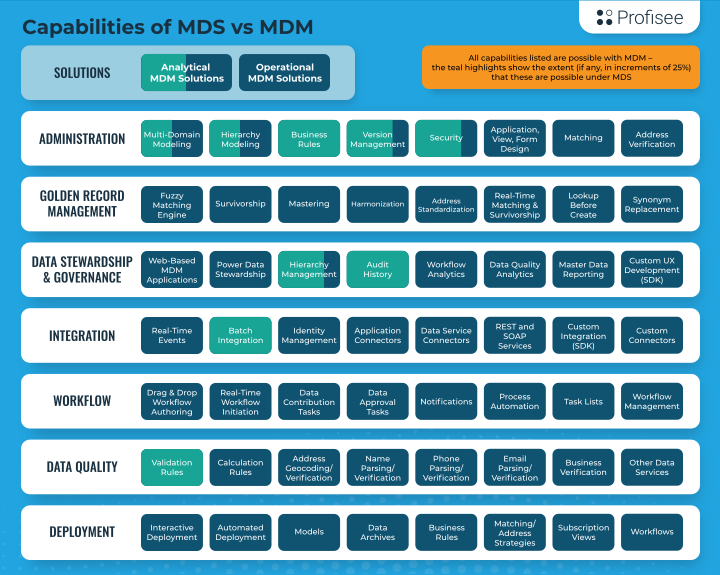
What do I mean by converged data management capabilities? Quality, MDM, integration, analytics. Right? All of these things coming together with the lines between the and metadata management and governance as well, of course.
Where the lines between them are becoming increasingly blurry, increasingly blurry. So where the line between a data catalog and an MDM is still there, but it’s blurred. Where the line between an MDM platform and a data quality platform is blurred, or the line between day qual quality and metadata management platform is blurred.
We’ve always had, always had overlapping capabilities in this space. It’s it’s always been the case, but I think what we’ll increasingly and we already see we are already seeing this, but we’ll see more of this where there’s more overlap, but where there is overlap, there is integration, right, between those platforms. Right? So instead of there being overlap, right, in a integration capability in an MDM, I think we’ll start to see those things actually come together.
Does this mean that there will be no no longer best of breed providers? Of course not. Of course not. There will be best of breed providers that are selling standalone MDM platforms, standalone data quality platforms.
But what we will see, and we’re already seeing it, is where those platforms are deeply integrated at the point of capability overlap, at the at the point of functional overlap.
MDM has data quality capabilities in it. Data catalogs have data quality capabilities in it. And when they are overlapped, that is the integration point with these other providers. So you will start to see best of breed providers come together.
Right? Either come together or partner with, as strategic alliances with, the bigger suite providers. Classic example is my employer, Prophecy. We’ve got a deep integration to Microsoft and we’re building out additional integrations to other platforms like Databricks, which we have an integration to, and Snowflake, which we have an integration to.
And build out integrations into data catalogs as well, like to have an integration into Atlan, Calibre, Alation, on and on. That is where we are going as a provider of one of these systems, and I know it’s where other providers are going. So there will still be this idea of stand alone. So as a buyer, as a CDO, don’t be afraid.
One could argue that’s actually a viable form of protection against lock in, against getting you know, putting all of your eggs into one giant mega provider. We’ve seen this in the past. Doing this doesn’t necessarily yield positive results.
Remember Siebel? Right? When something becomes everything to everybody, maybe not necessarily the best thing. So don’t be afraid of best of breed solutions because if the people who are running those software companies are doing it the right way, they are deeply integrating to these other platforms. So the worlds are coming together.
And, again, why? Why are they coming together?
Gen AI is a big reason. AI is a big reason. Right? But cost savings are another reason. And you try to get rid of some of these overlaps and capability, but having an integrated management platform is is I mean, it to me, it is just a natural evolution of this space.
That’s top trend number seven, my friends. Number eight. Hey. This is a short one, but top trend, everybody’s now an AI expert.
Everybody’s an AI expert. Four years ago, in the data and analytics space, nobody was talk very few people were talking about AI. Very few. Some.
Some.
My finger is disappearing into my sign.
Some people were talking about AI. But all of a sudden now, then out last three years, everybody’s an AI expert. My friends, I am not an AI expert. I am a data management expert.
Some of that actually gets into unstructured data. So it gets into the data that AI wants, but I don’t know how to write an AI algorithm.
I’m not a data scientist.
Never have been. Never claimed to be.
My expertise is data management, structured and unstructured. But I’m not an AI expert, but I know what AI needs.
I know what AI needs. So be wary. This isn’t about me. This is about you.
Be wary whether that is a consultant, whether that is a vendor. Right? Whether that is somebody you’re looking to hire.
Be very, very skeptical of their AI credentials.
Right? Because if we are to adapt, if we are to pivot, if we are to shift our foundations towards this world, we need people we can rely on. We need people we can trust. And there’s a lot of people out there who have pitched a sign saying they are an expert, AI expert, talking about AI generally in the frame of platitudes. So this is a tell.
I like poker.
I’m not very good at it, but I like it. And that’s a phrase we use in poker. It’s a tell. Right? If somebody’s out there talking about about a lot of platitudes with AI saying things like, you know, bad data equals bad AI, and that’s their primary sales pitch, for example, one of many.
But if they’re talking in a lot of platitudes and they actually can’t get into specifics about how to change your operating model, what it means to build a a an actual model, what it means to manage a data state, what it means to manage a data science function, how data science is different than than general BI. Right? If they can’t articulate the differences between this highly probabilistic world of AI and our deterministic world of BI, if they can’t get into specifics about how these things differ, if they can’t explain why data scientists prefer to go to source systems instead of dealing with the output of a data quality hub or an MDM hub, if they can’t talk in any detail, then are they really an AI expert? Chances are they’re not. They just say they are because that’s this AI watching is rampant. It’s rampant in the solutions that we purchase. It’s rampant in the consultants that we partner with, and it’s rampant in the resumes of people that you’re reviewing right now.
So be very, very skeptical that people have the AI pedigrees that they say they do because we need experts. We need people we can trust. That includes me. So just just be skeptical. I’m just seeing a lot of people flying an AI banner, and if you peel that onion, it doesn’t take too long to figure out there’s not a lot of substance there.
Be wary. Numero nine. Number nine. Well, top trend number nine, semantic pedanticism reaches all time high.
Semantic pedanticism. This is a phrase that I coined, I think I think maybe three years ago, to define the it was kind of like a tongue in cheek. I I I did it in a LinkedIn post, and I was like, man, this actually explains a lot of things. And it was my attempt to explain really kind of two things.
One is why do we keep inventing new words to describe old things? Like like, we are incessant about just just new words. Right? Like, data literacy. Good grief. Just call it training. Please call it training.
But we we we created a new phrase, data literacy. We do it all the time. So that’s kind of one phenomenon. And the other phenomenon is is we fall down these rabbit holes of meaning and we argue and bicker constantly about the meaning of things. We we we we we talk about the meaning of things all the time, and we get to we tend to be rather tribal. Right? We we tend to be these when we fall down these rabbit holes, we get into arguments about what the how to define things, like semantics.
Like, one of the most meta LinkedIn posts I had of twenty twenty five, arguably the most meta of any post I’ve ever had, was people arguing about the meaning of the word meaning.
I’m not joking. Like, hundreds of comments. So we have this phenomenon in our world, right, which is, like, we make up new stuff, we make up new world words, and then we argue about the meaning of things. Right?
Like like, just I was like, wow. What’s going on here? So I built a framework. I’m an analyst.
Right? You you can take the boy out of the analyst firm, but you can’t take the analyst out of the boy, and I’m an analyst. And I when I analyzed this, I was like, ah, there’s this thing called this semantic physic pedanticism feedback loop, and there’s actually incentives. That’s the feedback loop.
There are incentives to create new things. There’s incentives for analysts to create new things. There’s incentives for thought leaders to create new things because it creates the illusion that there’s a new insight, that there’s new value. And if you’re an analyst and you create that illusion, oh, wow.
There’s this new thing called data literacy. I better I wow. I I I had no idea. I had no idea that we needed to train our end users on how to use our dashboards.
Wow.
Mind blown. Mind blown. I better go subscribe to an analyst room so I can get the insights I need in order to learn this new thing. Peel the onion. Reality. Not so new.
Not so new. So I I I built this feedback. What I’ve noticed, and I don’t know why this is, but this the the quibbling about the definitions of things, quibbling about meaning, quibbling about, you know, and and introducing new words to to describe old things or or words that, like, are are are not net new.
I I just we just keep doing it. And it just seemed like it hit a fevered pitch last year, and I and I and I think it’s a result of the paralysis. Right? I think it’s a it’s a result of the navel gazing. We love to navel gaze. Right? Like, we’d love we’d love to look inwards.
And and the more we navel gaze, I think more the more we are prone to quibble and split hairs on definitions of things. Because many of us at Harder Librarians, right, we’re classifiers of things. We’re labelers of things.
And when that’s your job, well, you get passionate about it. And that hit an all time high in in twenty twenty five. I just I giggle. Like, the the, you know, the argument about the meaning of the word meaning.
True story, my friends. True story. I love it.
Alright. Top ten number top ten. Top trend. Number ten. And this one, I I I didn’t wanna put this as number ten, and I didn’t even want it to be on the list, but it’s it’s a trend. And it’s it’s a sad one, But it’s real. And this is mid career disruptions.
I saw in twenty twenty five, wow. Maybe it’s because I’m mid career. This this could be a little bit of well, I’m I’m close to a late career, to be honest. But maybe this is a little bit of the kind of self reinforcing nature of the algorithms, particularly LinkedIn, but not exclusively. But I saw a lot of folks this year who are, you know, mid to late career, losing their jobs.
And, you know, a lot of people are are getting new jobs. A lot of people are are taking new positions, and those are great things. That’s awesome.
But I saw a lot of people losing their jobs. Right? And those same people who are, you know, probably reasonably well compensated. Right?
Because they’re they’re mid to late career. They’ve been doing this twenty years. Right? Highly skilled, highly experienced.
Right? Highly experienced, where all of a sudden, you’re out of a job.
Right? You’re a director of analytics. You’re you’re a senior manager of of of data governance. You’re who knows? Maybe even VP where, you know, you’re cruising along and your career is progressing and then poof, you’re out of a job. And for those folks, it’s tough.
It’s tough because their wages are high, their experiences are are equally high. Right? Their knowledge is equally high. But what I’m seeing is those people are struggling to get rehired quickly, and they’re taking six months plus, upwards of a year to get rehired. And when they do get rehired, typically, they’re taking a lesser title with lesser pay. Right? Now I don’t know what’s going on here.
I don’t I I think this may be in part. Of course, not entirely.
But in part, think this could be a result of AI. I I don’t know this to be true. I’m I’m speculating here. So this is pure speculation, but could could a early to mid career professional plus AI equal these skills or at least create the perception of equal skills to a late career person? Could you downsize, riff a late career person and get two mid career people for the same price and more output.
When you layer in AI, yeah, I maybe you could. Right? Maybe you could. Maybe you can’t. You’ll never you’ll never replace that experience. You’ll never replace that knowledge.
But could you create the perception at least, you know, temporarily? Could you create the perception that you could actually do better? Potentially. I don’t know.
This is pure speculation, friends, and I and I need to do a little bit more research here, and I need to do a little bit more talking at these events and talk to some of the folks who’ve been affected this way or talk to some of the CDOs who have made the decision to downsize, like career professionals. But it’s certainly a trend that I’ve been noticing. It’s something that I’ve been seeing. It’s not one I wanna report.
It’s not one that I’m happy about, of course, but it’s out there. So what does that mean? Well, you know, what that means is is that we need to disrupt ourselves before others disrupt us.
So if you are mid to late career, you need to become invaluable. You need to become your team’s AI expert.
You need to become the networking fiend. You need to go to these events. You need to get engaged. You need to start writing sub stock articles. You need to get out there and active on LinkedIn.
Build your brand. Right? Build your knowledge. Build your skills. Build your network.
Work yourself into a situation where you have value that goes above and beyond the things that you are doing at work. Get involved in in in in a local data community, whatever it is. Try to disrupt yourself.
Right? Find ways if you’re worried about being automated, then automate yourself. Do it to yourself before others do it to you. Build your own GPT.
Go and copy and paste every email you’ve ever sent. Follow your corporate security and data guidelines, of course, but go build your own GPT. Digitize yourself. Right? Find ways to improve your productivity and augment your productivity.
Right? Become seen as that overperformer within your organization. Doesn’t necessarily protect you a hundred percent, but it’ll make you far more attractive the next time around. If you’ve got the AI skills, Right?
If you if you were out there building your network, if you were out there active in events, if you if you were doing if you were doing all these things, right, it’s gonna it’s gonna be far far more difficult to make the choice to downsize you and far easier to make the choice to bring you on if you are. And it’s all about your value as as as a data professional. So lot of things we can be doing. Right?
I know a lot of us who are late in our careers didn’t want to be in this position. Right? We didn’t want to be in a position of having to learn new skills necessarily and having to work go back to working fifty or sixty hours a week. But I’ll tell you my friends, when this happens, it’s tough, Particularly if you got kids in college, particularly if you’re helping take care of older parents, particularly if you’ve got like mortgage payments, all of the things, health care payments, all these things.
All these things. So my advice to you my friends is make yourself invaluable, but dis disrupt yourself.
Disrupt yourself. Build your own GPT. I could go on.
Contact me offline. We can brainstorm with it. We can brainstorm about it because these these are things that I think all of us all of us mid, early, late career need to be thinking about because the AI is out there. Right?
And I’m an AI optimist. I’m absolutely an AI optimist, and I think that in the long run, there will be more opportunities than we’ve ever had before. I think Javan’s paradox, this is the idea of induced demand. Think if we can figure out unstructured data.
Right? If we can figure out how to get our hands around this world, this probabilistic world of AI, I think there’ll be greater demand for our for our services than there ever ever ever has been before.
So I’m optimistic about AI. I’m optimistic about twenty twenty six. I’m optimistic about your job and about my job, but that doesn’t mean we can sit on our laurels. It means we need to move. We need to grow. We need to develop. That to me is the ongoing story of twenty twenty six.
So if you wanna hear more about what’s coming in twenty twenty six, tune in in two weeks. Tune in in two weeks to the CDL Matters podcast.
With that, I bid adieu to twenty twenty five. It’s been an okay year. I hope it’s been a good year for you, my friends. I hope you’ve enjoyed the content we’ve produced here on the CDO matters podcast.
We’re gonna keep doing it all of twenty twenty six. I look forward to that. I look forward to seeing you on another episode sometime very, very soon. With that, bye for now.
ABOUT THE SHOW