
































Episode Overview:
Why 90% of Your Data Isn’t AI-Ready
Most CDOs are still measuring AI readiness with a BI-readiness checklist and it’s costing them. 80 to 90 percent of enterprise data is unstructured, sitting outside every governance program built over the last three decades.
📌 In this episode:
-
The split Malcolm calls “the world of measurement vs. the world of meaning” and why Gen AI lives entirely in the latter
-
Why only 25% of the data feeding AI models today is actually governed (per Dresner Research)
-
Why a product manager and a value engineer might matter more right now than any new governance policy
-
Why the 30-year-old model of data ownership breaks down in an AI-driven world and what it needs to become instead
💬 The takeaway: “You get budgets of millions of dollars to solve this problem but every day we disempower ourselves by saying ‘garbage in, garbage out.'”
About the host: Malcolm Hawker is a former Gartner analyst, Chief Data Officer at Profisee, Editor-in-Chief of CDO Matters on Substack, and host of the CDO Matters Podcast. This keynote was recorded live at the CDO Magazine CDO/CAO Summit.
If you liked this episode: Check out “Beyond Data Catalogs: Building Context for AI and Data Products (Ep. 87)”
Subscribe to CDO Matters Monthly → https://profisee.com/cdo-matters-community/#join-community
Follow Malcolm on LinkedIn → https://www.linkedin.com/in/malhawker/
Episode Links & Resources:
Good morning. Good afternoon. Good evening. Good whatever time it is wherever you are in this amazing planet of ours. My name is Malcolm. I’m the host of the CDO matters podcast, and thanks for joining.
What you’re gonna experience today is a little bit different. We’re taking a summer break. It is currently late June twenty twenty six, and we’re gonna take a two month hiatus. We’ve been doing the CDO matters podcast for over three years now.
We have an amazing library of over a hundred episodes, and we’ve never taken a break, which is, like, crazy to think of. We’ve been publishing episode after episode. And this summer, we’re gonna grab a Corona or some other drink of choice. We’re gonna kick our feet up, and we’re gonna take a little bit of a break. But not really. Because what you’re watching now is the introduction to one of three of our top podcasts from twenty twenty five.
We made some good stuff in twenty twenty five. And instead of just leave you with nothing in June, July, and August of the summer of twenty twenty six, we’re gonna leave you with some of the best gems from twenty twenty five. We’re gonna replay those and post them here because we know that a lot of people don’t go very deep in the catalog. They tend to look at the latest episode, and that’s great. And we appreciate you doing it, but we want the opportunity to highlight some of the best conversations we had in twenty twenty five, and that’s what you’re about to watch. I don’t know which one you’re about to watch, but I know you’re gonna enjoy it. And, hey, if you do, join this community.
Provide some feedback on the content. Sign up for our newsletter. Check out my Substack. Connect with me on LinkedIn, all the socials.
We do this content consistently throughout the year, not just podcasts, but white papers, blogs, LinkedIn. And by we, I mean me and my amazing team at prophecy. We’d be thrilled. I’d be thrilled.
Keep speaking to myself and third party.
Everybody at prophecy, including me, yours truly would be thrilled if you joined this growing community. That would be awesome.
We’ll be back this fall, sometime August, September time frame, right just before we start to kick off the Data Hero Summit, which is coming this fall again. I think this is the third annual Data Hero Summit that Prophecy is putting on. We’ll be back this fall with some amazing episodes. We’ve got some episodes, I I think you’re really, really gonna enjoy. We’re gonna be focusing, of course, a lot on AI. We’re gonna be focusing on the things we’ve always focused on is how to make CDOs most successful.
We’re gonna be diving deep into enablement. How do I actually integrate data foundations into Agenetic Workflows? Just a lot of amazing content coming up this fall. I hope you enjoy this throwback version from twenty twenty five.
With that, I’ll leave you to it. Enjoy the episode. I’ll see you all again for fresh and updated and new content in the fall of twenty twenty six. Enjoy your summer, everybody.
Hello. Hello.
Hello. I’m not gonna let anybody fall asleep after lunch. If anything, I bring the passion. You’ll see that. I’m gonna talk hopefully not too quickly. There’s a lot of ground to cover.
First, a few things. Thank you to CDO Magazine, to Steve Wanamaker, Lexi, the whole team. This is a wonderful event. It’s my honor to be here. I’m looking forward to the partnership this year.
Awesome. Thank you to you for taking time out of your busy days to be here. It’s not easy to carve out an entire day. I know this.
Thank you for coming. Yes. I have a podcast. It’s called CDO Matters.
It’s designed and built for chief data officers and anybody that wants to be a chief data officer. On May first, we will publish our first or our hundredth our one hundredth episode, which is kinda crazy to me.
But we cover all the topics that are near and dear to your heart. You’ve heard a lot about context, maybe semantic layers. Hey, I’ve got a podcast on that. What’s a data fabric?
Hey, I’ve got a podcast on that. How do I become more AI ready? Hey, I’ve got a podcast on that. So check it out, CDO matters, I’d be thrilled.
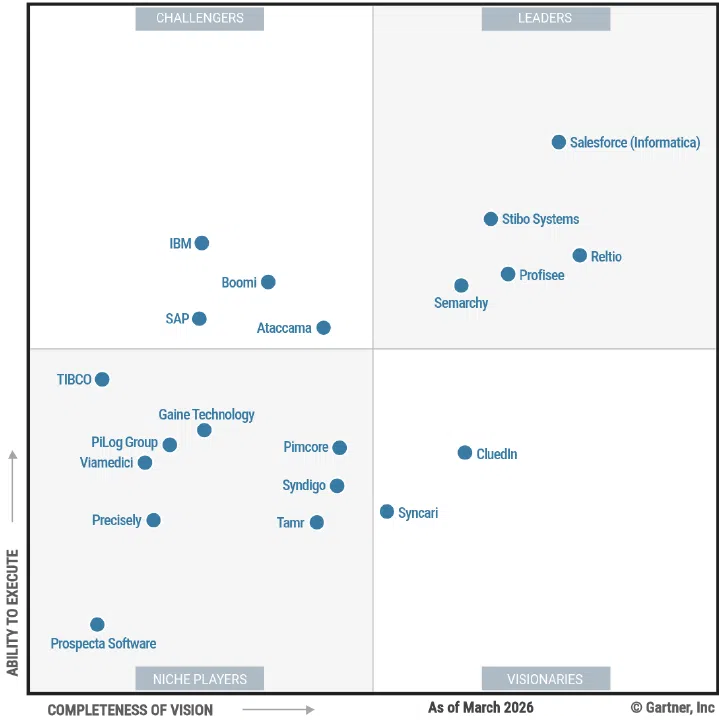
Lastly, I need to thank my company, Prophecy, for allowing me to have the best job in data. Prophecy is a leader, and I could say that because the magic quadrant was just published last week.
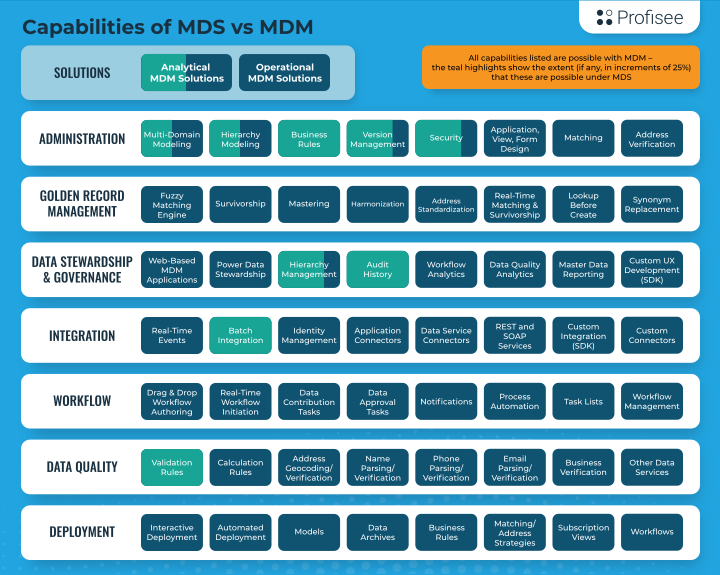
Prophecy is a leader in master data management, and if you would like to learn more, we’ve got a booth just over there. We can talk about MDM.
Let’s get into it.
Little bit about me really, really quickly. This is the photograph of me regretting life choices.
When my wife and I made did a major addition to our small little beach house in Florida, and I thought it would be a good idea while we weren’t living in the house while it was getting renovated that I would just completely gut all of our existing bathrooms and rebuild them from scratch.
Yeah. This is me on the day that I had to figure out how to jackhammer into the floor because I had to completely replace all the plumbing and all the electrical in our nineteen sixty three beach house.
And I had done that. I had jackhammer into the floor. So when I’m not talking about data, I love to do DIY. I love to work with my hands and use my body, and I will fix anything.
I’ll try to fix anything. It may take months and months, much to my wife’s chagrin. But I’m here with a story of hope, my friends, because this is now the bathroom. So anything is possible.
If I can do this, so can you.
I I do a lot of great stuff, and I’ve got a long and storied history. Before this, I was an analyst at Gartner, if that matters. I have been a chief data officer. I’m currently chief data officer. I’ve been a CIO as well. You name it in data and analytics and infrastructure, I’ve done it probably at least once.
Let’s get into it.
I had the privilege of giving a keynote speech at a conference called Knowledge Management World, Kilometers World, last December in Washington DC, and I could I had what could best be described as a Stranger Things moment. People familiar with Stranger Things with the upside down world? The whole premise of Stranger Things is there’s this whole other world that we didn’t know about that was there.
And I walked around Kilometers World, and I went to all the sessions, and they all sounded eerily familiar to me. Everybody was talking about how to enable trusted data for AI, and how to curate and classify data for AI, and how to how to become more AI ready. And then I go into the exhibit hall, and there are over a hundred vendors in this exhibit hall all talking about AI readiness, all talking about data management, all talking about data governance, and I hadn’t heard of one of them.
I was a Gartner analyst. It’s my job to understand vendors in this space, I didn’t know a single one of these vendors. Why?
Because they exist in this world called knowledge management.
Knowledge management and information management loosely aligns to what I’ll be talking about today, is unstructured data. But the fact is, just like the last presenter was talking about how the CISO has always kind of been there, this whole other world, this upside down world, and I don’t wanna say one’s upside down, one’s these two worlds have always been there. They’ve always been there, just on different sides of the same symmetric equation.
This, my friends, is the dichotomy. The world of data, the world that most of us come from, and the most of us really know quite well, and then the world of knowledge and information management.
I would loosely call these things the world of measurement, the world we come from, the world most of us live in, and the world of meaning.
These worlds are coming together, not out of convenience, not out of happenstance, because they must.
You’ve heard about context, context, context. I was at the Gartner Data and Analytics Summit about a month and a half ago in Orlando, and if I had a dollar for every time I heard the word context, I could have paid for my bathroom rental.
All I heard was context over and over again.
Why?
Why? Well, I’ll tell you why.
We’ve got different languages. We’ve got different lexicons, but these worlds need to come together.
The thing that might the the kind of the conclusion that I came to is that ironically because life is this is funny this way. This is an irony. It’s that it’s our job to name things. It’s to classify things.
To put them into buckets and to put labels on them. And across these two worlds, we don’t even share the same language. We will say a glossary. They’ll say a controlled vocabulary.
We’ll say an attribute. They’ll they’ll say a facet.
You probably heard about ontologies.
You saw the presenter of the keynote this morning talking about ontologies.
So we’ve got these two parallel worlds that necessarily must start to come together.
The reason why they must come together is because of AI, particularly generative AI.
Generative AI was born from the world of meaning. If I were to go back to the last slide with the two circles, Gen AI sits squarely in the world of meaning.
It needs complex prompts. It needs text. If you try to force feed an LLM a table, you’re not gonna like the results.
It doesn’t digest tabular data very, very well.
So this talk about context is our attempt to operationalize data from the world of measurement into the world of meaning. Gen AI lives in the world of meaning. It’s what it needs.
So why is context important? If we are going to operationalize the data sitting in our highly relational rows and columns data, which most of us are managing day in and day out, then we need to add context to it. We need to bring closer to that side of the equation. The flip side here is also true.
Meaning, if we want more predictability, more accuracy, more consistency, we need to pull the data out of the world of meaning into the world of measurement.
Right now, there is a trade off happening between these between these things, and what you’re seeing is companies investing a lot of money making these ridiculously large prompts involving things like complex rags, DAGs, dogs, all of these very, very complex prompt that drop a ton of data into a prompt to try to get more accuracy, to make these things called LLMs to act more like Power BI.
To act more like these highly deterministic systems that we’ve been managing forever and ever. So these worlds necessarily must come together.
One way to think about these worlds is a spreadsheet versus a story.
I love a thought exercise of what if our business applications, instead of storing these highly atomized little chunks, the intersections of a row and a column that have stripped away all context, that have stripped away all intent, that have stripped away everything other than what is in that intersection of a row and column. What if we started to have our business applications actually store narratives?
Store stories.
Malcolm went to Amazon dot com. He clicked on this product. He moused over. He looked over here.
That’s extremely rich in context.
Extremely rich in context. And it’s these two worlds that we need to try to bring together. The world of measurement and the world of meaning.
Something that I’ve really struggled with over the last few years, especially since the explosion of ChatGPT, is we keep talking about AI ready data like it’s the same thing as BI ready data. It’s not.
Data that is ready for the world of measurement, measuring at scale, is not the same as data that is needed for AI or preferred by AI. Maybe that’s a better way of saying it. Gen AI, and when I say AI here, folks, I’m talking about Gen AI. Machine learning, traditional machine learning, rows and columns, good stuff.
But the data that is preferred by Gen AI is that story, is that narrative, that complex, long prompt. The more you can prompt, the more context you can provide, the more narrative you provide, the better the answer gets.
Yet many of us continue to conflate the world of BI ready and AI ready as just this one catch all thing.
They’re not.
But vendors have been telling you for three years, go double down in your foundations. You need to double down on foundations, and yes, we do.
We need to double down on foundations.
But if we double down on the same foundations we’ve been doubling down on for the last thirty years, we will not move the AI needle. And that’s because of this dichotomy between what is ready for BI versus what is ready for AI.
And the delta here, my friends, is what Gartner says is eighty to ninety percent of all data in your organizations.
Eighty to ninety percent of all data in your organizations is unstructured, Sitting in SharePoint servers, sitting in Word docs on hard drives, PDFs, m p fours, video files, recording of your call center interactions with your agents, and on and on.
It’s this data that we need to get our hands around.
We live in a golden age of data and analytics. I cannot imagine a better job to have right now than the jobs we have.
Why?
This.
Our total addressable market is is like we we we tapped ten percent of it. Maybe.
Dresner Research says that twenty five percent, only twenty five percent of the data being used to train AI models, which includes machine learning, only twenty five percent of that data is governed.
Think about that.
Seventy five percent of the data that is going into these AI models is completely ungoverned because it’s that stuff.
It doesn’t conform to the data quality rules we have sitting in our data pipelines, that doesn’t conform to the governance policies we have out there.
This is massive opportunity, my friends. Massive opportunity.
So we need to bring these worlds together. Did we go forward? We didn’t go forward. Oh, I we did. I skipped it. What do we need to do? We need to unify the governance of all of this.
Well, you need to unify the governance of all of this.
There is a common use case. It’s GenAI. There’s a single use case that we’re trying to solve for. GenAI. But at the framework level here, at the bottom level of this pyramid I’m gonna show you, the opportunity is around governance.
How do we bring these two different columns together?
The world the worlds here are are quite different. This is this is why I get rather frustrated when I hear people equating and just saying AI readiness like it’s something that we’ve been doing for the last thirty years, because honestly, we haven’t. Knowledge managers have.
Content managers have. Learning management system people have. There are people in your organization who have been doing this stuff on the left hand side. They’ve been doing it for thirty years.
They’re just smish mashed all over your organization. They’re sitting in HR. They’re sitting in product. Some people even in IT.
Some in customer support doing the things on the left, and they’ve been doing it, spoiler alert, for a lot longer than we’ve been doing our stuff.
The world of library science predates anything we do, and that is largely the world that I’m talking about.
And there are two very different worlds. One is inherently probabilistic. I talked about this before, and the other one is inherently deterministic.
I can tell you, I’m a CDO, and I’ve been doing this a long time. I don’t really know what data quality means for a paragraph of text, and I don’t really know how I’m gonna solve that problem yet. We need to work together to figure all of these things out. If I read a paragraph of text and come to one conclusion, and you read a paragraph and come to a different conclusion, am I wrong?
Those are the types of problems we’re gonna need to figure out.
Because what I just said is the world of probabilistic systems, probabilistic behavior. We’re only gonna know until that model digests that data. In the past, we could run data quality rules completely in a vacuum, independent of how the data was concerned. We would know if it broke our data pipeline.
We would know if it conforms to our data governance policies or not, because our failure mode is error.
Things break. But a failure mode in the world of meaning is a misunderstanding. I’m not entirely sure what you mean.
And if our AI doesn’t know what I mean, we mean, or what we intend, or what it’s trying to solve, well, we got a bit of a problem.
Alright. So we need to unify these worlds under a common use case. We need to bring the world of meaning into our world of measurement.
How?
With everything we’ve been doing, I would largely argue. And some of the insurance space or medical may say I’ve been trying to deal with, like, transcribing doctor’s notes for a while. I get it. Or maybe automate, you know, use use using technologies to to scan insurance policies. I mean, yes, I understand we’ve been trying to solve for some of this, but not at the scale that we need to solve for this. Not nearly the scale that we need to solve for this. So what do we need to do differently?
What must we do differently to support this entirely new paradigm?
Well, as much as we’re not supposed to talk about technology, I’m a technologist, so I I’ll I’ll start with that.
Short answer, people process technology, we need to figure it out. Everybody says, well, it’s a people problem. Yeah. It’s a people problem.
It’s a process problem. Most certainly it is.
It’s also a technology problem. You hear a lot these days of this evolving context layer. That was the other thing that I would love to have played business bingo at at Gartner. Context layer, ding, because I heard that a zillion times too.
It’s not enough.
What I think of as a context layer is not enough.
All the things here need to start to come together. Data catalogs, MDM, the ontologies that are sitting in your learning management system, the ontologies and the hierarchies that are sitting in your IT service management system that have been ignored for the last twenty years.
Yes, metadata. Yes, taxonomies. All of this needs to come together into a unified management plane that enables four things.
A place to go manage governance policies. A place to enforce governance policies.
Yes. Data stewardship. I love the Waymo example.
That’s what I hope we get to, is that, like, the exceptions, the rare exceptions, then we have the data stewards that are sitting in things that go like this. Isn’t that cool?
Data stewardship needs to be supported. And something I’m calling this trans translation layer. A a semantic layer. Maybe you wanna call it a semantic layer, but this thing that is AI powered that understands that customer and prospect are conceptually the same thing, or that they’re from our other panel. The seven versions of revenue are conceptually the same, but also slightly different.
These things need to come together.
Can I go back? Yeah, I can. Yay.
So this technology is starting to form. It’s slowly coming together, but you can’t go buy this today.
The vendors will make you believe that that’s exactly what they’re selling you. Right now, today, it’s context layer.
Most data catalogs are positioning themselves as, oh, we’re a context layer. Well, they’re not not.
They’re part of the equation as they’re an important part of the equation as they always have been. Ditto with MDM.
Ditto with any sort of taxonomy or ontological solution. Ditto with data governance platforms that are not data catalogs. Most kinda call themselves that. But the vendors know this world is coming together, but there is kind of this arms race going on. Business application vendors know this is happening.
That’s why Salesforce buys Informatica. It’s why SAP buys Reltio.
It’s why ServiceNow buys data dot world.
Right? They know this is happening. They know this is coming together, and they want to keep you in their walled gardens.
The analytics providers also know this is happening. The analytics hyperscalers, the Googles, the Amazons, the Microsoft know this is happening, and they’re trying to build all this out.
What I think is probably going to evolve is something in the middle between those, because the business application providers will always try to bring you in into their walled garden, into their proprietary data standards, into their data models, into their process flows, and the same is true, I would argue, largely with the analytics providers.
But there is this world evolving in the middle of all of this, a data management layer that brings all of these capabilities together.
It’s not there yet. We got a ways to go, but it’s starting to form. Gartner would call it a converged data management platform.
So what else is needed here from a technology or not just a technology perspective? Well, would argue, my friends, we need to rethink how we manage and govern data.
We need to rethink everything. This is a brave new world, and if we try to enforce the world of measurement onto the world of meaning, it will not work.
Our operating models, our frameworks, most importantly, our mindsets need to change away from a rules driven world to a probabilistic world.
You heard today about data products. I’m a believer.
I’m a believer, but data products exist on a spectrum.
The original data products were born out of the data mesh. Shift left, get close to source. It’s all about scalability. It’s the primary driver for the original forms of data product was scalability.
I am a shift right believer. I’m about customer success. I’m about customer value.
Not just scalability. We need to do both, and I think the best way to arrive at that is to go hire a product manager. I’m not talking about promoting an analyst and giving them a role of data product owner.
That’s not product management. I’m talking about hiring a skilled product manager who can help you understand the value that you drive, understand your business processes, understand that maybe sometimes a data product as defined by data mesh is completely appropriate, and other times a bespoke one off, only built once dashboard makes sense too.
It’s not an either or. It’s a both.
That’s a key theme of this presentation. It’s not about being probabilistic or deterministic. It’s both. The world of measurement is not going away. It will never go away. We will always need to measure things.
But we need to do both of these things. So, yes, we need scalable data products. Why?
Because we’re fast approaching a world where most of our customers are robots, but we also need to have product management. We need to have bespoke customized solutions to meet the needs of our customers in a way that drives value.
So we need to rethink data products. What does that actually mean? And it’s not an either or.
We need to rethink how we think.
I just happened to write an entire book about it, but if you like some of the more provocative takes of things that I’m sharing with you today, I think you’ll enjoy the book.
But we need to rethink our approach to our customers, and I use that word purposely, my friends, customers. I’m not talking about the end customers. Like, if you’re in health care, I’m not talking about the patient. If you’re in insurance, I’m not talking about the policyholder.
I I mean, I’m not not. I’m talking about the people who use your data and analytics insights. People who are using the AI, the people who are using the dashboards, those are our customers. We all have customers.
Start calling them customers. Don’t call them stakeholders. Don’t call them the business.
They’re our customers. Without them, we don’t have jobs. We need to rethink our roles. Just talked about that. Becoming more like business consultants. We need to rethink our data. We’ve got a really codependent dysfunctional relationship with our data.
We love to call it crap.
We love to complain about our data.
It’s the very thing that gives us a job, but we can’t stop complaining about it.
Can you imagine oh, you got you got your hand up.
Let let me come back to you.
Let me come don’t let me forget either. Thank you. We love to complain about our data. We say stupid things like garbage in, garbage out.
Would you if if you were sitting at a table with your CEO, your CEO looks at a report, the report is incorrect or it’s inaccurate, it’s got a duplicate record, who knows, whatever, right? And your CEO looks at you and says, hello, c d o, why is this this way? Would you ever say, hey, sorry boss, garbage in, garbage out.
Then you wouldn’t.
You wouldn’t because it disempowers you. And you know it disempowers you.
You get hired. You get budgets and millions of dollars to solve this problem. But yet, every day we disempower ourselves when we talk about garbage in garbage out. I talk about this at length in my book. I’d be thrilled if you checked it out.
We also need to rethink data governance. The frameworks we have around data governance are thirty years old.
They’re thirty years old.
I can tell you a story about the first time that I ever described myself as a data owner. It was in front of my chief data rep chief revenue officer, and I was a thirty something up and coming data manager. And I went into my chief revenue officer’s office and said, hi. I’m here to help you. Oh, great. And I own your customer data, FYI.
It’s one of the shortest meetings I’ve ever had. I tried to tell my chief revenue officer that me, the pumpkin IT who was doing the dashboards, now owned his customer data.
The concept of data ownership aligns to a model that is thirty years old, and I would argue, yes, we need racy matrices. We need accountability in data. I understand that. We need help from a stewardship perspective. We need our customers to be bought in. We need them on board.
But when we go and anoint mid career people in the data team and say, now you’re an owner of data that is shared widely, like customer, product, or asset, location, generally known as master data. When we say one person owns that, I don’t want that job.
That’s just one example, my friends, of how we need to think differently about data governance.
We desperately need to think about data governance as an enablement tool and not a control tool. How do we do that? By proving its value.
If you had to sell data governance in your data governance shop, right, you set up a store, here’s my data governance store. Who wants to come and buy some data governance?
Think about it that way. I’m not saying run your data governance organization as a p and l, but that’s the kind of thinking we need.
It’s the kind of thinking that we need.
So what are some practical steps?
I think there’s a huge opportunity for us as chief data officers to bring that world of knowledge management and unstructured data, the seventy to or eighty to ninety percent of data, we need to bring that under our wings. We need to bring that into our fold. I went and did talked to people at Knowledge Management World. Thousands of people. And I I just kind of played the role of the unfrozen caveman CDO and said, I don’t know anything about your knowledge management.
And I had conversations with people, and I said, would you be open to working for the CDO? You’re an ontologist. You’re building ontologies that describe your customer interactions on your website. Would you be open to working with the CDO?
The data people get all the money.
Yeah. Right? For all of us in budget fights right now? Yeah. Are we struggling for money? The people in the knowledge management roles are all over your organization, and and they would welcome potentially coming to work a data and analytics function.
Because they don’t they don’t necessarily have a single encompassing organization to describe what they do, but they’re out there. Go find them. Go have lunch with them. Talk to them about what they do from an ontology perspective, a context perspective, a taxonomy perspective.
Go have conversations about controlled vocabularies. Go have conversations about metadata. That’s where it starts. Metadata is the connective tissue between the world of meaning and the world of measurement.
Yes, we need to bring these people into the governance fold as well, and it starts with metadata.
We need to have common definitions of shared metadata that span both of these worlds. The seven definitions of revenue. We need to work together to figure what those are. We need to figure out what the shared definitions will be going forward.
You need to hire product managers. As a CDO, if there were one role two. Can I have two? If there were two roles that I would hire for, now, product manager, value engineer.
First one, to interact with the business and define the requirements to build the products that are gonna transform your organization, AI or otherwise. The second one, to quantify the business benefits of doing so.
Value engineer. Somebody who knows how to model the benefit of data within the organization.
That would be the, I would argue, is the most critical role that most of us do not have.
You need to rethink your operating model, including governance. How do you go to market? We need to think more like product managers. We need to think like we’re building and marketing a product.
Go to market. User training. Maybe not so much literacy. I’m not a huge fan of that, because what’s the opposite of literacy?
I I I don’t know a lot of consumers who who like being called illiterate, but trainees are critical. It’s critical.
And anybody who’s building and selling a product knows that.
Lastly, you’ve heard about this.
Multiple presentations. Go break some stuff.
Go break some stuff. Yes, I know we work in regulated industries. Yes, I know we need to be careful.
But it took I love I love the I love the slide about it took forty years for regulation to to come in the airline industry. I’m not saying we need to go go to jail, or go to break stuff irresponsibly, but that was a good topic in the last conversation, in the last panel I was in. Right? Responsible innovation, I think was the phrase.
How do we do this responsibly? Because there are ways to go break stuff responsibly. You can put some fences around the room where you go break stuff. And ultimately, what you wanna get to who’s familiar with the d I k w framework?
Has anybody seen this pyramid before?
A few heads, but I’ll tell you that for a knowledge manager, content manager, somebody who’s responsible for building and managing your search process internally, they’ve seen this a zillion times. DIKW, data information knowledge wisdom.
We need to build an operating model and and build an infrastructure so it supports all of it. Data, sitting at the bottom, the intersection of a row and column, working all the way up to knowledge.
That three hundred page page narrative, the story. Wisdom is the unique domain of human beings, hopefully, for now, and hopefully forever.
Maybe. But we need to manage all of it, and we do that, we will enable the trust that many of us have been talking about over the last, oh my god, four years since Gen AI exploded on the scene. So my last question is entirely, rhetorical.
I know you are.
I know you’re ready.
Let’s go do this. We’ve got big problems to solve. I would be thrilled if you bought my book.
I’d be more thrilled if you checked out my podcast. It’s called CDO Matters.
Maybe relevant to a few people who do data in the room. I don’t know. Title suggests it is.
And last, my call to action here is if you wanna become a member of the CDO matters community, I I create content like a machine. I’m every two weeks we do a podcast. Every every month we do a live event on on LinkedIn. I’m creating blogs, newsletters.
I’ve got a Substack.
And I’m giving away everything I learned after three years of being a Gartner analyst.
So thank you for that. Thank you for attending. It’s great to be a part of this community.
Thank you.
ABOUT THE SHOW