


















Master Data Management — Start Here
You’re In The Right Place

New to MDM or evaluating vendors? Learn what master data management is, why it matters, and why organizations choose Profisee to get there faster.

Putting AI to work on your data?
It's only as reliable as the data behind it. Profisee helps you build the foundation your AI initiatives require.
Understanding Master Data Management
Most data problems aren't actually data problems.
They're MDM problems.
Explore the fundamentals of master data management: what it is, what problems it solves, and why modern MDM is faster and more achievable than ever before.
Master data management (MDM) gives organizations a trusted foundation for business decisions. It creates a single, reliable source of truth for the data that matters most: customers, products, suppliers, locations and more.
What is MDM? | Business Definition
MDM, master data management, is a technology-enabled discipline to allow organizations to create business rules and manage business rules for consistent and accurate and trustworthy and fit-for-purpose shared data assets across the organization. So that last little bit there is really important: shared data assets. So these things all together: the policies, the procedures, this is data governance; technology enablement, which is the software, it’s a critical aspect of most large-scale MDM initiatives; and plus, of course, the idea of data being widely shared across the organization, across systems, applications, disciplines. This is where the economies of scale really, really come to the fore, where you can have consistent management of customer data, product data, or asset data to allow for economies of scale, to allow for business efficiencies, to allow for consistent decision-making across the organization. So MDM at its heart enables both operational efficiencies, in terms of allowing the organization to operate far, far more efficiently than it ever would as individual silos, but beyond the operational efficiencies it also enables organizations to scale and to generate new revenue streams, to understand their customer needs, to drive new innovation within their organization. So that’s what MDM is.
MDM is a centralized data platform that connects systems, resolves inconsistencies and continuously improves the quality of enterprise data over time. It becomes the trusted system of record that downstream applications and analytics rely on, and the data infrastructure that makes enterprise AI trustworthy at scale.
How Does MDM Work? | Technical Overview
MDM through more of a technical lens: if we were to look at this more from an architectural perspective, what MDM is, is a data hub. It’s a data hub, and it’s also an integration hub that will typically sit above source systems. So you can imagine you’ve got multiple systems of data: CRM, ERP, digital marketing platforms, you name it. These are the systems of record for things like customers and assets, employees and locations, where all of this data is sitting in these individual silos. MDM is a data hub that will sit on top of, physically speaking and virtually speaking, sit on top of these systems, and will manage copies of customer data, product data, asset data, location data in that data hub. So it’s a physical hub, and it’s also an integration hub because MDM is tied to those source systems. MDM will sit between the source systems and analytical systems. So MDM will take the data, will create a single trusted golden master version of customer, asset, location, where that information can be provided to analytical systems. It can also be pumped back down into those source systems. So no longer do you have multiple versions of customer, multiple versions of product, either within a silo or across silos. So MDM can enable you to have a single trusted, consistent view or consistent operational version of a customer record or an asset record or employee record, any of that data that is widely shared across the organization.
MDM standardizes, governs and connects your critical data across systems and teams. It applies data quality rules, manages relationships, automates stewardship workflows and ensures everyone operates from the same trusted information, so your analytics are reliable, your operations run cleaner and your AI initiatives work the way they’re supposed to.
What Can MDM Do for Me?
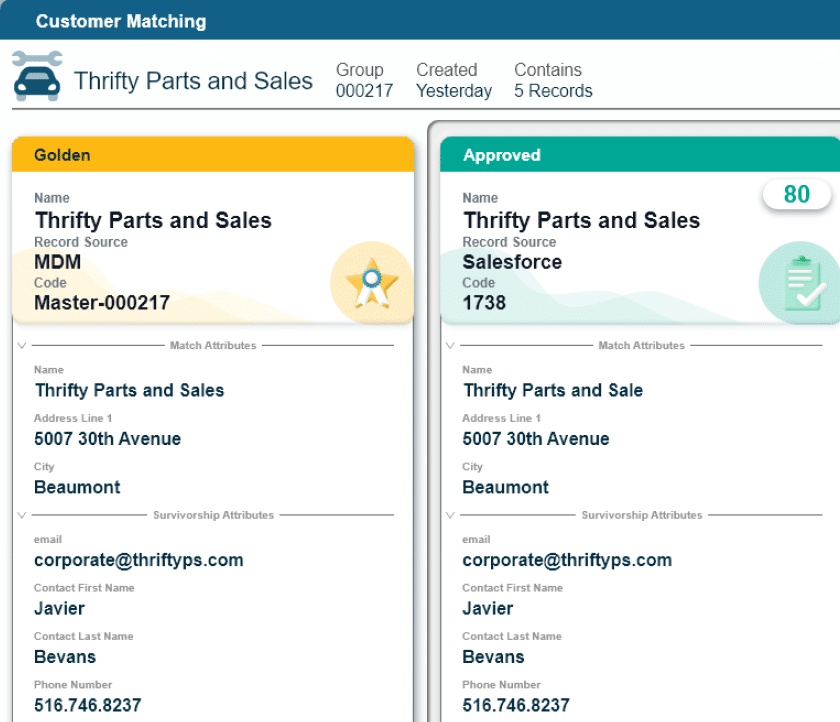
So, to the question of how MDM kind of works: at the core, MDM is a data management hub. It’s also an integration hub. But how MDM works is that it will take very small snippets of data out of source systems and allow you to apply consistent data governance policies and procedures to that data, to allow you to have consistent definitions, quality, and hierarchical structures related to that data. If we look at the core capabilities of MDM, if you asked Gartner, for example, there are 13 capabilities. I won’t go into all the details of the 13 that make MDM unique, but here are some of the things it does. It applies consistent data quality rules to that data, so when is data for your customers accurate or inaccurate? It enables something called entity resolution, which is a fancy way of saying magic. It allows you to know if Acme, Acme Inc., and Acme Co. are one thing or three things. It’s also an integration hub; it allows you to tie data together across systems. It’s also a place where you can manage business rules related to complex relationships that may exist within your data, whether that data is a customer or a product or an asset or a location. So all of these things come together, in addition to administrative capabilities that allow you to manage and configure all of these rules in very flexible, adaptable ways. So you take the core mechanics of MDM, how it works and how it brings data together; the way it lets you manage some very specific governance policies and procedures for that data to ensure consistency and accuracy; plus some of the administrative capabilities of MDM, like data stewardship, management of data, and validation and verification of data. You take all three of these things together, and that’s how MDM works.
What Problems Does MDM Solve?
At a high level, what MDM solves for is that it breaks down data silos that naturally evolve over time within large organizations. What we see is that within any organization, there’s functional specificity around how those organizations work. Finance works to fulfill finance workflows, customer service works to support customer service workflows, and on and on. And over time, as business applications are built and created to support those functions, like CRM or ERP or digital marketing platforms, it’s natural to see the data in those systems that is widely shared, like customer data, naturally evolve to best fit the purpose for which it’s being used within that workflow, whether that’s finance or accounting. So what we’ll see is that although the customer may be conceptually the same customer, the way it’s represented is slightly different across all of those systems. What MDM does is help break those silos to have a single, consistent, accurate, trustworthy view of that data, a single version of the truth of that customer data, by pulling data out of all of those systems and creating a record that can be used as an enterprise-wide record to help data flow better and more efficiently through those various systems. So the problem that MDM solves is often one of data quality, where the data is inconsistent across systems. It’s often one of operational efficiency, where today you may have a swivel chair that takes contract data out of a CRM and enters it into an ERP system. So MDM can allow for workflow and process automation. It can allow for better decision-making, because if your CEO asks, “Hey, can I have a full report on this customer?”, the data for that customer could be represented in different ways, in different structures, in different formats, and the CEO will ask, “Well, this data is different from here to here. Can I really trust this data?” So from an analytical perspective, it can provide confidence and accuracy in decision-making that is harder, and certainly more time-consuming, to create if MDM wasn’t there in the first place. So by breaking these silos, and by allowing for the management of business rules, aka governance policies, that allow you to create consistent and trusted views and uses of this data across the organization, MDM allows for analytical insights, better decision-making, and automation of business processes, and it allows for, frankly, better decision-making within the C-suite.
Sed ut perspiciatis unde omnis iste natus error sit voluptatem accusantium doloremque laudantium, totam rem aperiam, eaque ipsa quae ab illo inventore veritatis et quasi architecto beatae vitae dicta sunt explicabo. Nemo enim ipsam voluptatem quia voluptas sit aspernatur aut odit aut fugit, sed quia consequuntur magni dolores eos qui ratione voluptatem sequi nesciunt. Neque porro quisquam est, qui dolorem ipsum quia dolor sit amet, consectetur, adipisci velit, sed quia non numquam eius modi tempora incidunt ut labore et dolore magnam aliquam quaerat voluptatem. Ut enim ad minima veniam, quis nostrum exercitationem ullam corporis suscipit laboriosam, nisi ut aliquid ex ea commodi consequatur? Quis autem vel eum iure reprehenderit qui in ea voluptate velit esse quam nihil molestiae consequatur, vel illum qui dolorem eum fugiat quo voluptas nulla pariatur
Is MDM Right for Me?
When we talk about who MDM is built to support, who it’s helping within organizations, we naturally first look at IT leaders, senior IT leaders. So often this is chief information officers; increasingly it’s also chief data officers, maybe vice presidents of data and analytics, but people in an IT organization who are managing the data estate. They’re responsible for data governance, they’re responsible for data quality, and they’re often responsible for data science, increasingly for ML, for AI. The people who are managing these data infrastructures are typically the ones who are being tasked to solve the problems of data inconsistency and data duplication. And so we typically see senior-level IT leaders as the ones leading the conversation when it comes to the implementation of MDM as a discipline and a technology.
Sed ut perspiciatis unde omnis iste natus error sit voluptatem accusantium doloremque laudantium, totam rem aperiam, eaque ipsa quae ab illo inventore veritatis et quasi architecto beatae vitae dicta sunt explicabo. Nemo enim ipsam voluptatem quia voluptas sit aspernatur aut odit aut fugit, sed quia consequuntur magni dolores eos qui ratione voluptatem sequi nesciunt. Neque porro quisquam est, qui dolorem ipsum quia dolor sit amet, consectetur, adipisci velit, sed quia non numquam eius modi tempora incidunt ut labore et dolore magnam aliquam quaerat voluptatem. Ut enim ad minima veniam, quis nostrum exercitationem ullam corporis suscipit laboriosam, nisi ut aliquid ex ea commodi consequatur? Quis autem vel eum iure reprehenderit qui in ea voluptate velit esse quam nihil molestiae consequatur, vel illum qui dolorem eum fugiat quo voluptas nulla pariatur
The fastest way to get started with MDM
- Missed cross-sell opportunities
- Customers receiving the wrong communications
- Operational inefficiencies hiding in inconsistent product data
Take the Next Step
Ready to Evaluate MDM Solutions?

You know what
MDM is and why it
matters

You understand
the problems it
solves

You know the
first steps to get
started
Choosing the Right MDM Solution
Not all MDM platforms are built the same.
The best modern MDM solutions are fast to deploy, flexible to configure and designed for long-term scalability. Here’s what organizations consistently look for, and why many choose Profisee.MDM for the AI era
It's not a tagline. It’s where the market is going. Profisee is already there.
Why customers choose Profisee
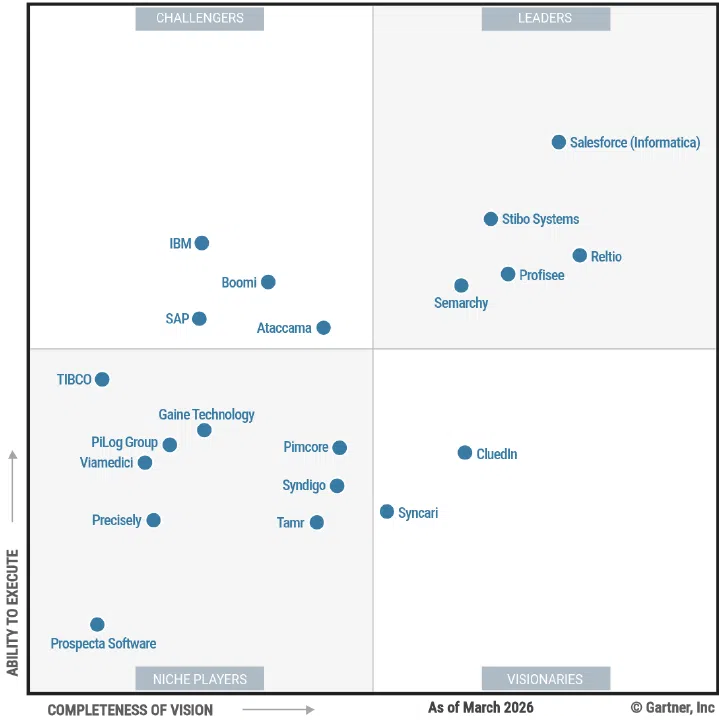
2025 Gartner Peer Insights
What to look for in an MDM solution
Not all MDM platforms are created equal. Use the criteria below to evaluate any solution and see how Profisee measures up, including how it helps you build the clean, connected data foundation your AI initiatives depend on.

Fast time to value
MDM initiatives shouldn’t take years to show results. Profisee customers typically see payback within 6 to 12 months using our proven 90-day FastStart methodology.

Flexibility without complexity
Your MDM platform should adapt to your business, not force you into rigid workflows. Configure matching, survivorship, governance and stewardship experiences without custom code.
Built for your ecosystem
Your data doesn’t live in one place and neither does Profisee. Open, flexible integration means trusted data wherever your business runs.
A partner, not just a platform
Technology matters, but so does the team behind it. Profisee earned a 100% willingness-to-recommend rating in the 2025 Gartner Peer Insights report because customers value both the platform and the partnership, including helping them prepare their data for AI-driven use cases.What customers say
Verified reviews from Gartner Peer Insights
The Profisee team has been a fantastic partner starting on Day One of our MDM platform selection process, during a lengthy and complex implementation, and on into a series of platform upgrades.
Sr. Master Data Architect
Source: Gartner Peer Insights
The support team is really responsive. We have recurring meetings to discuss our experience as a user of the product and issues encountered. Very good user experience.
Director of Data Architecture
Source: Gartner Peer Insights
A very flexible platform that helps streamline and manage our data assets. The Profisee platform is technically stable and very well supported by both the vendor and their implementation partners.
Data and Analytics Manager
Source: Gartner Peer Insights
With the Profisee Platform, it is now easier than ever to manage our data with little to no problem. Tickets are attended to in a timely and effective manner by an excellent support team.
Chief Data Officer
Source: Gartner Peer Insights
