


































Episode Overview:
The State of the Data Nation: Why Your Roadmap Is Already Behind
The data and AI landscape shifted more in the last six months than in the three years prior and most data teams are still operating off roadmaps that predate it. Malcolm Hawker goes solo to give data leaders an honest read on where things stand and what to prioritize for the rest of the year.
📌 In this episode:
Why Gartner’s keynote message — that it’s okay to be a late AI adopter — is advice Malcolm thinks is negligent, and why you don’t have three more years
How agentic AI and tools like Microsoft Foundry and OpenAI Studio are finally connecting the dots between data foundations (MDM, data quality, governance) and real AI business outcomes
What SAP’s acquisition of Reltio means for MDM customers and who should be paying close attention
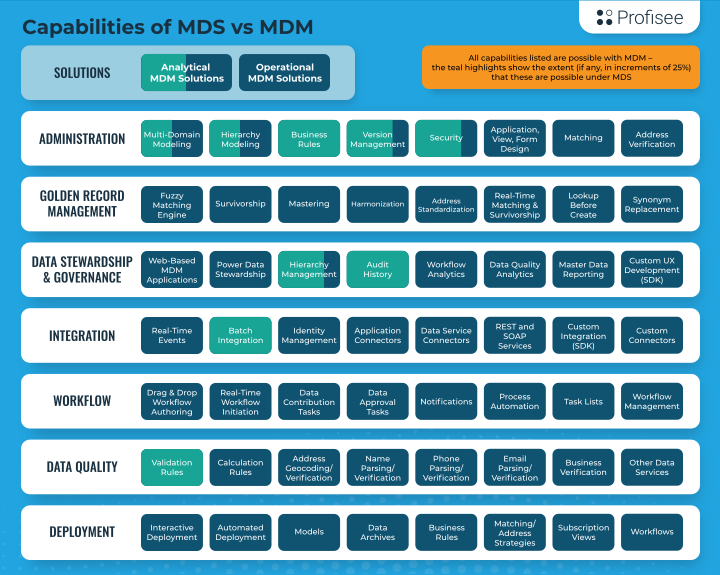
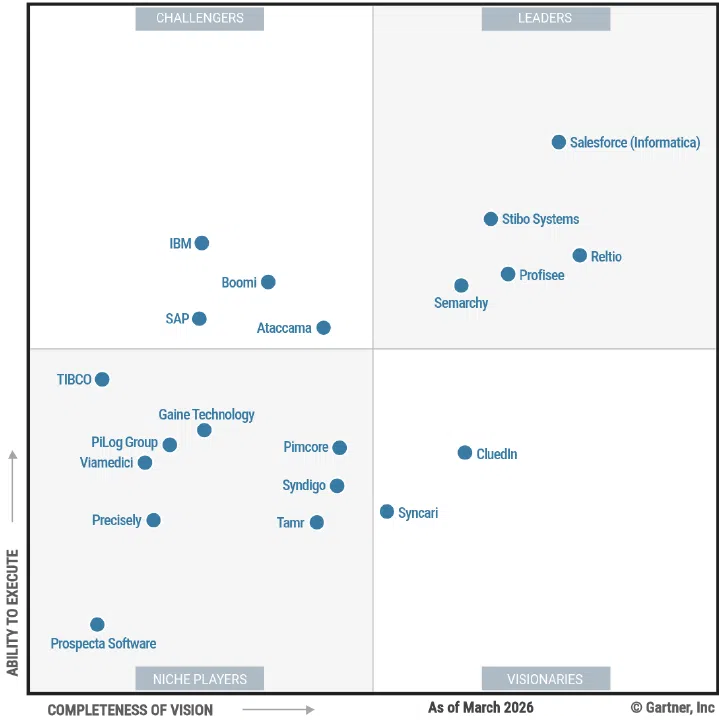
Profisee named a leader in the new Gartner Magic Quadrant for MDM: what it means and why it took four years to get here
💬 The takeaway: “If you don’t have some idea of how you need to adapt your governance model to support AI, you don’t have three years to figure it out because you already had three.
Episode Links & Resources:
Good morning, good afternoon, good evening, good whatever time it is, wherever you are on planet Earth.
Our amazing blue orb. It gets more amazing watching all of this footage from the Artemis mission. I don’t know if you’re the same.
I find that, like, really intoxicating and really, I don’t know, really uplifting. May maybe maybe I I just am wowed by technology, but I find all of that just rather humbling.
And I love watching the footage. I love watching these photos of of the planet Earth. And, you know, I say that. I say it’s this wonderful blue orbits, our wonderful planet, honestly because I mean, I I’m I feel so lucky to be alive. I feel so lucky to be here. I feel so lucky to be having these conversations with you every week. Maybe it’s with somebody else, maybe it’s just me today like I am solo.
And that’s just kind of my silly way at the beginning of these podcasts to say, hey, I’m really thankful you’re here and I’m thankful to be here and I hope you get some value out of these conversations.
But I think it’s just so cool to see these photos.
Hey, native people. Welcome back. It’s just gonna be me today. I I realized that I haven’t done a solo solo recording in a while, and there’s so much going on. I I thought I would just just pour it all out.
Like I was in a little kid, I I used to collect Legos and build things with Legos and I pour all the Legos out onto the floor and I’m and I’m gonna pour my Lego out today. So today’s conversation is gonna be a catch up. It’s gonna be my thoughts on all the things that are going on right now. I realized that I haven’t actually given an update since I was at Garter.
I’ll talk a little bit about Gartner at the beginning. I don’t wanna go deep on that. I wrote a blog post. I wrote several things on LinkedIn.
If you’re looking for a a deep overview of my perspectives on on on Gartner, probably the blog post would be the best way to do that multiple pages of blog and written content. But more than anything, wanna give kind of a state of the nation. There’s so much going on. The technologies are moving, my gosh, so fast.
My head is spinning. And I thought it would be useful for me and for you as a listener to just kind of take a step back, breathe a little, and figure out what the heck’s going on and what should we be doubling and tripling and quadrupling down on through the rest of the year. Obviously, it’s it’s April. I’m recording this April sixth.
You’re probably gonna get this reasonably soon. I don’t have a lot of backlog episodes.
You’ll probably listen to this maybe at the latest or early May. Your budgets are already set. Probably your road maps are set for the year.
And then maybe you could just use this as a validation point. And if you’ve got the ability to maybe do some shifting around from a road map and budget perspective, Maybe the things I’m gonna say today will be helpful because there’s a lot going on and things are changing. And frankly, if you were doing roadmaps like last this was my this this was normal for me when I was leading a data data team. I’d be doing roadmaps as early as September or October of the previous year.
Yeah. We went agile and, yeah, we’d have to kind of change that. But at a thematic level, I’d kind of be locked and loaded on what I wanted to be working on the coming year by easily by Thanksgiving. For sure by Thanksgiving.
The budgets would be locked well before Thanksgiving. So if you’re in the same kind of boat, you probably built a road map that is now at least six months old and you’ve just kind of started on it and maybe time to revisit or or just recalibrate. Gosh, my friends. There’s so much going on.
How are you? How are things? Thanks for listening. Thanks for tuning in. Thanks for subscribing.
I hope you get value from these discussions. That’s my goal. My goal is to extend the tenure of chief data officers or help anybody who wants to become a chief data officer to become a chief data officer. It’s a pretty good gig, I think.
It’s a golden age of data and analytics. It’s the best time to be in data. I’m not one of these doomer, gloomers that thinks that AI is gonna automate everything we do, because we’re the people building it, friends.
You know, yeah, there’s gonna be some automation in data management. Of course, we’re gonna automate some stuff. Without a doubt, we’re gonna automate some stuff. But if there’s a career that I’d be betting on right now, honestly, and I say this from my heart, it’s in data. So you came to the right place, you’re in the right career, you’re on the right career track.
Let’s figure out what the heck’s going on in early twenty twenty six, shall we? Oh, by the way, comments are welcome. Connect with me on LinkedIn. If you listen to these podcasts and you haven’t connected with me on LinkedIn, you really should because send me a DM, send me a question, throw a digital shoe at me.
I may not always be right. Maybe you disagree with something at stake in this podcast. That’s cool. But let’s engage. We are creating a community here, my friends, and I call it a community, and I I do that purposefully.
We’ve got several thousand people on an email listing. We are gonna be doing more community centric events this year and the following year. So I’m gonna take a page out of my friend Juan Cicada’s playbook and start doing some, you know, local, like, in your city type dinners type events, smaller gatherings. Yes.
We’ll continue. Prophecy will continue to sponsor events. I will continue to speak at the big events. I will be going to the big events, of course.
But we’re gonna be doing more small, more intimate, more community like events in a town near you. It’s a big focus for us this year.
We’re gonna partner with CDO Magazine this year. We’re gonna be doing some events at CDO Magazine. By the time you listen to this, one would have already happened. Second week, April sixteenth in Columbus, Ohio, CDO magazine is doing a lead legal leadership summary. This will publish after that, so it will have already happened.
But we’re looking forward to doing more of those events this year. I’ll be recording podcasts just like this at CDM Magazine events. I know we’re gonna be doing something in New York. We’ll be doing something in Dallas.
We’ll be doing something in Chicago. We’ll be doing something in Boston. So if you’re in one of those four cities and you are a CDO or somebody who wants to be CDO, you’re in a data leadership position, or maybe in a data management position, come on out to the CDO Magazine events. They’d love to have you.
We’d love to have you. Say hi to me.
And maybe I’ll be recording an episode of the podcast. You can swing by and say hi.
So we’re gonna be building this community. If you’re a part of it, thank you. You can look forward to more valuable content through the year. This is my job, is to provide content to data leaders, whether that is written content. These podcasts, you name it. My book, I’m thinking about another book.
It’s a lot of work. It’s a lot of work. Well, to do it the right way. But what do I mean by the right way?
It’s like me being the right of me. When I wrote the Data Hero Playbook, I didn’t use AI at all. Like zero. Zero.
Didn’t even use it as a proofreader. For better or worse, I wanted it to come from the heart. I wanted it to come from me and me alone. And I didn’t wanna kinda fall down that rabbit hole.
I I suspect future books will be involving AI more. Let’s start very briefly with Gartner. Again, I do welcome you to check out my blog post on this.
It it goes into depth. But Gartner was great. And Gartner is always great. And it is the preeminent event for data leaders. Now if you have thirty five hundred, four thousand dollars plus travel to Orlando for a week, so you know, throw in another fifteen hundred easily there.
If you work for a company that’s happy to throw five, six grand into professional development, Or maybe that’s your budget for the entire year, and you’re trying to figure out what should I do. Go to Gartner. It’s the best event. It is most certainly the best event.
And I and I’m not saying that, you know, I’m not trying to downplay the other events like the CDOIQs and the DGIQs and all of the other amazing events that I get to go to in the year. But, I mean, Gartner’s kind of like the Super Bowl. I mean, it’s kind of the preeminent event. It is.
It just it is.
The quality content is great. The quality of speakers is great. These are polished data professionals. Arguably, some of them more academic than practical. They they tend to lean on the academic and less so on the practical. That’s just kinda how it is.
But, yeah, well worth going. They drastically improved their AI centric content this year. Last year, their AI content was way behind way behind. This year, they drastically improved.
I think that largely is in part because Gartner actually kind of separated the the data and analytics and the AI team was one big team, they created a specific AI team and and staffed it with AI experts. So that’s a really good thing, and the AI level of quality went up drastically this year. The biggest concern I had with Gartner this year was the keynote, and it pretty much almost always is the keynote because I I think it is the opportunity to, you know, wow the crowd, the opportunity to set the stage, the opportunity to assert Gartner as a thought leader in the space. They do that.
But they to some degree, they they kind of have to keep the keynote a little milpost y, A little, you know, in the middle of the road, they can’t get too provocative and too edgy as they don’t wanna they don’t wanna alienate the, you know, their their customers. And they do know. They they are intimately aware that customers buy Gartner subscriptions not because those customers are like maturity level five. Nobody’s buying a Gartner subscription because they’re maturity level five because they’ve already figured out their governance model.
They figured out their operating model. They’ve nailed it. Right? If you’ve nailed it, if you’re the top five, ten percent of of, you know, data leaders and you you’re you’re nailing it, well, you probably don’t necessarily need a Gartner subscription to help you.
So they Gartner’s aware that most of the people that are going there are are the folks that that want some help, that want best practices, that want their hand to be taken and and led along. So Gartner can’t get too far ahead, and they and they can’t alienate their customers, and they can’t really kind of call anybody’s baby ugly. I go into this in detail in chapter five of my book, the Data Hero Playbook, in the many ways that that Gartner and other analyst firms, not just Gartner, that Gartner and other analyst firms tend to kind of slightly reinforce the status quo.
You know, there’s there’s an interesting business model there, there’s a subscription model in which, again again, I go into a lot of detail in my book. If you’re interested, check out chapter five of my book in in how some of the analysts were in consulting firm in in intent to to reinforce the status quo.
Long winded way of saying the keynote was really disappointing because Gartner in essence validated that a late adopter, a late adopter strategy in essence when it comes to AI, like if that’s okay.
Right? And basically they said, hey, you can be a late adopter and that’s fine. You can take in essence, I’m paraphrasing them. And I asked multiple people if I heard this the right way and they all said yes.
You you know, I heard the same thing. So it’s not just me. I I went I’m like because I’m like, wait a minute. Hold on.
Did I actually hear that? Did I just hear the leading analyst firm in the data in the AI space say, it’s totally okay to be a late adopter around AI and take the next three or four years to figure it out.
That’s what they said. In essence, I’m paraphrasing, but that’s what they said. I think I think that what Gartner realized is that a lot of their clients are overwhelmed. A lot of their clients are struggling with the basics. Yep. Get that too, because we all are to a certain degree. We all are to a certain degree.
And that a lot of their clients were saying, hey, this is I don’t need to do this. My business maybe isn’t asking that much, or maybe we need to focus on fixing some things before we figure out AI, or blah blah blah. And I think Gartner basically said, okay. It’s valid, obviously, and that’s okay. Take your time.
And I’m sitting in my chair at the keynote. I’m like, no, no. No.
Yeah. It’s okay to be a late adopter, but we don’t have three to four years to figure it out. I mean, if you’re a data provider and and you don’t have a strategy for how to adapt your operating model to support AI, you can’t take you head off take three years to figure it out. If you don’t have some idea of how you need to adapt, and we’ll talk about this in this podcast. If you don’t have some idea of how you need to adapt your governance model to support AI, you don’t have three years to figure it out because you already had three.
You already had the last three. Right? This is why so many businesses are getting increasingly impatient with us, the data providers, because we’ve had three years to figure it out and saying, take another three, we’ll be lapped.
We’ll be we’ll be like me running a long distance race when I was in junior high school. I was the guy getting lapped.
It is no fun to get lapped. Trust me. Like when you’re getting like literally lapped, we will be lapped. If you could take another three years to figure out what it means to, you know, how you’re gonna adapt your foundations, what what you what you need to do in order to become more AI ready. You take another three years to do that, my friends, it could be existential. It’s already existential.
So, you know, we need to start moving. We need to start figuring some of this stuff out. Not all of it. Not all of it. Some of it.
Some of it. We need to make some progress. So I thought that was kinda negligent.
This this idea of it’s okay to be a late adopter of AI.
I I I viewed that to be a little negligent on Gartner’s behalf because it should be. That if if you are you you and you believe yourself to be one of these later doctors and you you you are struggling and you don’t have a a strategy yet here, if you don’t understand how you need to approach data management differently, MDM, data quality, data integration, just the use of agents in the desktop, I could go on and on. If you don’t know how to change things in order to more embrace AI, you really haven’t started to figure any of that out yet, You don’t have three years.
You you should have already had some idea now, but like you don’t have three years. So that’s I mean that was my biggest takeaway from Gregor. I I again, I’d invite you to check out my blog.
It’s a great data conference. They do a good job.
There’s a lot of focus on AI readiness. I I’m not even entirely sure what that means.
But there was more of a focus on better AI content and I got to listen to pretty much almost all the presentations.
So I get the magic badge, which is awesome.
But one thing that Gartner does very well is is that if you have a full paid conference attendee badge, which I have, then you can listen to presentations offline after the fact, which is what I did. Right? Most of the time when I was at the at the event, I’m at the booth and I’m talking to clients, I’m talking to people.
Then I go back to my bat cave here at the beach in Florida and I listen to presentations. And I and I listen to almost all of them. So well worth the time. Anyway, let’s transition into the state of the nation.
My goodness. There’s so much going on. Let let’s just kinda start with what I’m seeing at a very, very high level. At a very high level, what I’m seeing is that a lot of the data management technologies and AI technologies, so we’ll just say both of them. AI, at least in so far as let’s just call it AgenTeq AI, that’s fine.
And their enabling technologies are rapidly advancing and so are data management technologies. And it’s now to the point where it is far easier for data leaders to be able to conceptually, the phrase I use is connect the dots.
Meaning, connecting the dots between AI use cases, what is needed to support an AI use case, and the things we do day in and day out with data management. I would argue three years ago when ChatGPT kind of exploded onto the scene, and arguably for the last three years, many of us have struggled to understand what is the tangible benefit of me doing the MDM and their AI? What’s the tangible benefit of me focusing on data quality or data integration, right, or basic data governance stuff? What is the connection between that, what we could just loosely call the foundations?
What’s the connection between that and enabling these AI use cases? I would argue for three years, for three straight years, we really haven’t known because those connections have not been very strong. They haven’t.
They haven’t. Those connections have existed in these complex AI workflows known as rag patterns.
Right?
Dog data something, object graphs, DAGs, data, a cyclical graphs, rags, retrieval augmented generation, where these processes, these intermediary processes that were all hand rolled, right, that were all that were all hand engineered, generally with thousands of lines of code.
Right? Generally with thousands of, like, little blocks of software, a lot of conditional statements, a lot of if thens, a lot of where you would allow an LLM to interface with these complex processes that would go and dip into a knowledge graph. Right? That we go dip into a vector database that you had created along the way.
Right? Where there was literal software that had to be hand rolled, hand coded to allow the fruit of your data management labor, MDM, data quality, data integration, just data persistence even, right, stuff sitting in your database, all of that to be consumed in a way that was meaningful and relevant for a large language model. Right? And for many of us, what the data consistently showed over and over and over again, for eighty five, ninety percent of us weren’t doing any of that stuff.
Weren’t doing any of it. What we were doing was we were allowing LLMs to be used on the desktop, which which is we still are.
And we’re basically just kinda rolling the dice from a risk perspective, from a compliance perspective, having a lot of constraints on what you can do and what you can’t do. But where you would see HR people writing job descriptions, you’d see marketing people writing, you know, positioning statements, go to market documents, customer FAQs, where there was certainly adoption.
There’s certainly adoption, but not really high value adoption and not certainly not a complex adoption, right, where you were writing these very, very complex intermediary processes. I’ll just call them intermediary processes where you were able to draw a hard line between the output of, let’s say, an MDM process, for example, a gold master table, a table of gold master records, your customer master records.
Were they exposed that to an LLM required all of this intermediary work, then ninety percent of it was working.
Just work. Right? For better or worse. Some of us work, most of us were not. That’s what I mean by connecting the dots. The line between AI usage, value, business outcomes, and the stuff that we’ve been doing for thirty years, foundational things, the line just wasn’t there. Those thoughts were not connected for most of us.
That is my high level takeaway of what is changing.
That, my friends, is what is changing.
The AI, the fundamental AI, these foundational models are not changing. The the LLMs are not changing. However, the tools that are being built on top of them, such as OpenAI Studio, Microsoft’s Foundry, other tools to help you, in essence let’s say, we can call them an SDK.
Nobody’s calling them SDKs, but, you know, software development kit ish, where these tools are evolving to the point where you can actually now more easily connect these dots, where two years ago, I made a post of this like last year. I I said I wouldn’t set an LLM lease on any of my structured data. Right? If you told if you if you pointed an LLM at a single database and told it to go do some stuff, warning, right, would would not end well. Right? Because they suck at math.
They they most certainly suck at math, but measuring anything, they suck at that.
They’re not really that good at SQL per se. They weren’t. They they drastically improved. Drastically improved their ability to to execute SQL.
Well, they’re not actually executing SQL. They can write the SQL. Let’s be clear. They’re not executing it.
Analytics platforms are executing SQL. LLMs are getting better and better at writing it. They were always kind of reasonably good at it.
But if there was no intermediary level, you were just kind of turning them loose on a on a structured dataset on a single database, I mean, you’re not gonna get consistent reliable outputs. Right? There’s no and there’s no context. Right? There’s there’s none whatsoever.
That’s another thing that we’re seeing evolve, and I’m gonna talk about that in a bit. But to make a long story very short, our foundations, foundations, the things we’ve always done, MDM, data quality, data integration, data governance, metadata management, stuff sitting in our catalogs. All the things that we’ve always kinda historically done that we call our foundations are now more relevant from an AI use case than they ever have been before because they are more easily leveraged. Right? There are these intermediary tools that are being built to allow us to expose that structured data in a way that doesn’t require a PhD and nineteen thousand lines of code in these extremely complex Rag patterns. They’re still there.
Right? They’re still they’re still there. Right? The complexity is still there, but the complexity of those patterns is being abstracted by increasingly advanced software, which is normal.
I mean, this just can’t like, we saw that with the Internet. Right? There was a time when you actually had to put an IP address into the menu bar of a browser to get anywhere. Right?
And then we did this DNS, and then we did domain names, and blah blah blah, and semantic web. We’re used to getting started on semantic web. But anyway, you know, it it very normal happened in the Internet where the beginning was rather complex, command line like, same thing with AI. And now we’re seeing a lot of these tools advance.
So now it’s relatively easy to integrate something like a customer master file into one of these agentic workflows, where you could go ask an agent something about your customers. We could go ask an agent a question like, well, you know, how much stuff did customer a purchase last year?
So that’s the thing that is changing. There is more of a hard line between our data foundations and AI use cases. Now there is a very interesting thing here, and this is something that that another takeaway from Gartner that I that I learned is that what we’re seeing is that there is an evolving trade off between cost and precision.
That if you need high levels of precision in in an agentic flow, right, if you need precision, if you cannot tolerate error, the more control you need over that prompt, over that agentic flow, over that agentic process, the more control you need over it. The more control you need over it, the more stuff, the more rules, the more context, the more data you need to stuff into a context window, meaning into every single prompt.
When you do that, it drives the cost off. Right? And what we saw at Gartner was this focus on what Gartner kept calling FinOps.
FinOps. FinOps. Like most people are even doing that, a FinOps. But where there is some idea where there is an increasing need to have some idea of the financial implications of the stuff we’re doing. It really reminded me of the beginning days of the cloud.
And yes, my friends, I’m that old. But in the beginning days of the cloud where anybody with a credit card could go and spin up an instance of AWS, and it was happening all over the place, and companies had no idea. Right? Like, had they would have no idea.
You’d be a CIO, and I was at the time, you know, where you’d look at your AWS bill every every or it wasn’t even yours. You didn’t even know because maybe there was expense reports happening in marketing, expense reports happening in PR, and all these instances are getting spun up left, right, center. I know it’s still happening, but where there was no so there was no idea of any sort of, you know, operational oversight of what you were doing within a AWS and the cost would just skyrocket. Right?
We’re seeing the exact same thing right now with GenAI, where a lot of tokens are being consumed.
And sometimes a lot of tokens are being consumed on use cases that aren’t generating that value. So Gartner called that FinOps.
Okay.
In other words, you need a business case, and you need positive ROI in the things you were building. This helps explain why, you know, there’s the ninety five percent failure rates. Because a lot of companies, what they’re finding is that to get the precision that they expect and the accuracy and the consistency that they expect, right, out of this highly probabilistic process, they’re having to cram a lot of data and a lot of constraints and a lot of rules into every single prompt. And when you do that, it’s the per query cost starts to go up.
And at some point, you could ask yourself, okay. Wait a minute. Does this actually make financial sense? And a lot of companies are learning learning well into these POCs that lo and behold, it actually doesn’t make any financial sense.
And then, yes, we now can actually start to get into the area of trustworthiness and consistency and accuracy out of these processes, but is there a cost justification for it? So, anyway, that’s what I’m seeing, is that I’m seeing these worlds start to come together. Now what does that mean? I’m seeing the the the dots be connected.
That what you do from a traditional data management foundational perspective, MDM, data quality integration, metadata management.
All of that, we’re starting to see now, oh, I get it. Now this is how this can manifest into this agentic workflow. I can go create complex agentic workflows, and they will actually be reliant on data sitting in a data catalog or sitting in MDN or sitting in a knowledge graph that I happen to manage as a data manager.
Eureka.
For two years, I would argue three years we’ve been struggling with that.
But now we’re seeing it. And what’s the proof that we’re seeing it? Acquisitions.
Acquisitions, my friends. Salesforce acquires Informatica.
ServiceNow acquires data dot world. And just a couple weeks ago, SAP requiring Raltio.
One of the reasons why I’m having this conversation with you today is like, I I’m like, holy cow.
A eureka.
What I’m seeing and now maybe I’m a little biased because I’m I’m an MDM guy, but it’s like good old fashioned MDM. Good old fashioned MDM is now being seen as critical as critical to our agentic hopes and dreams.
Right now, some of you may be saying, you may be saying to yourself, oh, well, we’ve been saying that since Jiji B launched. You know, bad data equals bad AI.
I know you’ve been saying it, but data practitioners have not been feeling it, right, because they haven’t been able to connect the dots. They haven’t been able to connect the dots between what we’re doing in an MDM hub and the performance of AI. They haven’t felt it. They haven’t seen it because there has been no connection because we’ve been working on use cases that don’t require that.
Right? We’ve been writing job posting, maybe writing some code.
Right? Maybe writing some marketing docs. But the stuff we’ve been doing hasn’t relied on that data. Now it can because there are these intermediary tools that are allowing us to expose data in our data catalog, or data in our data lakes, or data in MDM into these agentic processes. The dots are getting connected and the big vendors know it.
The big vendors know it. Right? SAP knows it, Salesforce knows it. It’s interesting, when Salesforce bought Informatica, Mark Benioff, the chief executive officer of Salesforce, was quoted many times as saying when he was asked about Informatica, he would say that they were bought that they bought their MDM capability. He said it multiple times.
Now, of course, Informatica has more than just MDM. They’ve got they catch every arrow in the data and quiver.
But I found it interesting. It’s like, okay. MDM. Alright. Cool. And now SAP, a company that even had its own MDM platform, this thing called MDG, master data graphics, has gone and bought Raltio.
ServiceNow goes and buys a data catalog, and there will be more.
Mark my words, right, I don’t have any magic forward looking goggles, which I did because I’d be trading crypto if I did.
But I’m telling you, there will be more.
Independent data catalogs, for example, ATLAN, Collibra, Alation.
One or all three of those, most certainly, there is there will there will be movement there. Independent MDM vendors like Prophecy, some marquee, handful of others are are gonna be increasingly attractive to the large software providers and or the large data platform providers, the Databricks of the world, Snowflakes of the world, and the Microsofts of the world, or even the AWSs and GCP or Googles of the world. Right?
These things are coming together into these converged platforms.
This is another theme that Gartner was focusing on this year, this idea of this converged data management platform, where you need a single pane, p a n e, a single pane, an operational pane, to do things like orchestrate data pipelines, orchestrate data quality jobs, manage master data, do integrations, manage a data catalog, a single place to do all of those things.
You could call that a data fabric, and I will call that a data fabric. Some people are calling it a converged data managerial platform. Other people are loosely calling it a context layer. That’s not enough. It’s not enough.
I’m a big believer in context. I’ve had multiple podcasts. I I talked I talked to Lulit Kaspai from Enterprise Knowledge about about context layers. I talked to oh my god. Summit.
From oh my gosh. I should go back and look at my own podcast comment content. I’ve had at least three or four podcasts talking about the semantic layer.
Oh, Doug Kimball from Ontitex. Others. I I mean, at least Forbes talking about semantic layers and the importance of semantics and the role that that will play. So I’m a believer, my friends. I don’t get me wrong. This idea of a contrast layer is very, real. It’s not enough.
It’s not enough. You need more than just context. You need context and management and governance together.
All of those things together, interoperating together. Metadata management, metadata will sit at the kind of the foundation of that. It includes master data, by the way.
Metadata is critical, right, as our is a data catalog, as is context, but so is governance, and so is truth.
Right? One of the phrases that I keep saying over and over again in relation to the context layer is that understanding meaning, that’s fantastic. You need you need to understand what things mean and you need to understand relationships between things.
Context graphs, right on. Knowledge graphs, right on. We need more of that. Ontologies, Microsoft just launched one within their data fabric called Fabric IQ. We need more of that.
More, more, more. And that’s great. Understanding how things relate to each other, right, beyond just a join across two tables. Understand how things relate to each other in logical ways and in machine readable ways.
Very important. Hit hit parade. Let’s do it. That’s gonna be part of this converged data management platform.
But the other piece to meaning is truth.
And thanks to my friend Scott Taylor, who you would have heard on the one hundredth episode a couple weeks ago.
He kinda came up with this, a popularized society of true dandruffy, and I’m right with it. Thanks, Scott. I’m right with it.
You need both meaning and truth. Proof exists at a record level. That’s the world of n b m. This is why Salesforce bought Informatica.
It’s why Reltio was acquired by SAP. You need truth at a record level. Right? So this is a very long winded way of saying the ship is starting to finally reach the port, meaning all the things that we do and have been doing from a data management, data governance perspective, The dots are being connected and yes, we matter.
Yes, governance matters. Yes, MDM matters. Yes, data quality matters. And it is these things, all of these things are a necessary piece of this evolving puzzle.
We’ve always known it to be true, but we were stuck in platitudes. And nobody could really articulate how one connects to the other beyond just these petty platitudes. If I say, well, bad dating, bad AI. Well, that’s useless. Just mediating.
But now what we can say is is that if you want the precision that you would get out of relational databases, if you want that precision, right, if you want accuracy, you want consistency, you want predictability even, but if you want the precision that we’ve historically got from our BI, that means the AI needs to integrate with those systems and use those systems to drive the the the predictability, to drive the accuracy, to drive the consistency. And now the software just allow you to do that. That’s fantastic. But if you don’t have any of those things because you haven’t been focused on your foundations, you got a problem.
So, yes, we need to continue to focus on foundations.
But the other thing that is going on here is that it’s not just enough to focus on foundation.
So a key theme for you, my friends, through the remainder of this year, and this is always gonna be true and it was always been true, is that you need to walk and chew gum. You need to focus on foundations, but you need to move on AI.
You need to move on AI. Right? So how do you do both?
And I would even argue a third. A third is you need to evolve your operating model.
So we have a hard job ahead of us. And what do I mean by evolving our operating models? Well, it’s not just enough to continue to focus on the things that we’ve always been doing to drive great AI, even if the AI more easily plugs into that world.
Because there’s a whole other world out there. There’s a whole other world out there, and it’s known as unstructured data.
And I don’t wanna get into these pithy arguments about, well, all data has structure, Malcolm. Yeah. Vend is a semi structured and HTML, JSON, and all those things may have structure too, and even a junk chunk of text has some degree of If I say unstructured, what I mean is data nogging tables.
K? K? There’s this whole world that Gartner says is eighty to ninety percent of all of our data.
There are there’s gold in dumbed our hills, my friends. So as we focus on supporting some AI use cases, as we find ways to integrate our foundations into AI, as we find a way to double down on those foundations and get better at the things we need to get better at, we also need to start evolving our operating models.
We need to become more like librarians. We need to embrace knowledge management and not just data management.
Right? I I I’ll have a podcast specifically to talk more about knowledge management. I know I’ve done that in the past.
I know that I’ve talked to people like Lit at Enterprise Knowledge about what is knowledge management. He had a presentation last year at the Knowledge Management KWAM World, Knowledge Management World Conference, as a matter of fact.
But we need to be focusing more on knowledge management. We need to be focused more on ontologies and taxonomies and control vocabularies. We need to be focused on things like metadata standards across data that today is outside of your purview, meaning learning management systems, content management systems, all of this, search even. There are repositories of unstructured data out there.
Digital asset management systems, my gosh, the list is long.
Like knowledge management, learning management, even stuff sitting in SharePoint servers, for heaven’s sakes.
Marketing SharePoint sites, right, Word docs sitting in hard drives.
Eighty to ninety percent of our data is sitting trapped in those formats, and we need to get our hands around that stuff.
We need to get our hands around that stuff. So how do we focus on AI? How do we double down our foundations? And how do we adapt our operating models?
To go into worlds that we historically have largely ignored because there’s going to be value there.
There’s going to be value for our customers there. There’s gonna be value for AI there.
Lots and lots and lots of value.
So how do we do all three things at once? What does it mean for us as data practitioners that these worlds are starting to coalesce? Right? I’ll call it a data fabric.
That’s my preferred way of describing it. What does that mean to me? What do I need to be doing differently? How do I need to govern differently for unstructured data?
What should I be thinking about as data practitioner?
I’m glad you are.
A few things.
Number one, MVP, MVP, MVP. All right, minimal viable product. We need to move quickly.
We need to think about solving specific business problems and take an outcome driven approach.
Outcome driven approach on some sort of NPP.
What do I mean by outcome driven approach? You’re solving a problem, and you’re actually supporting a specific business outcome, which is the exact opposite of a framework driven approach. Framework driven approach would say, hey, Gonna go get the DCAM or the DM box, useful tools. I’ve I’ve got a cop I’m pointing over here. It’s okay. Copy of the DM box. It’s in my desk all the time.
But don’t focus on foundations, or I should say frameworks. Don’t focus on frameworks.
Focus on specific business outcome and work backwards from that outcome. This is relevant. This is relevant whether you’re talking about the behavior of an agentic workflow or agentic AI, whether it is a Power BI report, whether it’s a data integration. I don’t care. Work backwards from a specific business outcome where you have customer that has articulated a very, very specific need that you can put a fence around.
And then take a very, very MVP approach to everything. What’s the minimum amount of governance that I need to support this outcome? What’s the minimum amount of data management? What’s the minimum amount of data stewardship?
What’s the minimum amount of model? What are the minimum amount what the minimum amount of everything in order to deliver what you need to deliver across all three of those axes? Right? Focus on AI, focus on the foundation, and adapting our operating models.
Right? You can take a project centric approach to start biting off little chunks of any of those three.
Right? Projects are funny. It’s how it’s how we put scopes of of work together. It’s how we put a bow around the things, our units of work. Projects are fine as long as you approach each of those programmatically.
Meaning, it’s not a one and done. These are things you’re gonna continue to work on forever and ever and ever. Just like a data strategy, which is important to all of this. I I could hear some of you saying, well, what about the strategy?
Yeah. But it’s important to you. So maybe it’s number four. But I’m trying not to pile on too much.
But you can take an m v MVP approach to any of those things. Right? I’m trying to build out I’m trying to improve my governance foundation. Hey.
That’s great.
What’s a specific business outcome that would be better?
Right? What could you drive by an improvement of data? For example, if you reduce the number of duplicate records in your customer database, for example, maybe it’s MDM to do that. But if you reduce the number of duplicate records in your customer database, how would your business improve? Would you be more efficient at selling? Would your average selling price go up? Would your marketing costs go down?
That’s what I mean by business outcome.
That’s what I mean by business outcome. I’m not talking about better data. I’m not talking about data quality. I’m talking about a specific business outcome.
Pick one. I’m gonna reduce my marketing costs by five percent by through the elimination of returned mail. Boy, that’s an oldie butty goodie. It works.
The works.
Right? I’m gonna I’m gonna lower our marketing cost by a hundred thousand dollars a year by improving how we govern our customer data. What is the minimum amount you need to do today? What’s the minimum amount of governance?
What’s the minimum amount of business rules? What’s the minimum technology?
Right? All of those things together. Right? MVP, MVP work backwards from an outcome.
Yeah. We need to focus on AI. What’s the minimum of anything I need in order to deliver on this specific use case? So these MVP approaches, right, these fairly agile ways of working are more important than they ever have been before because we don’t have time to take framework driven approaches to anything.
We don’t have the time. We don’t have the time to go figure out all ten aspects of a governance framework. We don’t need we don’t have time even necessarily to figure out some of the kind of higher level issues related to ethics and bias and all sorts of other thornier issues related to how we manage some of that unstructured data. This is why picking the right use case is so important.
Right? A lot of the initial use cases here are fairly low risk, where the cost of being wrong or the cost of AI doing something stupid is reasonably low.
Right? And that’s okay.
And that’s okay. You’re still gonna learn. You’re still gonna develop some incredible lessons. Right? Growth mindset.
You’re gonna know what works and know what doesn’t work. So it’s okay as long as there is positive ROI. You’re focused on a specific business problem, and you’re learning as you go.
So I feel better than I have in a long, long time because of this idea of these dots slowly starting to be connected together. Right? And and where where you can now see a more direct line between the things that we do like MDM. Right?
And bottom line impacts on the behavior of things like AI. Look, we’ve always known things to be true. We’ve always known that it mattered, but we really haven’t focused that much on business cases. We haven’t really focused that much on ROI.
I think AI is gonna force our hand on this. We need to get a need to, and that’s okay. We’ll figure it out.
So in my last few minutes, I I do wanna talk specifically about my dear and beloved NBM acquisition of Raltio by SAP.
By now, you would have seen that there’s a new NBM magic quadrant.
Thank goodness.
It’s been five years.
It’s been five years. And now, officially, my friends, I can no longer say that my that I’m the co author of the last three.
Twenty nineteen, twenty twenty twenty one, I was a co author of all those three, magic quadrant for MDM, and can no longer say that I was the writer of the last three because there’s a new one. Lead author, Stephen Kennedy, supported by Divya Radhakrishnan and Lynn Roehosin, Usinnovae, Great job. Miguel, guys. I’m so thrilled for you.
I’m thrilled for the company. I’m thrilled for MDM. You know? Yes. The Reltia acquisition is a huge validation.
The Salesforce acquisition, huge validation. MDM, Magic Quadrant, another huge validation. We’ve always known MDM is important. We’ve always known it’s a little bit different.
We’ve always known it’s a little bit different. And it’s a little bit different because it’s deeply integrated to both analytical processes and operational processes. And it’s a little bit different because it enforces governance policies at a record level.
And note my focus on the word enforce.
MDM is different. Unlike data quality or data catalogs that just kind of, hey, highlight there’s an issue, they may highlight an issue here, MDM actually enforces compliance to data governance policies within its platform.
Alright. You can make sure that the customer name is being captured correctly correctly at run time within operational processes. So we’ve always known NPM is different. We’ve always known that it adds unique value.
We’ve always known it’s an important part of the data ecosystem, but we have a hard time articulating that. But I think now with these acquisitions with the Magic Quadrant, I think it’s gonna be easier for NDM geeks like me to be able to say, hey. This stuff is really, really important. We need to figure it out.
Specific to the Relltio acquisition, a brilliant move by SAP. An absolutely brilliant move by SAP. SAP had a a platform called MBG.
In essence, they would give it away.
Right? If you if you spend enough on enterprise software with SAP, they basically throw MBG into the mix, and most companies still didn’t wanna eat it, at least outside of this budget. Right? If you if you’re if you are a manufacturer, if you’re building things, right, and, you know, you are using deeply embedded in procurement processes to supply chain processes and vendor management, bomb management, of that, MDG would make sense.
And if you were only using SAP, MBG made sense. But the minute you started to integrate data from outside, maybe you’ve got multiple ERPs. And maybe you’ve got Oracle ERP. Maybe you’ve got Dynamics.
Maybe you’ve got In for. Who knows? The minute you have multiple ERP systems, MBG became a liability.
Because moving in and data in and out of sales in and out of the SAP, well, it’s easier in and out of Salesforce. But data in and out of SAP, it’s just it’s never done an email.
It’s it’s like to be like this recovery group for people who’ve had to deal with the SAP API and their underlying data structures, particularly in the legacy ECC type deployments. Good grief. Not easy. Not easy.
So acquiring royalty is a brilliant move by SAP.
It signals that SAP is willing.
Now it will remain to be true. We’ll see in time. We don’t know now.
They say SAP says they’re gonna remain agnostic, and they’ll and they are saying that they will use Raltio as this bridge between SAP data and non SAP data.
That’s not how SAP has historically worked.
When SAP acquires companies, they tend to assimilate them. Right? So will Relatio be folded into the business data cloud and will it become, in essence, the high powered MPG that is running on SAP’s proprietary data models and only SAP’s proprietary data models, that happens, that’ll be problematic for non SAP companies who purchased Drelltia. So I’m not so sure SAP wants to alienate all of those customers. Reltia has about two hundred customers, give or take.
My estimate is that easily well, let’s just say thirty percent are probably running SAP. I think that’s probably yeah. Probably thirty, forty percent, maybe.
So, you know, it was well over a hundred.
Probably close to a hundred and thirty or a hundred and forty. Relteo customers that aren’t running SAP, and if SAP makes that shift, it’ll alienate those customers and lose all that revenue. They’ll have an amazing technology platform. Raltio’s got a great technology platform. They always have. They were the first to SaaS. They were the first to use graph based visualizations.
So they’ve got a good technology platform, and SAP will benefit from that.
They may be willing to forego the route the revenue there in order to have a deeply integrated MDM platform into their proprietary data cloud. Remains to be seen.
I don’t know. Remains to be seen.
Brilliant move by SAP, it’s a brilliant move by Reltio.
You know, Reltio, their last valuation was at the peak of the peak of the peak. They were unicorn status, but my my bet is their last valuation was probably somewhere fifteen to twenty x.
I’d be willing to bet their current valuation is closer to a hundred and ten, more like eight or nine, maybe ten.
But this is a this is my way of saying that, you know, I I the existing, you know, relative investors more than likely we don’t know this for a fact. I’m just guessing based on market dynamics, where the market’s gone. And for the last few years, relative investors were were primarily many of them underwater or having a hard time to, you know, getting liquidity against against that investment. So the fact they got liquidity, great. Good for them. The fact they got an opportunity to kinda reset at current and basically mark their platform to market, great for them.
Right? That’s gonna free up not to mention the fact that they are now a subsidiary of this company with very, very deep pockets. Also great for them. So we’ll see what happens from a product roadmap perspective. From a strategy perspective, I’m not so sure.
You know, it could be interesting for cultures. You know, SAP is not necessarily a kind of forward leading, highly innovative, you know, hard charging culture. Reltio is. Their leader, Minish Sud, has done an amazing job in building that company, building a great company and providing value to their customers, and I hope that remains to be true, and hope they keep some of the core DNA of Raltio post acquisition. We’ll see.
So if you are a Raltio customer, you know, TBD. If you’re running SAP as your ERP, I think it’ll probably be a good thing for you. If you’re not, the jury’s out. We don’t know.
So I don’t know. It it’s it’s a really good thing for MDM. And when I saw the announcement, I was I was so excited for Minish. I was so excited for the folks at Bellfield, I was so excited for everybody else.
Right? Everybody else like me, or like every other vendor, it’s amazing.
Lastly, in my last couple of minutes, Prophecy was named a leader in the Magic Water. We’re elated. Bro, we’ve been working hard. We have been working so hard.
I’ve been at Prophecy four years now. Can’t admit. I can’t believe that’s true. Four years.
And every day, every day that’s something that has been in the back of all of the senior leadership’s brain at Prophecy is leader. Becoming a leader. Driving. Adding value.
Solving customer problems. Adding value.
Being a better product, right?
Building out the roadmap, focusing on AI, focusing on the things we need to focus on, focus on our positioning, focusing on how we interact with the market, focusing on analyst relations, all of it. We’ve been doubling down for literally years.
For years we’ve been focused on what we need to do, and now Prophecy’s a leader. And from a vision perspective, there’s only two companies that have more vision in this space.
Those are Raltio, now owned by SAP, and Informatica, owned by Salesforce. So if you’re looking for a best of breed MDM that’s got an amazing vision that Gartner says is the best that is not owned by SAP or Salesforce, that’s Prophecy. Now there’s only three vendors that have a better ability to execute, the two aforementioned and Steve O, that tends to focus mostly on him.
So again, we’re elated. We think that this is validation that if you are looking for a best of breed master data management solution, then your best option is most certainly going to be Prophecy, regardless if you are running in Microsoft or not. Yes. We’ve got some deep integrations into the Microsoft stack, but we’ll run anywhere.
We’ll run-in GCP. We’ll run-in AWS. We’ll run on my laptop. We’re Kubernetes based and we can literally run anywhere.
And having this validation from Gartner was was pretty great.
Even even for jaded old soul like me, it it was it was it’s it’s just great because we’ve just been working.
We’ve been working so hard at this. Hats off to my boss, CMO Reed Gustmus, and my partner in crime here, our head of AR, Ben Bourgeois, who just kinda took this and ran with it. And if it wasn’t for Ben’s hard work, none of this would be happening. So congrats to those two and congrats to the entire team of prophecy. We are absolutely positive and thrilled.
With that, my friends, I hope this has made some sense. I hope you you can see what I mean by this idea of dots being more clearly connected.
Foundations are important.
AI is as critical as it’s ever been. We don’t have three years to make some traction on it, and we need to find ways to work differently. We need to evolve our operating models. We need to focus on our structured data. We need to focus on new ways of thinking to get us where we need to get. This is my mission.
You’ve made it this far. Like, subscribe, do the socials.
Would love to have you join this community and look for me in the neighborhood close to you sometime soon.
Thanks for tuning in. Thanks for liking. Thanks for subscribing. Thanks for support everything we do on Within. I will talk to another episode of CTO Matters sometime very soon. Bye.
ABOUT THE SHOW